
FMCS vs CRS: Choosing the Right BIS Route for Overseas Manufacturers

  • Home
  • BIS
  • FMCS vs CRS: Choosing the Right BIS Route for Overseas Manufacturers

For overseas manufacturers, BIS certification is often treated as a formality that comes after product development and distributor onboarding. In reality, the choice between FMCS and CRS quietly defines your India entry timeline, cost exposure, and regulatory risk.

Many brands only realize this after facing rejection, re-testing, or customs delays. By then, distributors lose confidence and launch plans stall. This section-by-section breakdown is meant to help you choose the right route before filing, not fix mistakes later.
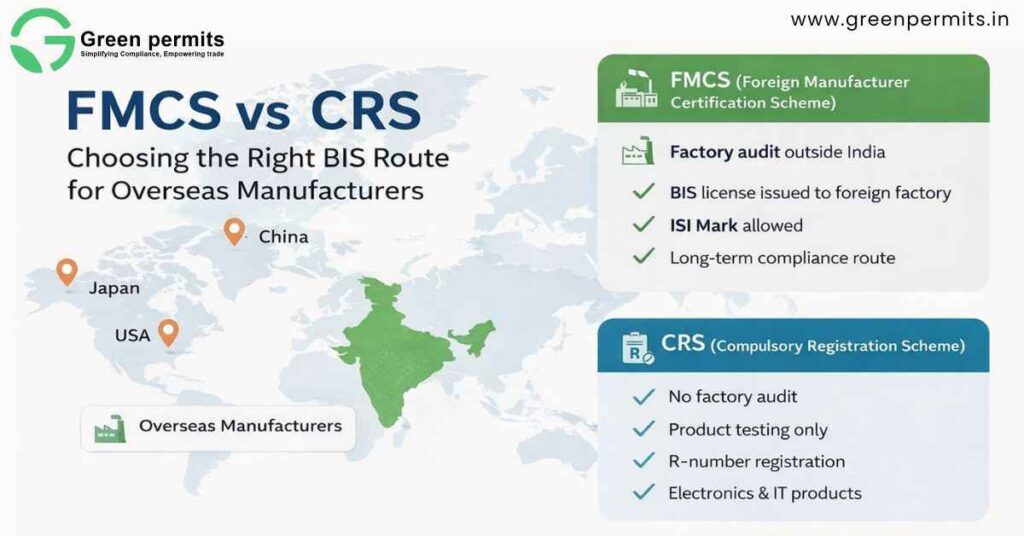
FMCS vs CRS

Why BIS Has Two Separate Certification Routes

BIS does not follow a one-size-fits-all compliance model. Indian regulators distinguish between products that can cause public safety or infrastructure risks and products that fall under standardized consumer electronics safety norms.

This distinction is the foundation of FMCS and CRS.

From a regulatory lens, BIS is answering two different questions:

  • Can this product be tested and approved at a product level?
  • Or does BIS need visibility into how and where this product is manufactured?

This is why the routes exist separately and are not interchangeable.

What this means for businesses

  • Your product category determines the route first
  • Strategy comes after classification, not before
  • Filing under the wrong route almost always leads to rejection

What Is FMCS (Foreign Manufacturers Certification Scheme)?

FMCS is designed for products where manufacturing consistency and process control are critical to safety. Under this scheme, BIS certifies the foreign manufacturing unit itself, not just the finished product.

Unlike CRS, FMCS treats the factory as part of the compliance ecosystem. BIS wants assurance that quality is maintained batch after batch, not just in a lab-tested sample.

How FMCS Works in Practice

Under FMCS, BIS evaluates:

  • Manufacturing infrastructure
  • Quality control systems
  • In-house testing capability
  • Production consistency
  • Marking and traceability processes

Only after this evaluation does BIS grant permission to use the ISI Mark.

Key implications for overseas manufacturers

  • BIS officers physically inspect the foreign factory
  • The license is issued in the manufacturer’s name
  • Any change in factory location requires fresh approval
  • Compliance is long-term and tightly controlled

Products Commonly Covered Under FMCS

FMCS generally applies to:

  • Cement and construction materials
  • Steel and metal products
  • Cylinders and pressure vessels
  • Valves, pipes, and industrial fittings

Business impact

  • Slower entry, but stronger regulatory acceptance
  • Ideal for manufacturers with stable product lines
  • Lower compliance friction once approved

What Is CRS (Compulsory Registration Scheme)?

CRS was introduced to support fast-moving industries where product models change frequently, especially in electronics and IT hardware.

Instead of evaluating the factory, BIS focuses on whether a specific product model meets Indian safety standards through lab testing.

This approach balances consumer safety with ease of doing business.

How CRS Works in Practice

Under CRS, the approval process centers around:

  • Testing of product samples in BIS-recognized labs
  • Documentation review
  • Model-wise registration

There is typically no factory inspection unless BIS raises specific concerns.

Key implications for overseas manufacturers

  • Registration is granted per product model
  • New models require fresh registration
  • Faster approval timelines
  • Compliance effort increases with SKU expansion

Products Commonly Covered Under CRS

CRS typically applies to:

  • Mobile phones and tablets
  • Power adapters and chargers
  • LED lighting products
  • IT and AV equipment

Business impact

  • Faster market entry
  • Suitable for innovation-driven product cycles
  • Higher long-term cost if many models are launched

FMCS vs CRS: Business-Centric Comparison

Choosing between FMCS and CRS is less about documentation and more about how you plan to operate in India.

Key differences that affect decision-making

  • FMCS links compliance to the factory
  • CRS links compliance to individual models
  • FMCS favors long-term, high-volume manufacturing
  • CRS favors agility and speed

What businesses should evaluate

  • Product safety classification
  • Number of models planned for India
  • Expected product lifecycle
  • Long-term India market commitment

Which BIS Route Actually Applies to Your Product?

One of the biggest misconceptions is that manufacturers can freely choose between FMCS and CRS. In reality, BIS notifications and product standards decide this first.

Only after confirming applicability should a strategy be built.

Critical checks before applying

  • Is the product notified under mandatory ISI certification?
  • Is it listed under the Electronics & IT CRS Order?
  • Does BIS classify the product as safety- or infrastructure-critical?

Skipping this evaluation is the fastest way to waste time and fees.

Cost, Timelines, and Scale: What Manufacturers Overlook

FMCS Cost Reality

FMCS involves:

  • Application and license fees
  • Overseas inspection expenses
  • Initial testing and documentation

While the initial cost is higher, FMCS becomes efficient when:

  • Product designs are stable
  • Volumes are large
  • India is a long-term market

CRS Cost Reality

CRS appears economical initially, but costs increase due to:

  • Testing fees for each new model
  • Re-registration for design changes
  • Ongoing compliance administration

This becomes a concern for brands with aggressive SKU expansion.

Real-World Outcome of Choosing the Wrong Route

We often see overseas manufacturers start with CRS to “test the market.” As product demand grows, BIS scrutiny increases, especially when products drift into ISI-notified categories.

The result is usually:

  • Fresh FMCS applications
  • Factory audits added mid-way
  • Duplicate testing
  • Launch delays of several months

These issues are preventable with early route planning.

Common FMCS and CRS Mistakes Overseas Manufacturers Make

Even experienced global brands make avoidable mistakes during India entry.

Frequent issues we see

  • Filing CRS for products requiring FMCS
  • Assuming factory inspection is optional under FMCS
  • Incorrect appointment of Authorized Indian Representatives
  • Printing BIS marks before approval
  • Importing samples without compliance alignment

These mistakes often escalate into customs holds or DGFT queries.

How Green Permits Supports Overseas Manufacturers

Green Permits approaches BIS compliance as a market-entry strategy, not a filing task.

We help manufacturers:

  • Classify products correctly under BIS norms
  • Decide FMCS vs CRS based on business plans
  • Prepare factories for BIS inspections
  • Coordinate testing with approved labs
  • Align BIS certification with import and DGFT requirements

This proactive approach saves time, cost, and regulatory stress.

Conclusion: Decide Early, Scale Confidently

FMCS and CRS serve different purposes. Problems arise only when the wrong route is chosen.

FMCS suits manufacturers building a long-term India presence with safety-critical products.
CRS suits brands prioritizing speed and flexibility in electronics markets.

The key is not speed alone — it is getting it right the first time.

Book a Consultation with Green Permits

📞 +91 78350 06182
📧 wecare@greenpermits.in

Book a Consultation with Green Permits

Book a Technical Call with Expert

📞 +91 78350 06182