
Shantilal has been running his electrical goods trading business for over 25 years. He has seen tax reforms, policy changes, and market slowdowns—but nothing confused him like an email from the CPCB portal stating that his EPR registration was incomplete. Payments were pending, documents were uploaded, yet his imports were stuck.
For Shantilal, environmental compliance had always felt distant—something large corporates worried about. But suddenly, EPR wasn’t an abstract rule anymore. It was directly affecting cash flow, deliveries, and customer commitments.
This is exactly how EPR has entered the lives of thousands of Indian business owners today—not as a concept, but as a business reality.
Extended Producer Responsibility (EPR) is often explained in legal terms, but for businesses, its meaning is much simpler.
If your company manufactures, imports, or sells notified products in India, you are responsible for the waste generated after those products reach end-of-life. This responsibility doesn’t end at sale—it continues through recycling, reporting, and compliance.
What many business owners don’t realize is that EPR is no longer treated as a standalone environmental rule. It is now closely linked with:
In practice, EPR has become a business gatekeeper.
When EPR regulations started becoming stricter, most businesses reacted the same way—by postponing action.
Common thoughts we hear from founders and directors:
The problem is that EPR compliance is not linear. A small mistake—wrong category selection, incorrect target calculation, or missing recycler linkage—can delay the entire process.
For many businesses, EPR became stressful because:
The burden wasn’t the rule itself—it was the lack of planning.
Over the last few years, a clear pattern has emerged. Businesses that treat EPR as part of their operational planning face far fewer disruptions.
Instead of reacting to notices, they:
This shift changes everything.
EPR moves from being a last-minute compliance task to a predictable business process, just like GST or customs documentation. When managed correctly, it stops interfering with growth.
Businesses often ask, “What do we really gain by doing EPR properly?”
The advantage is not always visible immediately, but it compounds over time.
Companies with clean EPR compliance records experience:
In many sectors, especially electronics, batteries, and plastics, large buyers now prefer vendors who already have their EPR systems in place. Compliance has quietly become a qualification criterion.
Most people associate non-compliance with penalties. In reality, the bigger loss is indirect.
When EPR is delayed or mishandled, businesses face:
These costs don’t show up as fines—but they hit revenue, reputation, and planning.
For older businesses especially, this creates frustration. They’ve run operations smoothly for years, only to be blocked by a compliance issue that could have been avoided with early action.
EPR is not only affecting producers and importers. It has completely changed the landscape for recyclers and waste processors.
Recycling businesses today are no longer informal service providers. Under EPR, they:
For entrepreneurs entering recycling or refurbishment, EPR has created structured demand. Compliance is now tied directly to revenue, making sustainability a viable business model rather than a side activity.
A mid-sized battery importer approached us after facing repeated delays despite submitting documents multiple times. The issue wasn’t missing paperwork—it was incorrect EPR obligation mapping.
Once the targets were recalculated correctly and aligned with the right recycler category, the approvals moved smoothly. Over time, the business also reduced compliance costs by planning EPR obligations annually instead of reacting quarter by quarter.
The business didn’t change its scale. It changed its approach.
Businesses that have adapted well follow a few simple principles:
This approach reduces uncertainty and allows founders to focus on growth rather than regulatory firefighting.
EPR becomes manageable when it is understood early and structured properly.
Today, EPR compliance feeds into much larger conversations around governance and sustainability.
Investors, partners, and international buyers increasingly look at:
A clean EPR record signals that a business is serious, organized, and future-ready. For many companies, this credibility opens doors that marketing alone cannot.
EPR is no longer a future requirement or a distant regulation. It is already influencing how businesses operate, expand, and partner.
Those who delay will continue to face interruptions. Those who plan early will experience stability.
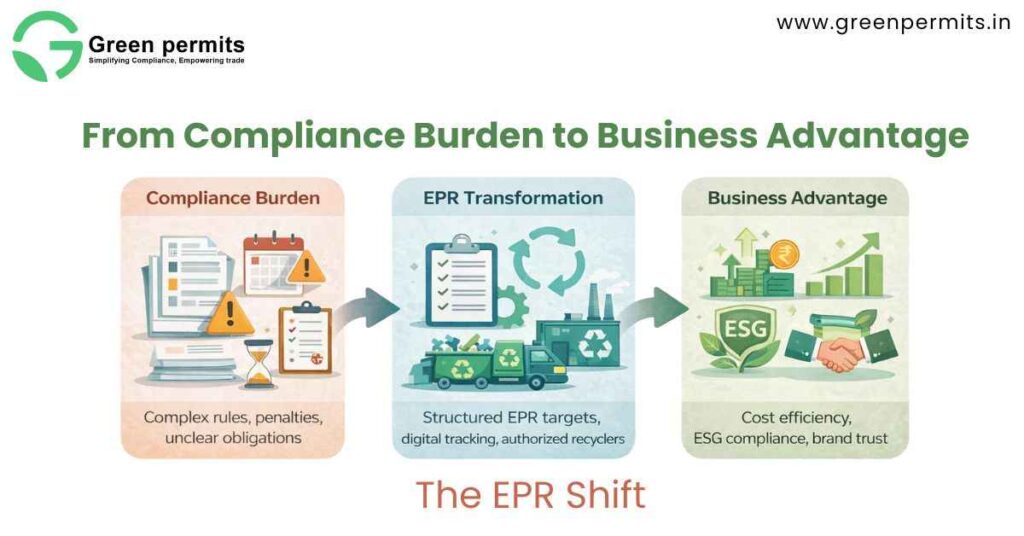
The shift is clear—from compliance burden to business advantage. The only decision left is when to adapt.
📞 +91 78350 06182
📧 wecare@greenpermits.in
Book a consultation with Green Permits and simplify your EPR compliance with clarity and confidence.