
When a recycling entrepreneur plans a new plant, the first instinct is usually to focus on machinery, land, and manpower. Funding is often assumed to be a formality. In reality, financing becomes the biggest bottleneck once the project reaches the bank or government desk. Files move slowly, queries keep coming back, and approvals get stuck for months.
Most of these delays don’t happen because funds are unavailable. They happen because funding decisions in recycling are deeply tied to compliance readiness. This blog explains where funding actually comes from and how businesses can unlock it smoothly.
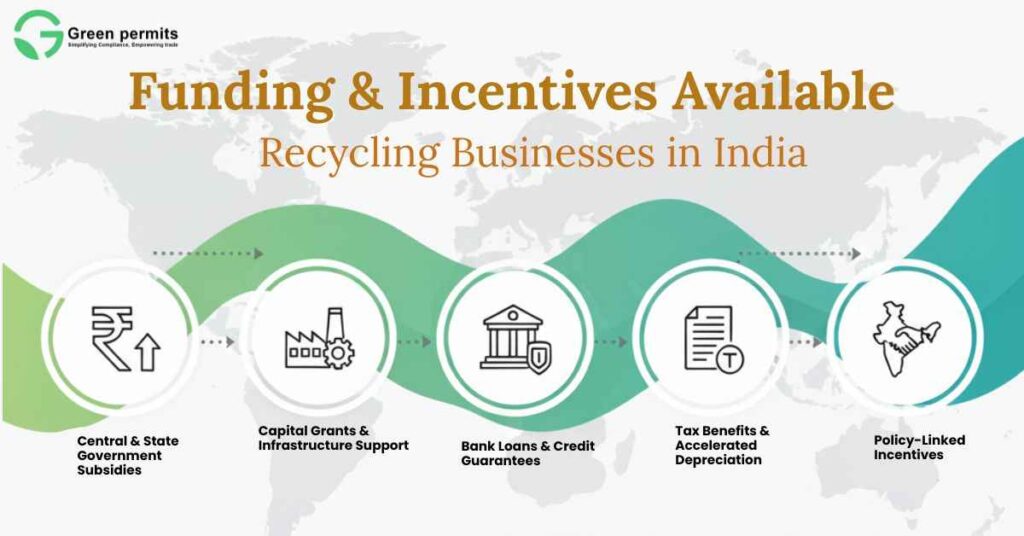
Recycling is no longer viewed as a support activity. It is now a core infrastructure requirement under India’s environmental and circular economy policies. Every new recycler helps the government reduce landfill dependency, manage hazardous waste responsibly, and meet national sustainability targets.
From a policy perspective, recycling businesses:
Because of this, recycling units receive policy-backed encouragement in the form of subsidies, concessional loans, and infrastructure support. However, the government expects recyclers to operate within a clearly defined regulatory framework.
Most recycling businesses qualify as micro, small, or medium enterprises. This classification unlocks several funding benefits that are not available to unregistered units.
MSME-linked schemes typically support:
For recycling businesses, MSME registration acts as a financial credibility layer, especially during early-stage funding.
SIDBI and NABARD play a critical role in financing projects that deliver environmental and social benefits. Recycling businesses fall squarely within this mandate.
Funding support generally includes:
What often determines approval speed is not the business idea, but whether environmental permissions and plant capacity details are already aligned. Clean documentation signals lower risk to lenders.
State governments compete to attract recycling investments because waste management is a local responsibility. This has resulted in highly attractive state-specific incentives.
| State | Focus Areas | Typical Benefit Pattern |
|---|---|---|
| Gujarat | Plastic, e-waste | Capital subsidy + energy cost relief |
| Maharashtra | Urban waste | Interest subsidy + tax incentives |
| Tamil Nadu | Battery, e-waste | Land support + power concessions |
Business interpretation:
Two identical recycling plants can have vastly different project costs depending on location. Strategic state selection can improve ROI from day one.
Recycling units dealing with municipal or bulk waste are often supported through public infrastructure programs rather than conventional subsidies.
These programs usually provide:
This funding model works best for recyclers who prefer stable, predictable revenue instead of upfront grants. It also lowers market risk during early operations.
Extended Producer Responsibility has changed how recycling businesses earn money. Under EPR, recyclers are not just service providers — they are compliance partners for producers and brands.
EPR-driven financial advantages include:
A compliant recycler with EPR registration often becomes financially stronger than a subsidised but non-compliant unit.
| Parameter | Business Insight |
|---|---|
| Market size | Large and expanding |
| Growth rate | Consistent double-digit growth |
| Policy support | Strong and long-term |
What this means for investors and banks:
Recycling is seen as a structurally supported sector rather than a short-term opportunity.
Funding rejection is rarely communicated clearly. In many cases, applications are simply delayed or parked.
From a lender’s point of view, these gaps translate into operational and legal risk. As a result, even viable projects get stuck.
One of the biggest mistakes recyclers make is approaching funding after installing machinery.
A better approach is to:
Correct timing ensures eligibility and avoids costly restructuring later.
Projects that move smoothly through funding channels usually have one thing in common — compliance clarity.
Key success factors include:
This approach reassures banks, authorities, and investors simultaneously.
India offers multiple funding and incentive pathways for recycling businesses. However, access to these benefits depends less on schemes and more on how well the business is structured from a regulatory standpoint.
Entrepreneurs who plan compliance and funding together:
Book a Consultation with Green Permits
Get expert guidance on funding strategy, recycling plant setup, EPR compliance, and regulatory approvals — all under one roof.