
Future of EV Battery Recycling in India: Policy, Profit & Demand

  • Home
  • Recycling
  • Future of EV Battery Recycling in India: Policy, Profit & Demand

Electric vehicle adoption in India is accelerating due to government incentives, rising fuel costs, and sustainability commitments from corporates. As EV penetration increases across two-wheelers, passenger vehicles, and commercial fleets, the volume of end-of-life batteries is also set to rise sharply.

For businesses operating anywhere in the EV ecosystem, battery recycling is no longer a future concern. It is becoming a regulatory requirement, an operational responsibility, and a strategic business decision that directly impacts cost, continuity, and compliance.
Future-of-EV-Battery-Recycling-in-India

Why EV Battery Recycling Is Becoming a Business-Critical Issue

EV batteries are fundamentally different from traditional waste streams. They contain high-value and hazardous materials that require controlled handling, recovery, and disposal.

From a business standpoint, this creates multiple pressure points:

  • Regulatory authorities treat EV batteries as high-risk waste
  • Improper disposal attracts penalties and enforcement action
  • Recyclable metals have strong resale and recovery value
  • Battery traceability is becoming mandatory across the supply chain

Companies that delay planning for battery recycling often face disruptions when audits, renewals, or expansions are initiated.

India’s EV Battery Recycling Policy Framework Explained Simply

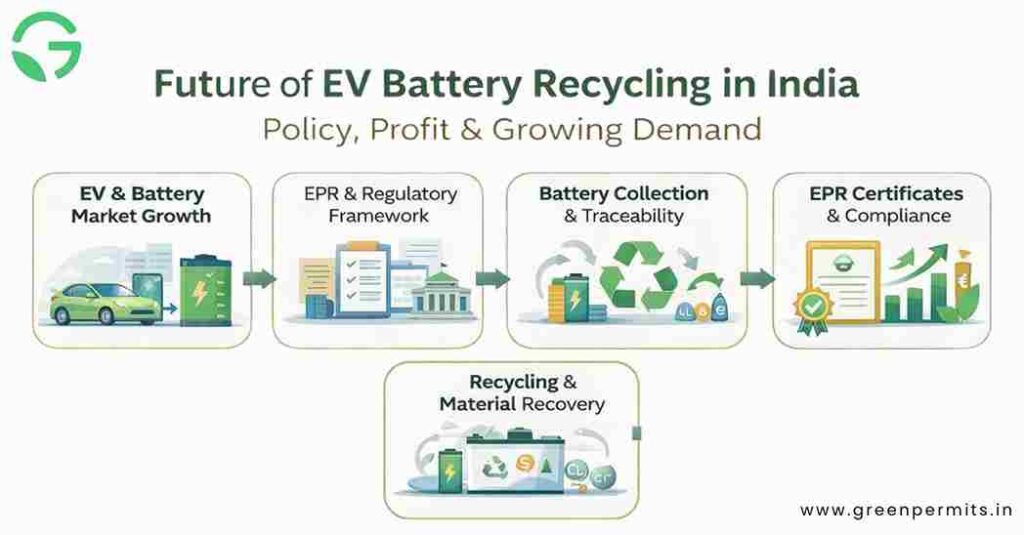
India has moved away from fragmented waste handling toward a centralized compliance structure for batteries. EV battery recycling is governed under Battery Waste Management Rules, with implementation routed through CPCB-managed online portals.

What the policy framework aims to achieve

  • Ensure safe handling of hazardous battery waste
  • Create accountability for producers and importers
  • Promote recovery of critical raw materials
  • Enable a formal recycling and certificate ecosystem

For businesses, this means compliance is now digitally tracked, auditable, and enforceable rather than informal or discretionary.

Who Falls Under EV Battery Recycling Obligations

One of the most common misconceptions is that recycling responsibility lies only with recyclers. In reality, liability begins at the point of market introduction.

Entities with defined obligations

  • EV manufacturers selling vehicles with embedded batteries
  • Importers bringing EVs or battery packs into India
  • Battery producers supplying OEMs or aftermarket players
  • Authorized recyclers processing end-of-life batteries

Each category has separate registration requirements, reporting duties, and operational conditions. Incorrect classification often leads to portal rejections or compliance delays.

Registration and Compliance Requirements Businesses Must Prepare For

Battery recycling compliance is not limited to a single approval. It is a structured process involving multiple regulatory checkpoints.

Typical compliance elements include

  • Online registration with CPCB or SPCB as applicable
  • Consent to Establish and Consent to Operate
  • Hazardous waste authorization where required
  • Periodic data reporting on sales, procurement, and recycling
  • Annual or quarterly returns through the EPR portal

Missing or inconsistent documentation is one of the biggest reasons applications get delayed or flagged.

EV Battery Recycling Demand in India: What Market Growth Signals

India’s EV growth directly translates into long-term recycling demand. Battery waste generation is expected to increase year-on-year as early EV models reach end-of-life.

What this demand growth means for businesses

  • OEMs will need reliable, registered recycling partners
  • Recyclers with capacity and approvals will see rising demand
  • EPR certificate availability will become a commercial factor
  • Non-compliant players will be pushed out of formal supply chains

This creates a clear advantage for businesses that establish compliance early rather than reacting later.

Profit Potential in EV Battery Recycling: A Practical View

EV battery recycling is often discussed only in sustainability terms, but the commercial upside is significant when compliance and operations are aligned.

Revenue drivers in the recycling ecosystem

  • Recovery and sale of lithium, cobalt, nickel, copper, and aluminium
  • Issuance and sale of EPR certificates to producers
  • Long-term recycling contracts with EV manufacturers
  • Strategic partnerships with battery producers and importers

Cost factors businesses must realistically account for

  • Regulatory approvals and renewal timelines
  • Technology selection and process validation
  • Skilled manpower and safety infrastructure
  • Ongoing compliance reporting and audits

Profitability depends less on scale alone and more on regulatory readiness and operational discipline.

Compliance Risks That Commonly Disrupt EV Businesses

Regulatory action in battery recycling is often triggered during routine processes such as audits, portal verification, or expansion approvals.

Common compliance failures seen in practice

  • Selling EVs without active EPR registration
  • Partnering with unregistered recyclers
  • Inaccurate reporting of battery sales or recycling data
  • Failure to meet annual EPR targets

These issues can result in penalties, license suspension, or delays in import and sales operations.

Why Early Compliance Gives Businesses a Long-Term Advantage

Businesses that treat battery recycling as a foundational compliance requirement rather than a post-sales activity gain structural advantages.

Benefits of early action

  • Faster approvals during scaling or funding rounds
  • Lower compliance costs through planned implementation
  • Reduced risk during inspections and audits
  • Stronger credibility with regulators and partners

In contrast, reactive compliance often leads to rushed filings, higher costs, and operational stress.

How Green Permits Supports EV Battery Recycling Compliance

Green Permits helps businesses navigate EV battery recycling requirements with clarity and speed. Our role is to remove regulatory complexity so companies can focus on growth.

We assist with:

  • CPCB and SPCB registrations
  • Battery EPR planning and filings
  • Recycler onboarding and compliance checks
  • Ongoing reporting and regulatory support

📞 +91 78350 06182
📧 wecare@greenpermits.in

👉 Book a Consultation with Green Permits


Book a Technical Call with Expert

📞 +91 78350 06182

FAQs

Yes. Businesses placing batteries or EVs in the market must comply with battery waste rules.

Manufacturers, importers, and battery producers are required to register.

No. Recycling without registration is considered non-compliant.

Authorities may impose penalties or restrict business operations.

Yes, especially for compliant recyclers with approved infrastructure.

By managing registrations, filings, and end-to-end compliance support.