
A battery producer once told us something that sounded confident but cost them dearly later:
“We’ve already filed EPR. We’ll handle costs next year.”
On paper, everything looked compliant. Registration was approved. Returns were submitted. Certificates were uploaded.
But when the next financial year arrived, their EPR cost had increased sharply — without any major change in production.
This is the reality many battery producers in India are facing today.
Battery EPR is no longer just about filing on time. It’s about how well you plan across years.
When EPR is treated as a yearly task, costs quietly build up. When it’s planned strategically, costs stay predictable and manageable.
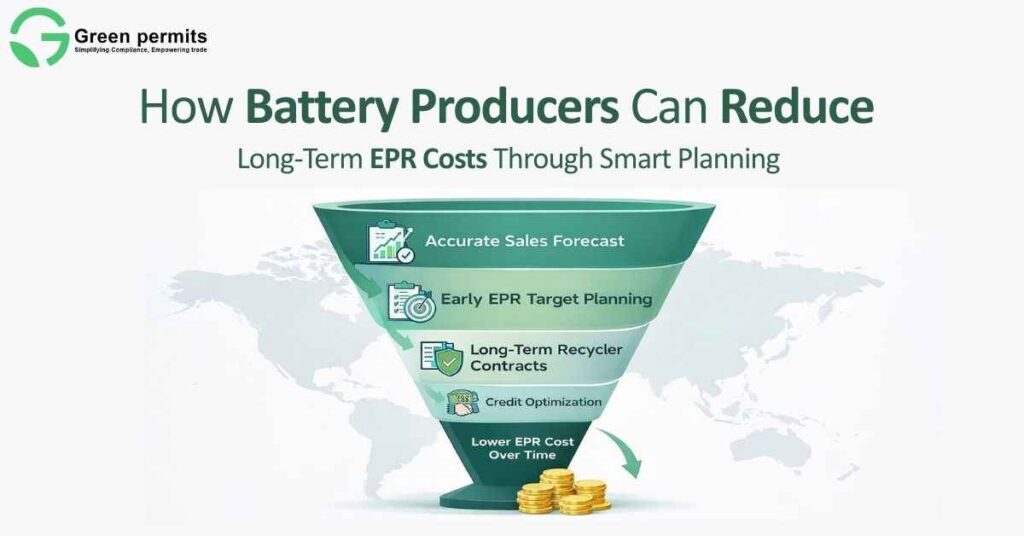
Battery EPR costs don’t increase because of one mistake. They increase because of small planning gaps repeated every year.
Most producers focus on meeting the immediate compliance requirement — filing returns, uploading certificates, and closing the financial year. What they miss is that CPCB evaluates EPR compliance as a continuing responsibility, not a fresh start every year.
Over time, this creates cost pressure that feels sudden but is actually cumulative.
Key reasons costs rise over time:
When these issues repeat, EPR becomes more expensive each year — even if production remains stable.
Many producers see EPR as a single number — the amount paid for certificates. In reality, EPR cost is the outcome of several business decisions made throughout the year.
Before cost reduction is possible, producers must understand what actually influences EPR spend.
Battery EPR costs are shaped by:
When these factors are managed proactively, EPR cost remains under control. When they are handled reactively, cost spikes become unavoidable.
What producers often overlook:
One of the most expensive misconceptions is that EPR resets every financial year. It does not.
Battery EPR works on historical data, consistency, and trend validation. Mistakes made in one year often affect targets and scrutiny in the next.
Producers who plan EPR only once a year usually face:
Over time, this reactive approach makes EPR cost unpredictable and difficult to budget.
Why annual-only planning fails:
Producers who successfully control EPR costs start planning before the financial year opens, not when deadlines approach.
Early planning allows businesses to see their EPR obligation as a forecasted number instead of a last-minute liability.
This shift alone changes how much producers ultimately pay.
What early planners do differently:
When EPR is planned alongside sales forecasting, it stops being a surprise expense and becomes a controlled operational cost.
Many producers assume all recyclers offer equal value as long as certificates are issued. This assumption often leads to higher costs and compliance issues later.
Recycler selection affects not just pricing but also:
A poorly aligned recycler strategy can force producers to rework filings, repurchase certificates, or respond to CPCB clarifications — all of which increase cost.
Common recycler-related issues:
Smart planning involves building a stable, verified recycler ecosystem, not switching vendors year after year.
Small data errors rarely cause immediate rejection — but they silently increase future EPR costs.
Inaccurate reporting creates inconsistencies that CPCB systems flag over time. These flags often lead to:
What makes this costly is that corrections usually happen after certificates are already purchased.
Common data issues we see:
Producers who audit and correct data early avoid paying twice for the same obligation.
Ignoring long-term EPR planning doesn’t always lead to immediate penalties. Instead, it creates a slow buildup of financial and compliance pressure.
Over time, producers face:
By the time the issue becomes visible, correcting it is far more expensive than preventing it.
One battery distributor approached us before the start of the financial year, not after receiving a notice.
Instead of filing immediately, the focus was on:
The result was simple but powerful:
The advantage wasn’t scale.
It was timing and planning discipline.
Battery EPR cost is not a fixed regulatory fee. It is a business outcome shaped by planning quality.
What smart producers understand:
EPR becomes expensive only when it is treated as an afterthought.
Battery EPR compliance is permanent. Rising EPR costs don’t have to be.
Producers who plan early:
Those who delay:
The difference is not regulation.
The difference is planning.
📞 +91 78350 06182
📧 wecare@greenpermits.in
Book a Consultation with Green Permits
We help battery producers review past EPR data, plan future obligations, and reduce long-term compliance costs — before problems surface.