
- Home
- About Us
- Services
- Resources
- Contact Us
- Home
- About Us
- Services
- Resources
- Contact Us
A few months ago in Gurugram, a mid-level IT service provider had a warehouse full of old laptops, CPUs, routers, and enterprise servers. When the management decided to upgrade their systems, they called several vendors for scrap disposal.
One recycler quoted nearly double the usual scrap rate because they were formally registered under the E-Waste Rules and could provide secure destruction certificates.
That day, the IT manager realised something unexpected:
formal recycling wasn’t just good for compliance — it had a premium market of its own.
The same opportunity exists for entrepreneurs across Haryana. This guide breaks down exactly how to enter and scale in this growing market.
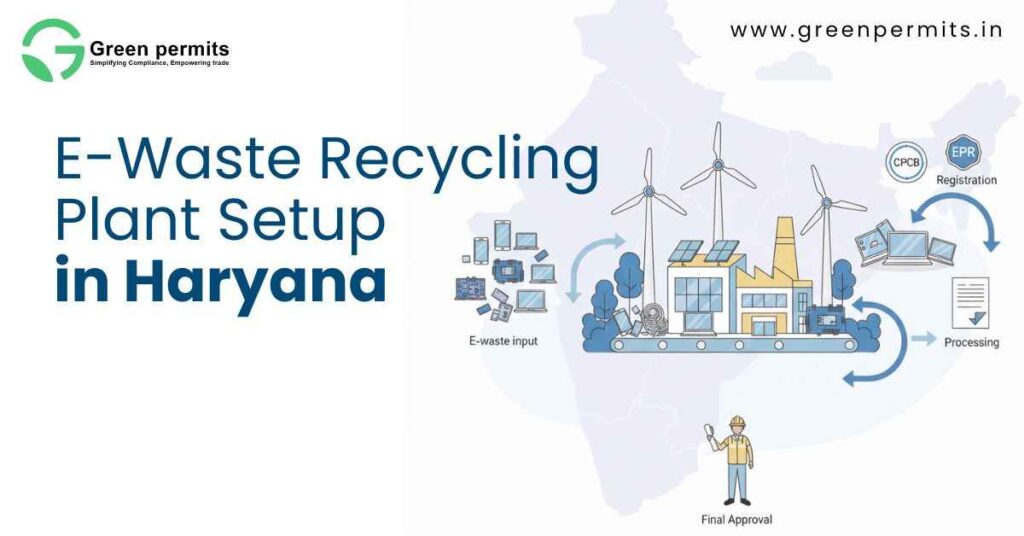
Haryana has matured into one of India’s most industrially diverse states, and this diversity directly translates to steady e-waste generation. Whether it is consumer electronics from heavily urbanised districts or industrial electronics from the automotive belt, the state produces constant recyclable streams.
The supply chain is large, dependable, and increasingly looking for legally compliant partners. Anyone entering the sector now benefits from both market demand and regulatory push.
Choosing the right location is a strategic decision and directly affects logistics, supply partnerships, labour availability, and regulatory approval timelines.
Corporate hubs, IT parks, BPOs and large-scale data centres make this district ideal for recyclers focused on laptops, servers, telecom gear, AV equipment and storage devices.
A major automotive electronics manufacturing zone. Ideal for recyclers handling industrial PCBs, wiring harnesses, controllers, sensors, and hybrid components.
Hosts a dense network of OEMs, MSMEs and electronics-heavy assembly units. Strong potential for B2B supply agreements.
These districts offer affordable industrial land, lower operational cost, and proximity to Delhi’s trading markets, making them suitable for scalable medium-sized plants.
E-waste recycling is a volume-driven business. A predictable and recurring flow of raw material ensures stable monthly revenue.
The biggest advantage in Haryana is the presence of bulk generators within a 50–70 km radius. This lowers transport cost and increases profitability per tonne.
Understanding the licensing framework is essential for starting operations without delays. Haryana follows the national regulatory structure under the E-Waste Management Rules.
Applied before setting up infrastructure.
The pollution control board evaluates:
Approval allows installation of your plant but not operation yet.
Granted after the plant is ready.
Inspectors verify:
A CTO is mandatory before taking in any e-waste.
Essential for legal recycling and for issuing recycling certificates to producers and refurbishers.
Key data required includes:
Quarterly returns must be filed to maintain active status.
Industrial e-waste contains heavy metals and must be handled according to hazardous waste norms.
Machinery depends on the scale of your plant. A typical plant has two critical zones: dismantling and mechanical segregation.
Smaller plants focus on manual dismantling, while larger plants invest in mechanised separation.
| Plant Size | CAPEX Range | Typical Output | Best Location |
|---|---|---|---|
| 1 TPD | ₹35–55 lakh | Basic dismantling | Rohtak / Sonipat |
| 3 TPD | ₹1.2–1.8 crore | Semi-automatic | Faridabad / Manesar |
| 5 TPD | ₹2–3.5 crore | Advanced lines | Gurugram / NCR belt |
Revenue is generated by selling recovered fractions such as:
Efficient recyclers in Haryana usually achieve breakeven within 18–28 months, especially when they tap into corporate supply chains.
Haryana’s industrial policies support recycling because it is a priority “green industry.”
How This Helps
By reducing upfront financial burden, these incentives improve project IRR and shorten the breakeven timeline significantly.
EPR laws have transformed recycling from an optional activity into a structured, compliance-driven requirement.
Recyclers with clean compliance records often receive long-term volume commitments from large companies, creating predictable revenue streams.
Recycling plants must demonstrate environmental responsibility at every stage.
Non-compliance can lead to:
Study volumes in Gurugram, Faridabad, Manesar, and nearby NCR regions.
Map competitors and identify supply gaps.
Prioritise locations with:
Include flow diagrams, capacity details, and safety mechanisms.
Submit all technical, structural and pollution documents for approval.
Ensure layout adheres to approved plan.
This validates your plant’s operational readiness.
Complete all portal entries carefully, including:
Maintain clean, accurate data to avoid penalties.
Offer collection, destruction certificates, and competitive rates to corporates, AMCs, institutions and aggregators.
| Sector | Estimated Volume (Tonnes/Year) |
|---|---|
| IT & BPO | 18,000–22,000 |
| Auto & Industrial Manufacturing | 12,000–15,000 |
| Telecom | 4,000–5,000 |
| Households | 6,000–8,000 |
Business Insight: This volume can support dozens of sustainable recycling operations.
| Requirement | Expected Time |
|---|---|
| CTE Approval | 30–45 days |
| CTO Approval | 45–60 days |
| CPCB Recycler Registration | 15 working days |
| Quarterly Returns | Every 3 months |
Haryana offers one of India’s most favourable ecosystems for e-waste recycling.
With a strong supply base, supportive industrial policies, and rising EPR-driven demand, entrepreneurs who enter now can build highly profitable and future-ready recycling units.
Clear compliance, proper licensing, and professional plant setup are the pillars of long-term success.
 +91 78350 06182
 wecare@greenpermits.in
Book a Consultation with Green Permits