
A mid-sized manufacturer of domestic electrical appliances had just completed a major dispatch before the festive season. Orders were lined up, distributors were optimistic, and the factory was running at full capacity.
Then BIS conducted routine market surveillance. The product carried the ISI mark — but a variant had been introduced without updating the license scope. Within a week, the stock was sealed at the warehouse level. Dispatch stopped. Dealers demanded clarification. Cash flow froze.
The management believed it was a minor technical oversight. For regulators, it was a compliance violation.
This is how ISI Mark compliance failures escalate into market seizures — not because businesses intend to break rules, but because compliance systems are not strong enough.
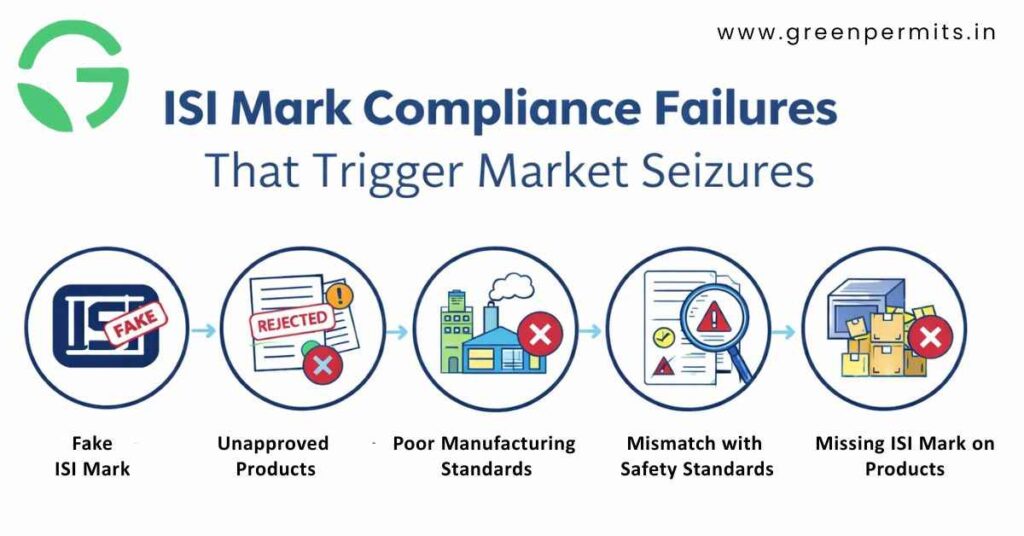
The ISI Mark is not simply a branding requirement. It is a statutory certification issued under the Bureau of Indian Standards framework and backed by enforceable law. When a product falls under mandatory certification through a Quality Control Order, the manufacturer is legally obligated to comply with the exact Indian Standard notified for that product.
Failure to comply does not result in just a warning. It can result in:
For most businesses, the shock comes not from the law itself but from the speed of enforcement. Once a compliance gap is detected, corrective options are limited.
ISI Mark compliance failures generally arise in the following areas:
Understanding these areas clearly is the first step toward prevention.
Over the past few years, the government has significantly expanded the number of products covered under mandatory Quality Control Orders. Many manufacturers who previously operated under voluntary standards now fall under compulsory certification requirements.
When a product category becomes mandatory, the risk profile changes entirely. The issue is no longer about quality positioning — it becomes a legal compliance obligation.
Common mandatory categories include:
For businesses operating in these sectors, non-compliance does not remain internal. It becomes an enforceable offence that can lead to market-level action.
This is one of the most serious ISI Mark compliance failures. It often happens unintentionally when license renewal timelines are not monitored closely or when production continues during pending renewal approval.
Businesses may assume that applying for renewal is sufficient. However, production and sale during an expired license period constitutes non-compliance.
This situation typically arises due to:
The consequences are immediate:
For many companies, this becomes a painful lesson in compliance tracking.
Many businesses innovate frequently — adding new models, improving design, changing material suppliers, or optimizing product specifications. Operationally, these changes may appear minor.
From a regulatory standpoint, even a small deviation from the approved standard requires formal approval.
This includes changes such as:
When BIS conducts sampling and detects deviation from the originally approved specifications, the entire batch may be considered non-conforming.
This is not about intent. It is about conformity to the approved standard. And that distinction matters legally.
One of the most overlooked causes of ISI Mark compliance failures is improper marking.
Marking guidelines are specific. The ISI logo, license number, Indian Standard number, and manufacturer details must appear in the correct format and location.
Common errors include:
These mistakes often occur at the printing or packaging stage. Unfortunately, regulators treat incorrect marking as misrepresentation.
When such errors are detected during surveillance, the stock may be seized even if the product quality itself meets standards.
BIS conducts routine factory inspections and random market sampling. Samples are sent to approved laboratories for testing against the relevant Indian Standard.
If a product sample fails testing, enforcement action follows.
This usually happens because:
The impact of surveillance failure is significant:
For businesses, this often becomes a reputational challenge beyond just regulatory compliance.
A market seizure is not just a legal problem. It disrupts the entire business ecosystem.
Direct impact may include:
Indirect impact often proves more damaging:
Many companies underestimate these indirect effects until they experience them.
In most cases, non-compliance is not deliberate. It results from weak internal systems.
Common internal weaknesses include:
Documentation gaps often include:
When inspection occurs, these weaknesses become visible immediately.
Preventing ISI Mark compliance failures requires structured systems rather than reactive fixes.
Businesses should implement:
Training is equally important. Production teams and dispatch teams must understand that compliance is not a paperwork function — it is an operational responsibility.
A simple internal checklist before every dispatch can prevent significant regulatory action.
Importers often assume that overseas manufacturers handle certification requirements. This is risky.
Before importing, businesses must:
Customs authorities now actively verify compliance for mandatory products. Non-compliant consignments may be held at port, leading to heavy financial losses.
ISI Mark compliance failures rarely begin as major violations. They begin with small operational gaps — an unapproved variant, a missed renewal, a labeling oversight, or incomplete documentation.
But enforcement action is swift, and the financial impact can be severe.
Businesses that treat compliance as an ongoing management function rather than a one-time certification exercise build resilience. They protect revenue, reputation, and long-term growth.
If your product falls under mandatory BIS certification, proactive compliance is not optional. It is essential.
📞 +91 78350 06182 | 📧 wecare@greenpermits.in