
When Rajesh, an entrepreneur from Pune, decided to set up a lithium battery plant, the first question he faced was surprisingly difficult: Which battery technology should I build the plant for?
Every consultant gave him a different answer.
Every investor pitch deck had a different recommendation.
And every manufacturer he met had a different concern — safety, cost, range, or compliance.
The truth is simple:
Your entire plant design, raw material strategy, BIS approvals, EPR obligations, and safety investments depend on this one decision.
This guide makes that choice easier, using an investor-friendly, compliance-aligned, India-specific approach.
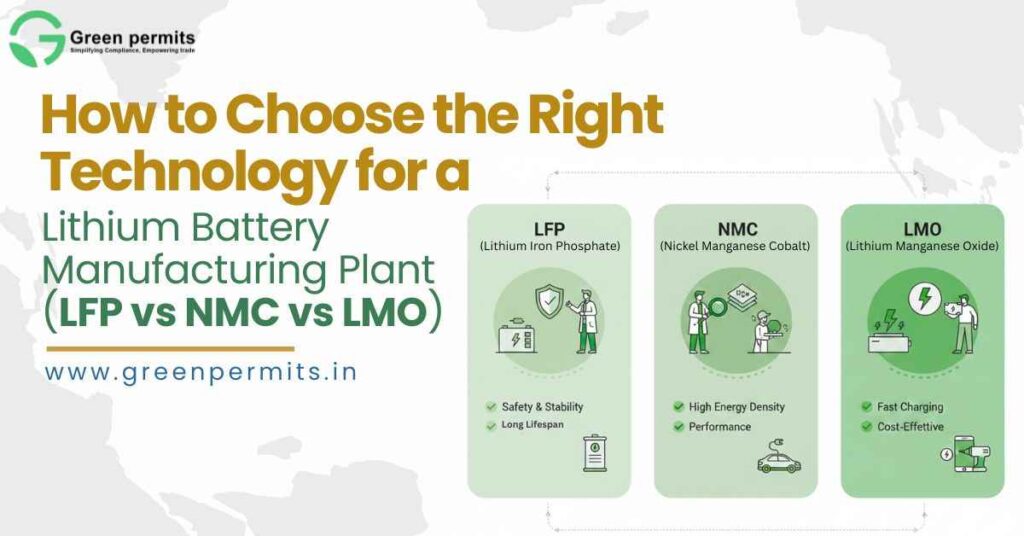
Lithium battery chemistries are not interchangeable. Each chemistry plays a unique role in the Indian EV, ESS and electronics market. Understanding this context is essential before choosing technology for a new plant.
India’s climate, import dependency, safety standards and rapidly evolving market segments mean that the best technology on paper isn’t always the best technology for business.
Here is where each chemistry typically fits:
Understanding this helps you avoid investing in a plant design that aligns poorly with market demand.
Most online comparisons talk about performance — but for plant owners, what matters is manufacturing complexity, quality control, EPR targets, safety risk and cost stability.
Here’s a deeper, production-oriented comparison:
Technical & Operational Comparison (India, 2025 Updated)
| Parameter | LFP | NMC | LMO |
|---|---|---|---|
| Energy Density | Low–Medium | High | Medium |
| Cycle Life | Very Long | Medium | Low |
| Safety (Thermal Stability) | High | Medium–Low | Medium |
| Raw Material Cost | Low | High | Medium |
| Raw Material Availability (India) | High | Low | High |
| Recyclability Value | Low | High | Medium |
| Temperature Tolerance | Excellent | Limited | Good |
| Business Risk | Low | High | Medium |
Interpretation:
LFP’s lower energy density is offset by higher safety and lower operational risk. NMC offers higher performance but significantly increases compliance, insurance and safety costs. LMO is less attractive for long-term EV manufacturing.
The long-term viability of your plant depends on how stable and affordable the raw materials are.
A Delhi-based investor recently shifted from an NMC plan to LFP after realising cobalt prices had doubled in less than two years, affecting plant feasibility.
Choosing a chemistry is ultimately a business decision. The total investment required varies significantly depending on the chosen technology.
Approximate Plant Setup Cost Comparison (Per GWh, India – 2025)
| Cost Component | LFP Plant | NMC Plant | LMO Plant |
|---|---|---|---|
| Capex (Per GWh) | ₹6XX–7XX Cr | ₹9XX–1,XXX Cr | ₹5XX–6XX Cr |
| Dry Room Cost | Medium | Very High | Low |
| Safety Systems | Lower | High | Medium |
| Formation & Aging Cost | Moderate | High | Low |
| Raw Material Cost | Lowest | Highest | Medium |
| Quality Control Complexity | Moderate | High | Low |
| Life Cycle Testing | Moderate | Intensive | Low |
| Insurance Premium | Lowest | High | Medium |
Interpretation:
NMC plants require substantially higher capex due to advanced dry rooms, thermal control systems, and strict BIS safety compliance. LFP is far more cost-effective and stable for Indian environmental conditions.
Choosing between LFP, NMC and LMO also affects how difficult, costly and time-consuming your compliance journey becomes.
Chemistry influences EPR certificate requirements:
Incorrect reporting or mismatch in chemistry percentages can lead to delays and penalties during annual returns.
Compliance can slow down plant commissioning by several months if not planned during initial design.
LFP production is comparatively simpler and safer:
This makes LFP suitable for first-time investors or small-to-mid-cap manufacturers.
NMC requires the highest technical sophistication:
Many plants underestimate this stage and face budget escalations.
LMO is comparatively easier:
However, due to lower EV applicability, investors must ensure long-term demand alignment.
Different businesses need different technologies. Your target market should determine the right technology.
LFP is the clear winner due to temperature tolerance, cycle life and cost.
NMC provides the required energy density and range.
LFP dominates because fire safety and lifespan are more important than energy density.
LMO or NMC blends may be suitable depending on battery size and discharge characteristics.
NMC often performs better in markets where energy density is prioritised.
Understanding your customer segment early prevents expensive redesigns later.
Many new investors rush into choosing a chemistry without understanding the operational and compliance consequences.
The most common mistakes include:
One investor in Gurgaon faced a six-month delay because their selected NMC cell design repeatedly failed high-temperature performance tests required during BIS certification — an oversight that cost the company crores.
If you are a new investor entering India’s lithium battery sector, start with a clear business question:
Who are you building for, and what problem are you solving?
For 80–90% of new Indian investors, LFP provides the best balance of safety, capex, and compliance stability.
Our team helps businesses across India with:
📞 +91 78350 06182
📧 wecare@greenpermits.in
Book a Consultation with Green Permits