When Aarav, founder of VoltCycle Renewables Pvt. Ltd., reviewed his first-year performance numbers, he felt a sinking frustration. His new lithium battery recycling plant in Gujarat had the capacity to process 8,000 tonnes annually, backed by high-end machinery, a skilled team, and a fully compliant CTO. But after 12 months of operation, the plant had only processed 1,300 tonnes of EV and ESS waste.
The issue wasn’t technology. It wasn’t permissions. It wasn’t even market demand.
It was supply.
Local scrap dealers showed inconsistent volumes. OEMs shifted their EPR obligations across multiple recyclers. Aggregators demanded unrealistic margins. Import partners asked for long-term commitments Aarav couldn’t meet. Every week, VoltCycle Renewables faced the same question:
“Where will tomorrow’s waste batteries come from?”
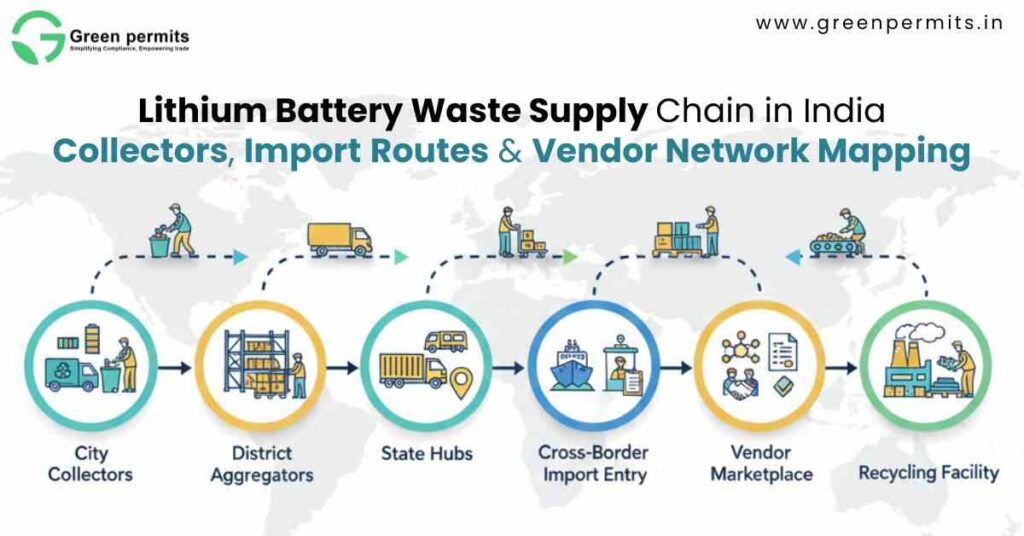
If you’re in the recycling, refurbishing, or EPR ecosystem, you already know this story. This blog breaks down the real supply chain—from local collectors to global import routes—to help you secure predictable, compliant, and scalable feedstock for your plant.
India’s Lithium Battery Waste Ecosystem: Why Supply Is the New Gold
India is entering its lithium battery waste boom—thanks to EV sales, telecom backup systems, solar ESS installations, and consumer electronics growth. .
This results in:
High competition among recyclers
Shortage of consistent feedstock
Rise in import of waste batteries to bridge the gap
Pressure on OEMs to meet EPR targets
Premium pricing for lithium scrap
To understand how to build a strong vendor network, you first need to map the ground reality.
Tier 1: Consumer-Level Waste Generators
This is where the life cycle ends and the supply chain begins.
Who falls in this category
EV owners (especially 2W, 3W fleets)
Home and commercial ESS users
Solar EPC project owners
Retailers selling electronics
IT hardware and UPS users
Telecom tower operators
Why they matter
They produce small but steady volumes of lithium waste batteries, although they almost never sell directly to recyclers.
How they behave
Driven by price, not compliance
Prefer dealing with local collectors
Have low awareness of BWM Rules
For businesses, this is the least reliable sourcing layer—but it’s where the chain begins.
Tier 2: Local Scrap Collectors (India’s Invisible Backbone)
Local collectors—often called kabadiwalas—drive the majority of India’s early battery collection network.
Characteristics
Operate small shops or doorstep collection
Purchase dead EV batteries, UPS packs, LFP modules
Have limited testing abilities
No formal billing or compliance track
Strengths
High accessibility
Fast pickups
Low competition at hyper-local level
Weaknesses
Zero documentation
High-risk inventory (swollen/damaged cells)
Potential regulatory concerns if not routed through formal partners
These players operate at a scale where shipments start moving inter-state in trucks.
Major hubs
Delhi NCR: Mayapuri, Mandoli, Faridabad
Mumbai: Navi Mumbai, Thane belt
Gujarat: Ahmedabad–Vadodara corridor
South India: Peenya–Bidadi (Bengaluru), Sriperumbudur (Chennai)
Their strengths
High daily inventory
Access to telecom, UPS, and EV fleet waste
Fast logistics
Better testing equipment
Their limitations
Quality inconsistency due to mixed chemistries
Potential fire risks during transport
Margin-driven negotiations
No long-term commitments unless pricing stabilizes
For recyclers, this is the single most significant domestic feedstock category.
Tier 5: OEM & Enterprise Partners (Future of Consistent Supply)
Corporate sources are the most compliant, traceable, and high-quality suppliers.
Who they include
EV manufacturers
ESS integrators
UPS and telecom companies
Retail majors (Reliance Digital, Croma)
Logistics battery fleet operators
OEM warranty return centers
Why recyclers love them
Stable monthly supply
Chemically uniform batches
Minimum damage
Proper documentation
Support in EPR certificate generation
Challenges
OEMs usually appoint only 1–2 recyclers per region
Requires strong credentials and compliance
Contracts typically demand audits and performance guarantees
But for long-term planning, this vendor category is priceless.
Tier 6: Import of Waste Batteries – Bridging India’s Supply Gap
Primary Keyword: import of waste batteries
India does not generate enough domestic lithium battery waste to match recycling capacity. This has led to a rapid rise in import of waste batteries, especially NMC and NCA chemistries with higher cobalt and nickel value.
Why imports are rising
Domestic scrap supply will only peak after 2027
Recyclers face severe feedstock shortages
Global players are eager to sell mixed battery scrap
India’s processing costs are competitive
Duty exemptions (in recent budgets) make imports more viable
Top Exporting Countries (Practical Experience from Industry)
Region
Typical Waste Battery Type
Advantages
UAE
EV modules, telecom UPS, powerwall-type packs
Large volumes, stable supply
Singapore / Malaysia
Mixed lithium scrap, black mass
Easy documentation, fast shipping
South Korea
NMC/NCA warranty returns
High cobalt & nickel value
Germany / Netherlands
Sorted EV packs & modules
Best documentation, premium rates
Import Routes to India (Common Shipping Patterns)
1. Middle East → Western Ports
Routes: UAE → Nhava Sheva / Mundra
Highest volume
Good for EV module scrap
2. South-East Asia → Southern Ports
Routes: Singapore / Malaysia → Chennai / Kochi
Great for mixed waste batteries
3. Europe → Western Ports
Routes: Germany / Netherlands → Nhava Sheva
Best documentation and compliance
4. East Asia → Eastern Ports
Routes: South Korea → Chennai / Vizag
Popular among large recyclers needing pure chemistry streams
To import waste batteries legally in India, recyclers need:
DGFT import license (restricted item category)
MoEFCC authorization for hazardous waste
Proper HS code classification
Pre-shipment inspection certificate (PSIC)
Invoice + packing list
Consent to Operate (CTO) for recycling plant
Fire and safety compliance
Lithium waste handling SOP
Bonded warehouse documents (if applicable)
This is where most recyclers struggle—not because the process is complicated, but because documentation must be perfect.
Vendor Network Mapping (Domestic + International)
Domestic Vendor Mapping
Tier
Vendor Type
Volume Reliability
Documentation Quality
T1
Consumers
Very low
Very low
T2
Local Collectors
Low
Low
T3
Aggregators
Medium–High
Medium
T4
State Dealers
High
Medium
T5
OEM Partners
Medium–High
Very High
T6
Import Suppliers
Very High
High
International Vendor Mapping
Supplier Category
Regions
Strength
Fleet scrap exporters
UAE, Qatar
Bulk EV batteries
Industrial scrap consolidators
Singapore, Malaysia
Mixed lots
Certified recyclers
Germany, Netherlands
High compliance
OEM service centers
South Korea
Pure chemistry batches
Regulatory Requirements at Each Stage of the Supply Chain
Stage
Requirement
Why It Matters
Collection
GST invoice
Traceability
Storage
Fire NOC, ventilated racks
Safety
Transport
UN-approved packaging
Prevents accidents
Recycler Procurement
BWM Registration
Legal compliance
Import
DGFT & MoEFCC
Restricted item
EPR Certificates
CPCB Portal
Fulfilling producer obligations
Top Risks in the Battery Waste Supply Chain
Random suppliers offering mixed, hazardous lots
Import seizures due to incorrect HS codes
Fire incidents in poorly ventilated storage areas
Heavy penalties for buying from unregistered vendors
Data mismatch during EPR filings leading to delays
Cash-flow problems due to spot buying at premium rates
A stable vendor network is the only long-term solution.
How to Build a Strong Supply Chain for Your Battery Business
1. Diversify Your Vendor Portfolio
Do not depend on one aggregator or one import supplier.
2. Build Transparent Pricing Contracts
Clarity builds trust.
3. Train Vendors on Safety Practices
This reduces fire risks and protects inventory.
4. Invest in Reverse Logistics
Partner with DG-certified battery transporters.
5. Build Digital Traceability
Use QR/barcode tracking as encouraged under updated BWM Rules.
6. Prioritize Compliance Over Cheap Deals
Shortcuts always end up more expensive.
Conclusion
India’s lithium battery waste supply chain is evolving rapidly—but still remains fragmented. The real opportunity lies in combining domestic collection with import of waste batteries, supported by strong compliance, vendor relationships, and logistics planning.
Companies that build structured sourcing networks today will dominate recycling capacity, black mass production, and EPR certificate trading over the next decade.
If you’re planning to set up or scale a recycling or EPR-led operation, the right supply chain strategy can make or break your business.
📞 Need Help With Vendor Mapping, DGFT Licensing, or EPR Compliance?
Green Permits is here to assist you. 📞 +91 78350 06182 📧 wecare@greenpermits.in