
Last December, a small business owner from Meerut, Ravi, visited our office.
He had saved for nearly four years to start a plastic recycling unit.
What he didn’t expect was the complexity behind approvals, machinery choices, pollution norms, and EPR documentation.
He said something many entrepreneurs feel but rarely admit:
“Even after arranging money, the real struggle begins when paperwork starts.”
If you’re planning to set up a plastic recycling plant in Uttar Pradesh, this guide is meant to simplify that journey, show you the exact compliance path, and help you avoid the delays that drain time, energy and capital.
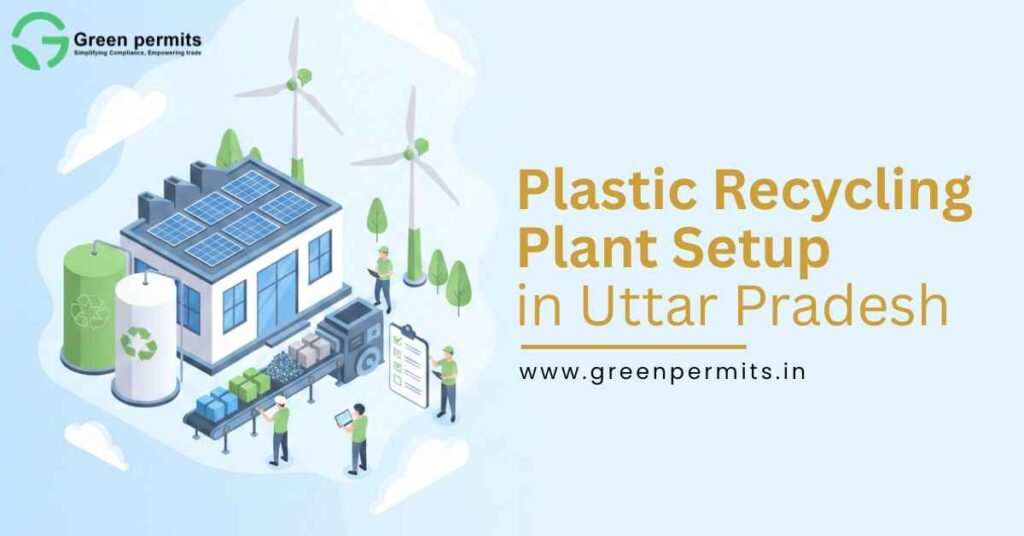
Uttar Pradesh has quietly become one of India’s strongest states for plastic waste processing. When investors look at UP, they see three things: volume, affordability and proximity to major buyers. The sheer population density of the state ensures that plastic waste generation remains consistently high. For recyclers, this translates directly into predictable raw material availability.
Industrial growth across sectors—FMCG, textile, footwear, automotive, electronics and packaging—also means more demand for recycled plastic granules. Many of these industries operate out of NCR, Noida, Ghaziabad, Kanpur, Lucknow and Agra, making UP a natural destination for recycling units.
Entrepreneurs also prefer UP because it offers a balance between affordability and infrastructure. You don’t pay NCR prices, yet you remain close enough to NCR to supply consistent volumes.
Choosing the right district determines 50% of your operational success. Transportation cost, scrap access, labour availability, and proximity to buyers—all depend on where you set up.
UP offers several strong industrial pockets where recycling naturally thrives.
Noida, Greater Noida, Ghaziabad
These districts form the industrial heart of UP. They host thousands of packaging, electronics, injection moulding and FMCG units. For a recycler, this means two things: plenty of scrap and plenty of buyers.
Kanpur and Kanpur Dehat
Known for leather, textiles and manufacturing units, these districts generate a continuous stream of HDPE and PP scrap. Labour availability is high, and land is more affordable than NCR.
Lucknow
The state capital offers a balanced environment for MSMEs. It’s easier to build relationships with state-level departments, and distribution networks reach all nearby districts.
Gorakhpur (Plastic Park Zone)
Government-supported clusters like the Plastic Park attract processors, traders and moulders—ideal for medium and large-scale recycling units planning future expansion.
Agra
Footwear and packaging industries make Agra a consistent generator and consumer of recycled PP and HDPE.
Varanasi and Prayagraj
Urban waste, tourism-driven consumption and emerging industrial activity make these good candidates for small-scale units.
The state’s geography supports both decentralized micro-recyclers and centralized large-scale processors. Depending on your scale and target market, you can either integrate with a local scrap ecosystem or supply to NCR-based brands.
One mistake many investors make is assuming scrap availability is automatic. In reality, scrap comes from networks—city aggregators, kabadi chains, industrial waste generators, and bulk scrap dealers.
Uttar Pradesh has a rich ecosystem for LDPE, HDPE, PET, PP and multilayered plastic scrap.
A successful recycling unit usually builds relationships with at least three different supply channels to avoid inconsistency in scrap flow.
The smartest recyclers in UP sign long-term sourcing agreements with aggregated scrap traders, ensuring price stability even when national rates fluctuate.
Setting up a recycling unit in UP isn’t difficult if you follow the correct sequence of approvals. Delays happen when documents don’t match the plant layout, machinery list, or process flow.
1. Consent to Establish (CTE)
Applied online through Nivesh Mitra before any construction or installation begins.
Important documents include: land papers, layout, process flow, machinery list, electricity load details and water consumption.
2. Consent to Operate (CTO)
Applied after machinery is installed and the unit is ready for production.
UPPCB authorities verify whether the plant matches the CTE conditions.
3. Plastic Waste Processor Registration (PWM Rules)
This allows you to formally recycle plastic and issue recycling certificates.
Without this, brands cannot legally engage you for EPR fulfilment.
4. Factory License
Required once manpower exceeds specific thresholds or manufacturing begins.
5. Fire Safety Certificate
Mandatory due to the flammable nature of plastic waste.
6. Local trade license
Issued by the municipal authority.
Optional or Conditional Licenses
UPPCB has significantly increased inspections.
Any mismatch in machinery capacity, effluent treatment setup or layout can pause your CTO for months.
Many entrepreneurs experience delays not because of lack of documents, but because of inconsistencies between documents, applications and physical site conditions.
The cost of setting up a plastic recycling plant varies depending on capacity, automation and choice of technology. Uttar Pradesh offers a favourable cost structure compared to western Indian states.
The good news is: once you establish a stable supply chain, your variable costs become predictable.
UP does not have a recycling-specific policy, but entrepreneurs can combine national and state MSME incentives to reduce capital burden.
Subsidies lower the financial pressure during the first 12–18 months, which is typically the hardest period for recyclers.
One of the biggest advantages for recyclers today is the rise of EPR (Extended Producer Responsibility). Brands must show evidence that a portion of their plastic packaging waste has been recycled. They meet this obligation by buying recycling certificates from registered processors.
This means recyclers now have two revenue streams:
If your processing quality is stable, you will always have buyers, because the EPR market keeps demand strong even when commodity prices fluctuate.
Plastic recycling is closely regulated to ensure environmental safety. UPPCB expects every recycler to operate responsibly, maintain proper records, and treat effluents properly.
The safest recyclers maintain a clean, verifiable documentation trail—this builds trust with both regulators and buyers.
The following is a simplified version of how a compliant recycling plant comes to life in Uttar Pradesh.
Choose a location close to scrap sources and buyers.
Prepare a project report that includes capacity, machinery, process flow and environmental safeguards.
Begin documentation and file your CTE application on Nivesh Mitra.
This must be approved before any installation begins.
Set up washing lines, grinders, extruders, ETP and electrical systems as per the approved plan.
UPPCB will verify the installation and pollution control measures.
This makes your recycling legally valid and EPR-compliant.
Begin processing plastic waste into granules, flakes or agglomerates.
Submit annual returns and maintain proper material logs.
Uttar Pradesh has everything a recycling entrepreneur needs: strong raw material availability, industrial buyers, competitive land prices and growing EPR-linked opportunities.
Success depends on two things:
clear compliance and consistent quality.
If you get these right from day one, UP offers a long-term profitable environment for plastic recycling.
Call: +91 78350 06182
Email: wecare@greenpermits.in