
- Home
- About Us
- Services
- Resources
- Contact Us
- Home
- About Us
- Services
- Resources
- Contact Us
A few months ago, an entrepreneur from Panipat reached out to our team with a common problem.
He had purchased machinery, rented an industrial shed, and hired operators. Everything seemed ready.
But when he applied for the Consent to Operate (CTO), the Haryana Pollution Control Board rejected the application because his ETP design did not match the actual hydraulic load of his washing line.
Three months of delay.
Three months of EMI.
Zero production.
Stories like this are extremely common in Haryana. Most entrepreneurs underestimate how compliance, documentation and the right plant layout decide whether a recycling business succeeds or gets stuck before it even begins.
This guide solves that problem.
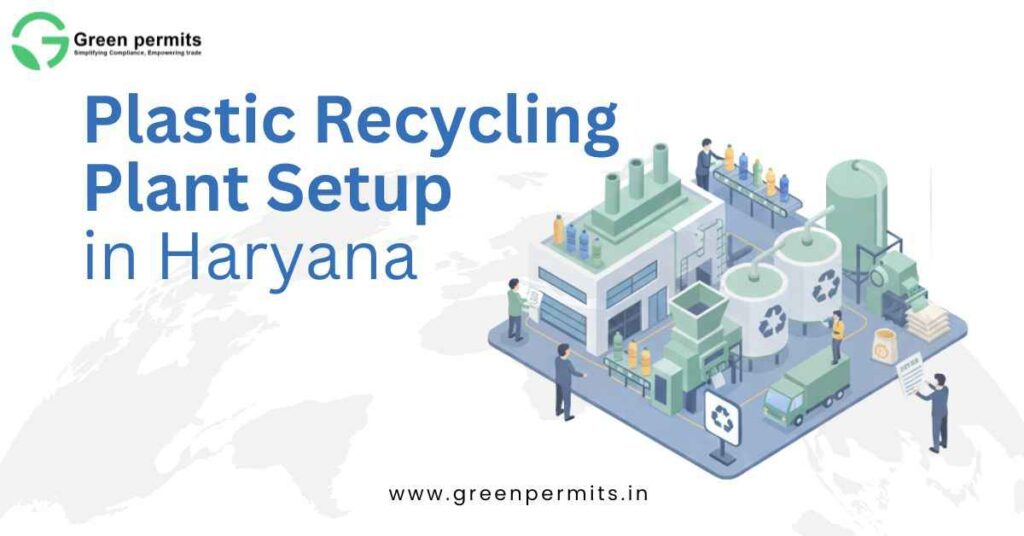
Haryana has rapidly grown into a preferred destination for plastic recycling due to its strong industrial base, proximity to NCR, and high demand for recycled materials. The state’s textile, automotive, packaging and household goods industries rely heavily on recycled granules, making it one of India’s most commercially attractive markets for recyclers.
Why Haryana is attractive for recyclers:
Haryana provides both the raw material and the demand — the two pillars of a successful recycling business.
Identifying the right location is crucial. The best-performing recycling units in Haryana are established in regions with stable waste supply and nearby industrial buyers.
Top industrial clusters to consider:
| Location | Land Cost (₹/acre) | Raw Material Availability | Nearby Buyers | Suitability |
|---|---|---|---|---|
| Panipat | 45–65 lakh | High | High | Excellent |
| Sonipat | 70–90 lakh | Medium | Very High | Excellent |
| Bahadurgarh | 80–120 lakh | Medium | High | Very Good |
| Faridabad | 1.2–2.5 crore | Medium | Very High | Excellent |
| Karnal | 40–60 lakh | Low | Medium | Moderate |
Insight:
If cost is a priority, Panipat and Karnal are strong options. For premium buyers and faster scaling, Sonipat and Faridabad are ideal.
A recycling plant’s profitability depends heavily on consistent access to waste. Haryana offers diversified raw material streams that reduce dependency and stabilise input costs.
Primary procurement channels:
Useful procurement strategies:
Compliance determines whether your plant operates smoothly or faces repeated shutdowns. Haryana has clear but strict requirements for plastic recycling units.
Issued by the Haryana State Pollution Control Board before installation.
Key components include:
Average processing time: 30–45 days
Mandatory if:
Requires submission of layout, safety plan, and compliance declarations.
Plastic has high fire risk, so this NOC is non-negotiable.
Common approval issues involve:
Required for all recyclers processing plastic waste.
It includes:
Issued after installation and successful inspection.
Most common CTO rejection reasons:
Anecdote:
A unit in Sonipat faced CTO rejection because stormwater drains mixed with washing wastewater. Separating the drains enabled immediate approval.
Choosing the right machinery directly impacts granule quality and profitability. Haryana’s industrial buyers prefer consistent, odor-free, contamination-free granules, so your line must be built for efficiency.
| Plant Capacity | Approx. Investment | Power Load | Workers Required | Expected Monthly Profit |
|---|---|---|---|---|
| 300–400 kg/hr | ₹28–40 lakh | 80–100 kW | 10–14 | ₹1–1.8 lakh |
| 500–700 kg/hr | ₹55–85 lakh | 120–180 kW | 14–18 | ₹2–3 lakh |
| 1 ton/hr | ₹1.2–1.8 crore | 220–300 kW | 20–26 | ₹3.8–6 lakh |
Insight:
Washing plants generate lower margins per kg but produce higher volumes, resulting in strong ROI within 8–14 months.
Haryana offers attractive incentives to manufacturing and recycling units under its MSME policy.
Key financial benefits include:
Eligibility requirements:
These incentives significantly reduce operating and financing costs, improving profitability.
Haryana’s industrial ecosystem ensures steady demand for recycled products.
Major buyers include:
High-demand materials:
Consistent quality often allows recyclers to charge premium rates compared to market averages.
Haryana is particularly strict about environmental norms for plastic recycling units.
Mandatory compliance requirements:
Common violations that lead to penalties:
A temporary shutdown often costs more than the entire ETP investment—making compliance non-negotiable.
A step-by-step roadmap:
1. Feasibility Assessment
Analyse raw material availability, buyer ecosystem and competition.
2. Land Selection
Choose industrial zones with proper zoning and easy logistics access.
3. Apply for CTE
Submit layout, machinery details, ETP plan and documents.
4. Install Machinery
Ensure safety distances, proper electrical setup, and shielding.
5. Install and Test ETP
Hydraulic testing is essential before CTO inspection.
6. Apply for CTO
Inspection includes wastewater checks, stack readings and site conditions.
7. Obtain PWM Registration
Complete documentation through the CPCB/SPCB online portal.
8. Trial Production
Assess granule quality, moisture and contamination levels.
9. Begin Commercial Operations
| Approval | Authority | Typical Duration | Notes |
|---|---|---|---|
| CTE | HSPCB | 30–45 days | ETP design must be accurate |
| Factory License | Labour Dept | 20–30 days | Required for 10+ workers |
| Fire NOC | Fire Dept | 25–40 days | Strict assessment |
| CTO | HSPCB | 30–60 days | Inspection-based |
| PWM Registration | CPCB/SPCB | 15–25 days | Mandatory for recyclers |
Recycling units face significant regulatory obligations. Not following them can lead to:
Even minor gaps in documentation can cause major business disruptions.
Haryana provides one of India’s strongest ecosystems for plastic recycling, supported by industrial demand, waste availability and government incentives.
But the real differentiator between a profitable recycling business and one stuck in repeated delays is compliance and setup accuracy.
A well-designed plant, correct documentation, and proactive licensing can save months of time and lakhs of rupees.
Our team assists with end-to-end compliance, licensing and plant setup.
📞 +91 78350 06182
📧 wecare@greenpermits.in
Book a Consultation with Green Permits