
Understanding ROI in Recycling Businesses in India
Return on Investment (ROI) in recycling businesses works very differently from conventional manufacturing or trading models. In India, recycling profitability is shaped not only by market demand but also by regulatory approvals, compliance timelines, EPR monetization, and operational discipline.
Unlike other industries, revenue generation in recycling often starts only after registration approvals. Any delay in CPCB or SPCB permissions directly impacts cash flow. Additionally, ongoing compliance such as returns filing and EPR certificate validation plays a critical role in sustaining long-term profitability.
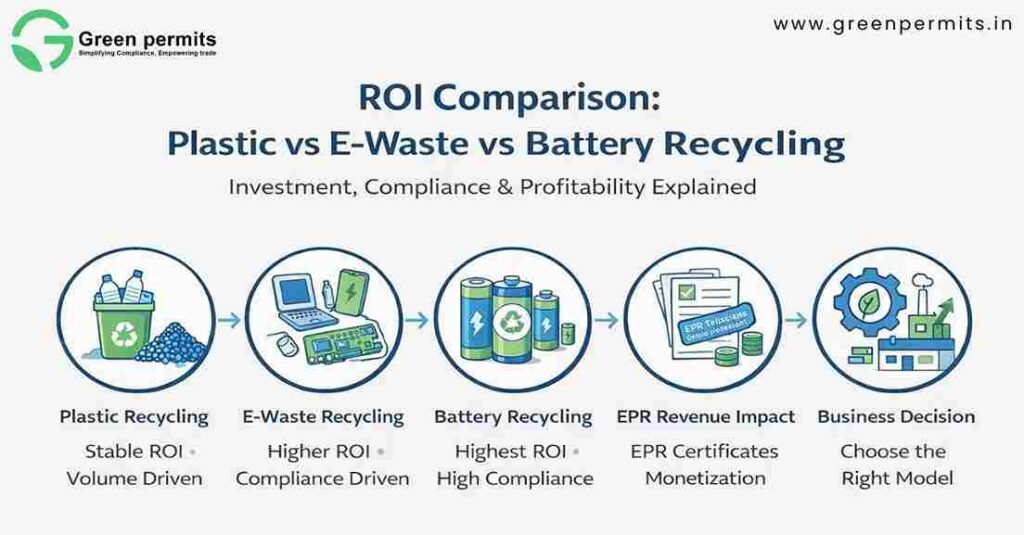
When comparing plastic, e-waste, and battery recycling, it is important to evaluate ROI from a compliance-adjusted business lens, not just projected margins.
Plastic recycling remains one of the most established recycling models in India. It is often preferred by first-time entrepreneurs due to its relatively predictable operational structure.
Plastic recycling plants usually require moderate capital investment. Machinery is widely available, technical complexity is manageable, and skilled labor requirements are lower compared to other recycling sectors. This makes entry barriers comparatively easier.
However, profitability depends heavily on scale and consistency of feedstock availability. Smaller units often struggle to maintain margins unless capacity utilization remains high.
Revenue typically comes from:
Margins in plastic recycling are usually thinner because:
Plastic recycling delivers steady but gradual returns. It suits businesses that prioritize operational stability over rapid ROI.
| Parameter | Typical Range |
|---|---|
| Initial Investment | ₹1.5–5 Crore |
| Payback Period | 3–4 Years |
| Net Profit Margin | 10–18% |
From an ROI standpoint, plastic recycling is best suited for businesses with strong logistics control and long-term volume contracts.
E-waste recycling operates in a much more structured regulatory environment, which directly influences profitability.
E-waste recycling plants require higher capital investment due to advanced dismantling and recovery systems. Registration under E-Waste Management Rules is mandatory, and only registered recyclers can legally generate EPR certificates.
The real challenge lies in process documentation, capacity declaration, and ongoing reporting. Businesses that underestimate compliance requirements often face approval delays that postpone revenue generation.
E-waste recycling profitability comes from multiple channels:
The ability to monetize EPR certificates significantly improves ROI compared to plastic recycling.
When approvals and reporting are handled correctly, e-waste recycling offers faster capital recovery than plastic recycling.
| Parameter | Typical Range |
|---|---|
| Initial Investment | ₹5–12 Crore |
| Payback Period | 2.5–3.5 Years |
| Net Profit Margin | 18–28% |
E-waste recycling is ideal for businesses that can manage regulatory complexity without operational disruptions.
Battery recycling currently offers the highest ROI potential among recycling businesses in India, driven by rapid growth in electric vehicles, energy storage systems, and regulatory enforcement.
Battery recycling plants require advanced technology, safety infrastructure, and strict environmental controls. Registrations under Battery Waste Management Rules are mandatory, and compliance scrutiny is significantly higher compared to other recycling sectors.
Quarterly and annual reporting, traceability of recovered metals, and accurate data submission are essential. Any inconsistency can lead to certificate suspension or regulatory action.
Revenue is generated through:
Because recovered metals have strong global demand, pricing power remains favorable for compliant operators.
Battery recycling delivers rapid ROI, but only for businesses with strong compliance systems in place.
| Parameter | Typical Range |
|---|---|
| Initial Investment | ₹8–20 Crore |
| Payback Period | 2–3 Years |
| Net Profit Margin | 25–35% |
This segment rewards accuracy, documentation, and compliance discipline more than scale alone.
When comparing all three sectors side by side, a clear pattern emerges: higher compliance responsibility leads to higher ROI potential.
| Factor | Plastic Recycling | E-Waste Recycling | Battery Recycling |
|---|---|---|---|
| Capital Requirement | Low–Medium | Medium–High | High |
| Compliance Complexity | Moderate | High | Very High |
| EPR Revenue Impact | Medium | High | Very High |
| Speed of ROI | Moderate | Fast | Fastest |
| Regulatory Risk | Low | Medium | High |
This comparison highlights why choosing a recycling business should be based on compliance readiness, not just margin projections.
One of the most common reasons recycling businesses underperform financially is delayed regulatory approval.
Typical compliance-related ROI risks include:
Every month of delay reduces effective ROI by increasing fixed costs without corresponding revenue.
Businesses that integrate compliance planning early often recover their investment significantly faster than those who treat approvals as a post-setup task.
Each recycling segment aligns with a different business profile:
The best ROI is achieved not by choosing the highest-margin sector, but by choosing the sector where your business can remain consistently compliant.
Recycling businesses in India do not fail due to lack of demand. They fail due to compliance gaps.
Strong ROI comes from:
When compliance is structured correctly, recycling becomes one of the most resilient and future-ready business models in India.
📞 +91 78350 06182
📧 wecare@greenpermits.in
👉 Book a Consultation with Green Permits
Get expert guidance on choosing the right recycling model, securing approvals faster, and maximizing ROI without compliance risks.