
For many business owners in Gujarat, the idea of tyre recycling starts with a simple observation. Transport yards stacked with worn-out tyres. Logistics fleets replacing tyres every couple of years. Scrap dealers struggling to move old tyres legally. What looks like waste on the ground is actually a steady raw material stream waiting to be organized.
But converting that opportunity into a running tyre recycling plant is not just about buying machines. Land selection, approvals from GPCB, pollution control planning, and financial structuring decide whether the plant runs smoothly or gets stuck before operations even begin.
This guide explains how to set up a tyre waste recycling plant in Gujarat, step by step, from a business and compliance perspective.
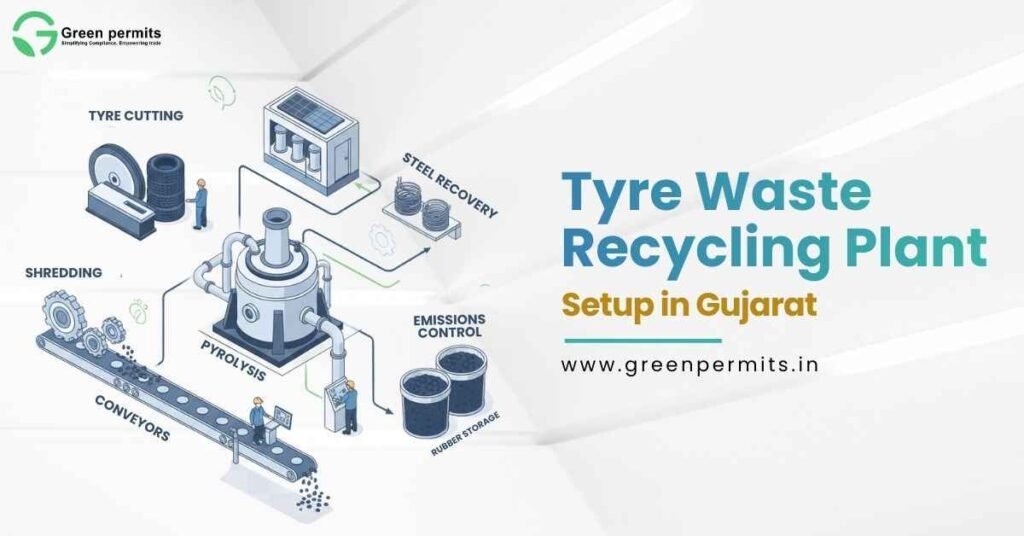
Gujarat’s industrial structure naturally supports tyre recycling businesses. The state has one of the highest concentrations of heavy transport movement in India, driven by ports, manufacturing hubs, and long-distance freight corridors.
Every port-linked truck, mining vehicle, factory loader, and logistics fleet contributes to a continuous cycle of tyre replacement. Unlike seasonal waste streams, tyre waste generation remains stable throughout the year, which is critical for recycling plant viability.
For investors, this stability reduces raw material risk. Plants do not depend on one supplier or one city. Tyres move across districts and industrial zones, allowing recyclers to lock long-term supply contracts.
Key reasons Gujarat offers a strong base:
Location selection directly affects approval timelines, transportation cost, and even buyer confidence. Gujarat offers several industrial pockets that are already aligned with recycling and heavy processing activities.
Dahej and Hazira work well for large-capacity plants due to port connectivity and distance from residential zones. Vapi offers a mature industrial ecosystem where pollution control infrastructure is well understood by authorities. Sanand benefits from the automobile and component manufacturing belt, while Kandla remains ideal for scrap aggregation linked to port activities.
Beyond geography, zoning matters. Land must be approved for industrial use, and distance norms from habitation, water bodies, and sensitive zones must be met before applying for consent.
A common mistake businesses make is finalizing land first and checking approvals later. This often results in redesigns or relocation.
One of the strongest advantages of setting up a tyre recycling plant in Gujarat is raw material availability. End-of-life tyres flow from organized commercial channels rather than informal scrap alone.
Fleet operators, logistics companies, ports, factories, and mining operations generate tyres in bulk and prefer structured disposal partners. Many are under internal sustainability pressure to ensure responsible waste handling.
For recyclers, this creates an opportunity to move away from daily scrap buying and towards contract-based sourcing. This stabilizes pricing, quality, and volume.
In practical terms, Gujarat-based plants often source tyres from multiple districts, allowing scale without overdependence on one city.
Tyre recycling is categorized as a polluting industrial activity. Regulatory approvals are not optional, and authorities monitor these units closely due to fire, emission, and oil-handling risks.
Before starting construction, businesses must obtain Consent to Establish. This approval reviews land suitability, plant layout, emission control plans, and waste handling strategy. Only after installation and trial readiness can Consent to Operate be issued.
Hazardous waste authorization is mandatory because pyrolysis oil, char, and residues fall under regulated waste categories.
What delays projects most is incomplete planning. Applying without finalized layouts or pollution control details often leads to repeated clarifications and long approval cycles.
Machinery decisions shape both compliance and profitability. Gujarat Pollution Control Board evaluates machinery not only for capacity but also for emission control compatibility.
Pyrolysis reactors must be supported by proper condensers, gas cleaning systems, and emergency safety mechanisms. Cracker mills and shredders must be designed to minimize dust and noise emissions.
From a business standpoint, machinery selection also determines output quality. Buyers increasingly ask for consistent oil parameters, clean steel wire, and predictable carbon black quality.
Cutting corners at this stage usually leads to operational restrictions later.
Investment planning should be realistic and capacity-driven. Smaller plants require less capital but may struggle with margins if compliance costs are underestimated. Larger plants benefit from economies of scale but demand stronger financial discipline.
Costs are spread across land development, civil construction, machinery procurement, pollution control systems, utilities, and statutory approvals.
What often surprises first-time investors is working capital. Raw material stocking, power bills, and compliance renewals require liquidity even before full revenue stabilization.
Planning for at least six months of operational buffer is considered prudent.
Gujarat encourages recycling and waste-to-resource industries as part of its sustainability and industrial growth agenda. Tyre recycling units may qualify for benefits under MSME and industrial promotion schemes.
Capital subsidies, electricity duty exemptions, and interest subsidies are available depending on investment size, location, and registration timelines.
However, incentives are not automatic. Documentation, timely applications, and compliance history play a major role in approval.
Businesses that structure incentives from day one recover a meaningful portion of their capital cost over time.
Tyre recycling plants generate multiple revenue streams, which reduces dependency on a single buyer segment. Pyrolysis oil finds demand in industrial heating and boilers. Recovered steel wire moves easily into the scrap steel market. Carbon black and char serve rubber, pigment, and construction sectors.
Gujarat’s industrial base ensures buyers are within manageable transport distance, improving margins.
The key is product consistency. Buyers prefer long-term supply partners over spot sellers, especially when quality remains stable.
Compliance does not end once the plant starts. Regular monitoring, record-keeping, and renewals are essential for uninterrupted operations.
Authorities focus heavily on emission levels, oil storage practices, waste movement logs, and fire safety compliance. Even minor lapses can lead to temporary shutdowns.
A common real-world scenario involves plants running smoothly for months but facing suspension during inspection due to missing records or expired authorizations.
Operational discipline protects revenue as much as machinery efficiency.
A realistically planned tyre recycling project in Gujarat takes between six to nine months from land finalization to commercial operations.
Projects that rush land acquisition or delay approvals often cross one year due to redesigns and regulatory clarifications.
Parallel planning of approvals, machinery procurement, and infrastructure significantly shortens timelines.
Tyre waste recycling in Gujarat offers long-term business potential when approached with regulatory clarity and structured planning. Businesses that invest early in approvals, layout design, and compliance systems face fewer operational surprises and gain stronger buyer trust.
The most successful plants are not the fastest to install machinery, but the ones that start operations without regulatory friction.
📞 +91 78350 06182
📧 wecare@greenpermits.in