
Over the last year, many vehicle manufacturers and importers in India have found themselves in a familiar situation.
A compliance email lands in the inbox, internal teams start asking questions, and suddenly there’s confusion about whether Vehicle EPR Registration applies to them.
Some assume it’s only relevant for large OEMs. Others believe scrapping is someone else’s responsibility.
But once the End-of-Life Vehicle rules came into force, one thing became clear: vehicle producers are now accountable beyond the point of sale.
This guide explains Vehicle EPR Registration in plain language — what it means, who needs it, how it works, and why early compliance matters.
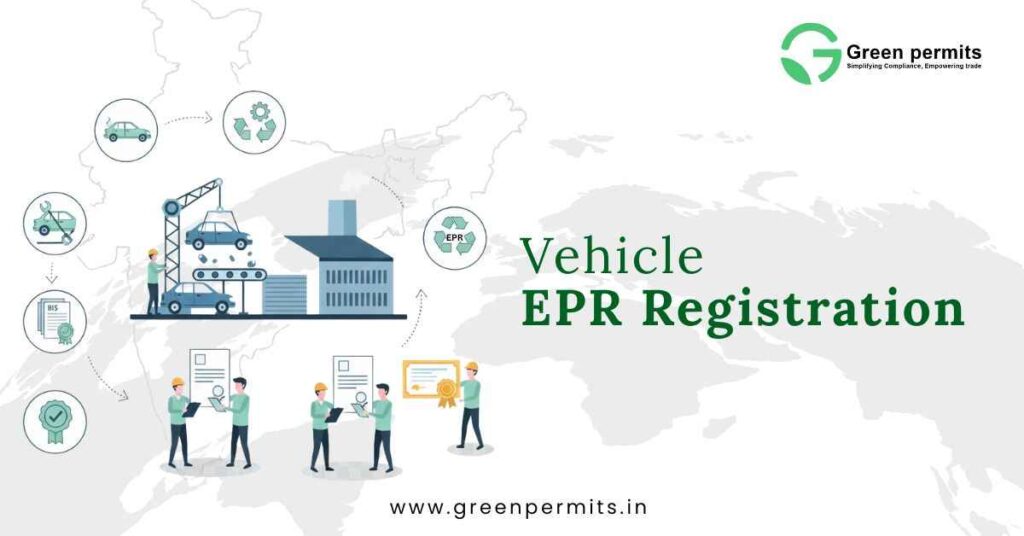
Vehicle EPR Registration is a mandatory environmental compliance requirement for vehicle producers in India.
It is built on the principle of Extended Producer Responsibility, which shifts accountability for end-of-life vehicles back to the producer.
In simple terms, this means producers must ensure that vehicles sold into the market are eventually scrapped and recycled in an environmentally sound manner.
Earlier, once a vehicle was sold, compliance responsibility largely ended. Now, regulatory responsibility extends to the vehicle’s disposal stage.
This change impacts cost planning, compliance strategy, and long-term risk exposure.
Vehicle EPR Registration is the formal process through which producers:
Vehicle EPR Registration is not limited to manufacturers alone. The definition of “producer” is broad and intentionally inclusive.
Businesses that must register include:
Many importers assume that if they do not manufacture locally, EPR does not apply to them.
In reality, placing a vehicle in the Indian market is enough to trigger responsibility.
For growing businesses and startups in the EV and mobility sector, this often comes as a surprise — and delays can quickly pile up if compliance is ignored.
Vehicle EPR Registration applies to:
Certain agricultural vehicles are excluded, but for most automotive businesses, the scope is wide.
If your product uses roads, has a registration lifecycle, and eventually becomes unfit for use, it is likely covered.
This makes Vehicle EPR Registration a baseline compliance, not a niche requirement.
EPR targets are calculated based on the steel content of vehicles introduced in earlier years.
Instead of focusing only on current sales, the system looks backward to estimate how many vehicles are reaching end-of-life.
This approach ensures producers remain responsible for vehicles already in circulation.
However, it also means businesses must:
Companies that delay registration often struggle to reconstruct old data, leading to rushed decisions and higher compliance costs later.
Vehicle EPR Registration is completed through a centralized online portal managed by the authorities.
Most delays occur not because of missing documents, but because of:
This is where guided compliance makes a real difference.
EPR obligations are fulfilled through EPR certificates, which act as proof that end-of-life vehicles have been processed responsibly.
Instead of forcing producers to manage scrapping operations themselves, the framework allows specialization:
This creates a structured, auditable compliance ecosystem.
Ignoring Vehicle EPR Registration is not a low-risk decision.
Businesses often discover EPR non-compliance during:
At that stage, compliance becomes urgent — and expensive.
Early registration offers more than just legal protection.
When compliance is planned proactively, it becomes a manageable business function rather than a recurring crisis.
Vehicle EPR Registration is no longer optional or theoretical.
It is an active, enforceable requirement that directly affects manufacturers, importers, and brand owners.
Businesses that act early gain clarity and control.
Those who delay often face higher costs, rushed decisions, and regulatory pressure.
📞 +91 78350 06182
📧 wecare@greenpermits.in
Book a Consultation with Green Permits
We help businesses manage Vehicle EPR Registration, data reconciliation, EPR certificate planning, and ongoing compliance — end to end, without confusion.