
Three years ago, Shivam AutoReclaim Pvt. Ltd., a small workshop outside Ahmedabad, struggled to keep up with the changing scrappage rules. Customers were asking for digital documentation, insurance companies insisted on dealing only with authorized centres, and even the local transport office began redirecting end-of-life vehicles to certified scrapping facilities.
Seeing this shift, the founder, Mehul, realized that vehicle scrapping was no longer a backyard business. It was becoming a compliance-driven, technology-enabled industry — and Gujarat was emerging as one of the most promising states to enter this sector.
This blog is written for entrepreneurs like Mehul who want clarity on how to set up a compliant, profitable Registered Vehicle Scrapping Facility (RVSF) in Gujarat.
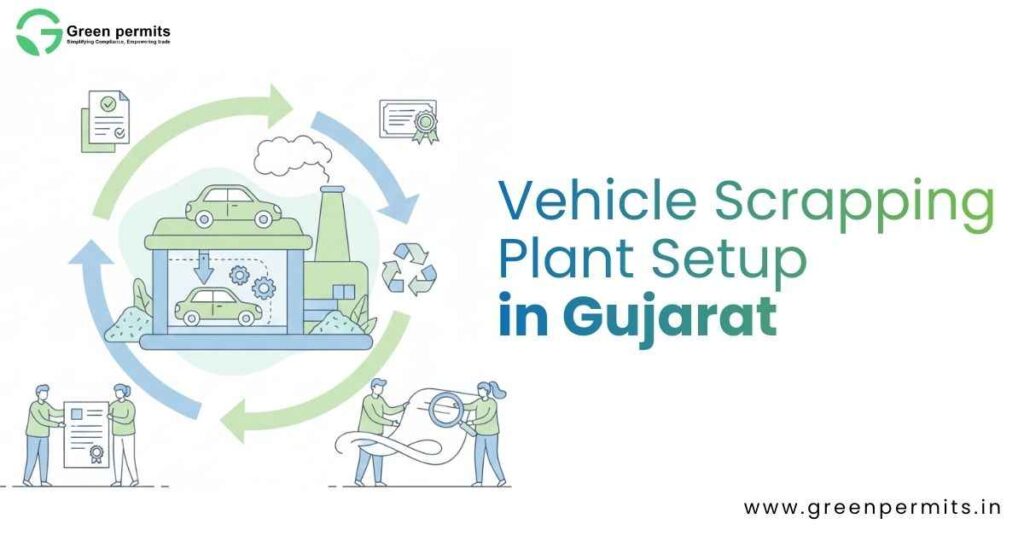
Gujarat has evolved into one of India’s most strategically positioned industrial states for recycling and automotive activities. The automobile ecosystem built around Sanand and the extensive metal-recycling belts in Vapi, Hazira, and Kutch create an ideal environment for setting up a scrapping plant.
For new investors, Gujarat offers the trifecta of vehicle supply, industrial infrastructure, and favourable land availability, lowering entry barriers compared to many other states.
Choosing the right location determines operating cost, approval timelines, and access to ELVs (end-of-life vehicles). Gujarat’s industrial belts offer several high-potential options.
Sanand is one of India’s most developed auto-manufacturing clusters. A scrapping unit here benefits from proximity to OEMs, high urban vehicle density, and fleet operators. The region also offers quick access to labour and engineering support.
Surat’s industrial region has a mature metal-recycling ecosystem. Existing RVSFs in the area indicate strong market acceptability. Industries in Hazira consume large quantities of processed scrap, providing downstream buyers for dismantled metal.
These regions are known for industrial estates with better land affordability. They house several metal-processing and plastic-recycling units, which aligns well with a scrapping facility’s output streams.
Being port-driven zones, these areas witness steady inflow of damaged, abandoned, or seized vehicles. For investors, this ensures consistent supply, which stabilizes plant utilization throughout the year.
A well-placed RVSF in Gujarat can reduce inbound transportation costs by 15–25%, directly improving operational margins.
An RVSF’s success depends on reliable inflow of ELVs. Gujarat offers multiple stable streams.
Diversifying sources reduces dependency on any one channel and ensures year-round utilization of plant capacity.
Compliance is the backbone of a legally operational scrapping plant. Gujarat follows central MoRTH rules combined with GPCB environmental clearances.
Even if the plant is physically ready, missing any compliance step can delay operations for months. Investors who organize documents early often cut approval time by half.
An RVSF must safely remove all hazardous components before dismantling and segregating materials. Modern plants use semi-automated lines to improve throughput.
Automation improves dismantling speed, reduces labour dependency, and increases recovery value — especially for ferrous and non-ferrous metals.
Below is a deeper look at the investment ranges for typical plant sizes in Gujarat. Costs vary by land type, machinery quality, and level of automation.
| Component | 25 Vehicles/Day | 50 Vehicles/Day | 100 Vehicles/Day |
|---|---|---|---|
| Land (1–2 acres) | ₹60–90 lakh | ₹1.2–1.8 cr | ₹2–3.5 cr |
| Civil construction & shed | ₹1–1.5 cr | ₹1.8–2.8 cr | ₹3–4 cr |
| Depollution & dismantling line | ₹1.2–1.8 cr | ₹2–3 cr | ₹3.5–5 cr |
| Crusher/Baler | ₹35–60 lakh | ₹60–95 lakh | ₹1–1.5 cr |
| EHS, CCTV & compliance systems | ₹20–40 lakh | ₹30–50 lakh | ₹50–75 lakh |
| Total CAPEX | ₹3.5–5 cr | ₹6–8.5 cr | ₹10–14 cr |
Higher-capacity plants benefit from economies of scale. A 50–100 vehicle/day plant typically achieves better margins because fixed costs spread over more units.
| Cost Head | Typical Range |
|---|---|
| Manpower | ₹6–15 lakh |
| Electricity | ₹1.5–3 lakh |
| Waste handling & logistics | ₹2–5 lakh |
| Compliance & audits | ₹50,000–1 lakh |
| Miscellaneous | ₹1–2 lakh |
Plants with standardized dismantling flows and long-term scrap buyers achieve faster break-even, often within 3–5 years.
The Gujarat Industrial Policy provides multiple benefits for recycling and circular-economy investments.
Impact on investors
These incentives can lower total project cost significantly, especially for first-time recyclers or MSMEs entering the scrappage sector.
Vehicle manufacturers and transport operators increasingly prefer partnering with authorized scrapping facilities.
Stable partnerships improve capacity utilization, reduce acquisition cost per vehicle, and strengthen cash flow.
RVSFs must maintain transparency, traceability, and environmental protection.
A practical roadmap helps investors avoid delays.
Business insight
Running GPCB and MoRTH applications simultaneously can shorten the overall project timeline by 2–3 months.
Setting up a vehicle scrapping plant in Gujarat presents an exceptional opportunity as India moves toward organized, environmentally responsible end-of-life vehicle management. The combination of ELV availability, strong industrial infrastructure, OEM involvement, and government incentives makes Gujarat a top choice for investors.
However, regulatory compliance and plant readiness are crucial. Proper planning, documentation, and systematic execution can save months of delay and significantly improve profitability.
Call: +91 78350 06182
Email: wecare@greenpermits.in