
A founder running a mid-sized manufacturing unit believed compliance could be handled later. Orders were steady, margins were decent, and customers were happy. Environmental registrations felt like paperwork that could wait.
Then one email changed everything.
A distributor asked for proof of EPR registration and SPCB authorization. Without it, the next shipment could not be accepted. Within days, sales were paused—not because of product quality or pricing, but because compliance was missing.
This is no longer an exception. For Indian businesses today, environmental compliance has become a basic condition to operate, not an optional formality.
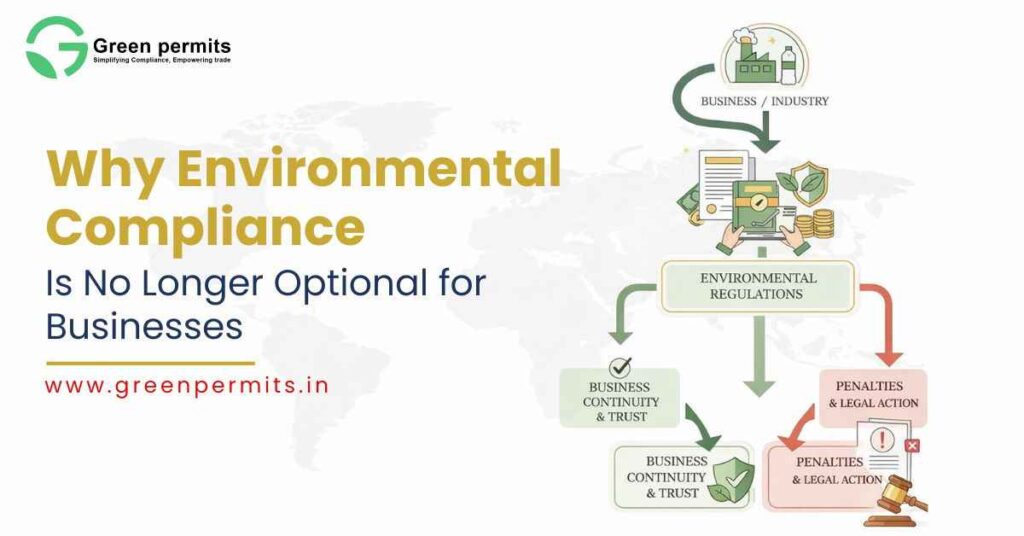
Environmental compliance is often misunderstood as pollution control alone. In reality, it now covers how your business is registered, tracked, and held accountable across multiple government systems.
For most businesses, compliance means:
It applies whether you manufacture, import, assemble, recycle, refurbish, or sell regulated products.
The biggest change is that compliance today is activity-based. Even a small company becomes legally accountable the moment it places a regulated product in the market.
Earlier, compliance depended heavily on physical inspections and manual follow-ups. That has changed completely.
This means enforcement no longer depends on inspections alone. Data itself triggers scrutiny.
From the government’s perspective, this ensures transparency. From a business perspective, it means non-compliance is visible, traceable, and difficult to ignore.
Different laws apply depending on what your business does. Many companies are surprised to discover they fall under multiple rules at the same time.
| Regulation | Business Activities Covered | Why It Matters |
|---|---|---|
| E-Waste Management Rules | Electronics producers, importers, recyclers | Mandatory EPR registration and recycling targets |
| Plastic Waste Management Rules | Brand owners, FMCG, packaging users | Plastic EPR, reporting, and labeling |
| Battery Waste Management Rules | EV, electronics, battery sellers | Battery EPR, traceability, QR/barcode |
| Hazardous Waste Rules | Manufacturing and processing units | Authorization and safe disposal |
What this means for businesses:
Even if pollution levels are low, legal responsibility still exists if your product or process falls under these rules.
Many businesses believe the worst outcome of non-compliance is a fine. In reality, the bigger risk is operational disruption.
A compliance gap rarely stays isolated. Once flagged, it often leads to deeper scrutiny across other registrations and filings.
| Area | Businesses That Comply Early | Businesses That Delay |
|---|---|---|
| Regulatory exposure | Controlled and predictable | High and uncertain |
| Client confidence | Strong and consistent | Frequently questioned |
| Expansion approvals | Faster and smoother | Delayed or blocked |
| Cost over time | Planned and manageable | Escalating penalties |
| Management effort | Minimal firefighting | Constant follow-ups |
Interpretation:
Compliance does not slow growth. Poor compliance does.
There was a time when smaller businesses escaped attention due to scale. That is no longer the case.
Today:
Many startups now face compliance questions before their first funding round, not after expansion.
At first glance, compliance looks like a cost. Over time, it proves to be a cost-control mechanism.
Businesses that plan compliance early usually spend less overall than those forced to fix issues under pressure.
Successful companies do not treat compliance as a one-time exercise. They integrate it into regular operations.
This approach reduces stress, saves leadership time, and ensures smoother growth.
Environmental compliance is no longer optional because:
For Indian businesses, compliance is no longer about avoiding penalties. It is about protecting operations, reputation, and future growth.
📞 +91 78350 06182 | 📧 wecare@greenpermits.in
Book a Consultation with Green Permits