
Amit runs a mid-sized auto components company in Pune. In early 2025, three of his containers were stuck at Nhava Sheva for nearly 6 days. Every morning, his CHA repeated the same line — “RMS has marked it for examination.”
Demurrage was ₹12,000 per container per day. Production was delayed. One European buyer even warned of a 2% penalty for late delivery.
That week alone cost him nearly ₹4.5 lakh.
He later discovered something critical — customs delays are not random. They are risk-based. And AEO approval directly changes that risk score.
The Authorised Economic Operator (AEO) programme is implemented under the Customs Act, 1962 in line with the WCO SAFE Framework.
It is essentially a government-issued trust certification for businesses involved in international trade.
To qualify, a company must demonstrate:
Average approval timeline: 90–120 days
If documentation gaps exist, it can extend to 150–180 days.
Customs in India operates through a Risk Management System (RMS). Every Bill of Entry is algorithmically scored based on:
A non-AEO importer typically experiences:
After AEO-T2 or AEO-T3 approval:
For importers handling 100 containers per month, reducing delay from 5 days to 2 days can improve working capital efficiency by 15–25%.
Since 01 April 2025, enforcement under environmental compliance has intensified.
Under the Environment Protection (End-of-Life Vehicles) Rules, 2025:
Failure to comply can attract action under Section 15 of the Environment Protection Act, 1986.
Customs authorities increasingly cross-check:
Similarly, under Plastic Waste Management Amendment Rules 2025:
Shipments lacking compliance alignment can face detention.
An AEO-approved entity, having undergone compliance validation, faces significantly lower RMS suspicion.
| Regulation | Key Requirement | Deadline | Applicable To | Risk if Ignored |
|---|---|---|---|---|
| ELV Rules 2025 | EPR registration & obligation declaration | 30 April | Vehicle Producers/Importers | Shipment hold, penalty |
| ELV Annual Return | Filing of annual data | 30 June | Producers | Portal suspension |
| Plastic Waste Amendment 2025 | QR compliance | 01 July 2025 | Importers using plastic packaging | Import detention |
| AEO Programme | Compliance audit & validation | Ongoing | Importers/Exporters | High RMS scrutiny |
Interpretation:
Customs systems are now integrated with environmental compliance tracking. AEO approval creates a lower-risk identity within this interconnected framework.
| Step | Authority | Timeline | Documents Required | Risk Area |
|---|---|---|---|---|
| Application Filing | CBIC | Day 0 | IEC, GST, PAN, 3-year records | Incomplete submission |
| Preliminary Scrutiny | Customs | 30–45 days | Financial solvency documents | Data mismatch |
| On-Site Audit | Customs Audit Team | 60–90 days | SOPs, IT systems, warehouse records | Weak internal controls |
| Final Grant | CBIC | 90–120 days | Approval order | Rejection if non-compliant |
Companies with structured documentation reduce approval delay by 20–30%.
Consider a mid-sized importer:
If AEO reduces delay by even 2–3 days, annual savings can exceed ₹3–5 crore depending on volume.
Additionally:
Ignoring structured compliance in 2026 can result in:
Customs delay is often a symptom of broader compliance weakness.
Because:
AEO approval:
In a compliance-driven economy, AEO is not just a customs benefit. It is a business risk management tool.
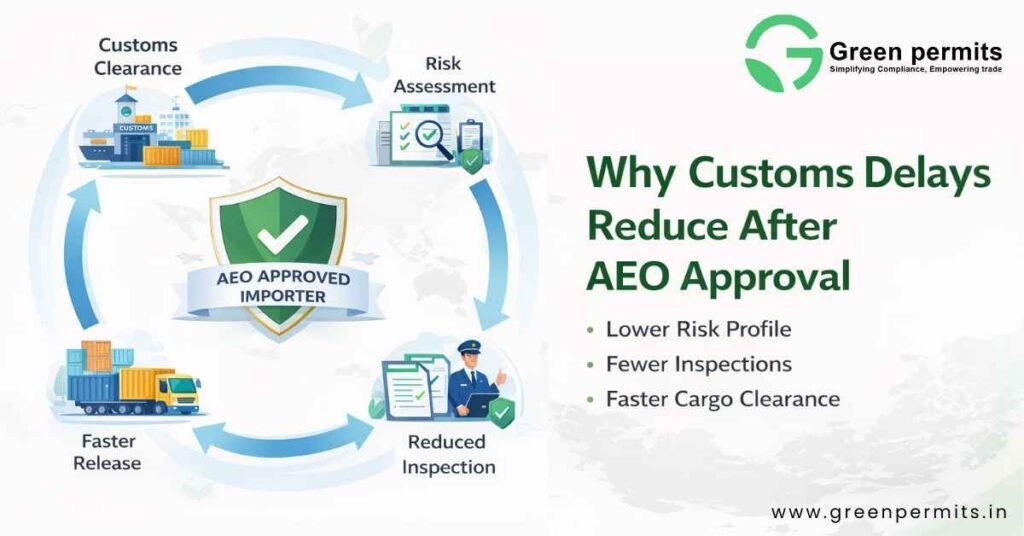
Customs delays reduce after AEO Approval India because the system begins to trust you.
Lower RMS score.
Fewer inspections.
Faster clearance.
Better working capital.
Reduced regulatory friction.
In 2026, environmental compliance, GST integrity, and customs profiling are interconnected. Businesses that align documentation, EPR obligations, and AEO certification operate with structural advantage.
Delays are expensive. Compliance is predictable.