
A business owner from Gujarat once told us,
“Metal ka rate toh strong hai… scrap mil raha hai… profit toh guaranteed hai, right?”
Three months later, his plant was operational — but cash flow wasn’t.
Why?
He had calculated machinery cost… but not EPR integration, CPCB portal compliance, hazardous waste authorization, and working capital lock-in.
Battery recycling in India can be profitable — but only when cost, compliance, and recovery economics are planned together.
Let’s break down the real numbers.
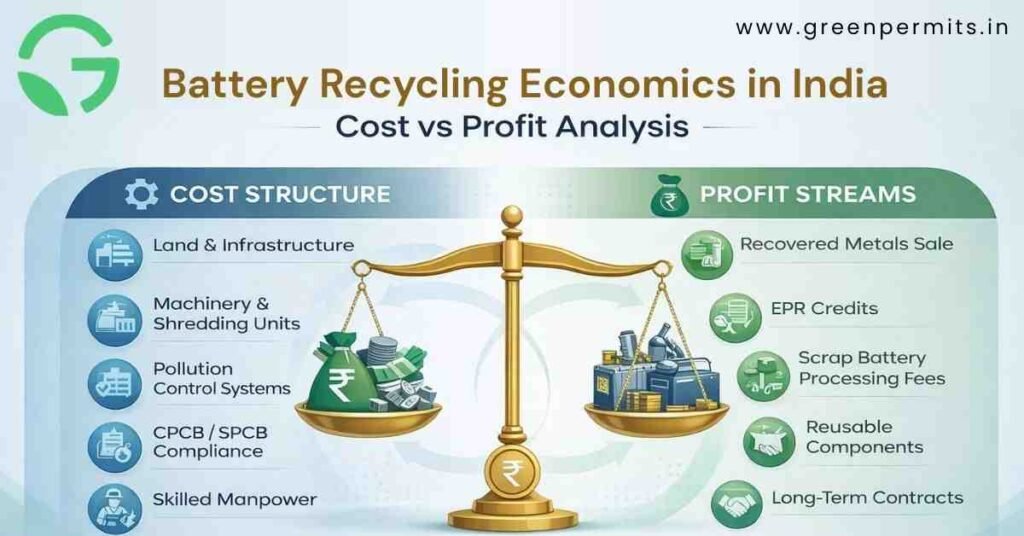
Battery recycling economics in India depends on five major pillars:
With EV adoption rising and Battery Waste Management Rules, 2022 (amended 2025) strengthening compliance obligations, recyclers are no longer just scrap processors — they are compliance-driven resource recovery businesses.
Before talking profit, let’s understand the opportunity.
India’s EV transition, solar storage, telecom backup systems, and consumer electronics are driving battery waste volumes sharply upward.
| Segment | 2023 Estimate | 2030 Projection | Source Context |
|---|---|---|---|
| Lead-Acid Waste | ~1.2 million tonnes | ~2 million tonnes | Industry + CPCB data |
| Lithium-ion Waste | ~70,000 tonnes | 4–5 lakh tonnes | NITI Aayog EV forecasts |
| EV Sales | 1.5 million units | 8–10 million units | Govt mobility targets |
What this means for business:
Lithium-ion recycling margins are expected to strengthen significantly after 2027 as first-generation EV batteries reach end-of-life.
Many entrepreneurs underestimate the entry cost.
| Plant Type | Capacity | Estimated Investment |
|---|---|---|
| Lead Acid Recycling | 5,000–10,000 TPA | ₹3–6 Crore |
| Lithium-ion Mechanical Dismantling | 2,000–5,000 TPA | ₹5–12 Crore |
| Advanced Lithium Hydromet Plant | 10,000+ TPA | ₹25–50 Crore |
Consultant Insight:
Most plant delays happen at the Consent to Establish (CTE) and portal registration stage — not at machinery installation.
Once operational, profitability depends on managing recurring expenses carefully.
| Cost Head | Approx % of Revenue |
|---|---|
| Scrap Procurement | 65–75% |
| Power & Utilities | 8–12% |
| Labour | 5–8% |
| Environmental & Compliance | 3–5% |
| Miscellaneous | 5–7% |
Interpretation:
Your scrap sourcing strategy directly impacts margins more than machinery quality.
Battery recycling is no longer just about selling lead.
Under Battery Waste Management Rules, recyclers generate EPR certificates after processing battery waste. Producers must purchase these certificates to meet compliance obligations.
This creates a second revenue layer beyond metal sales.
Let’s look at realistic numbers.
| Particular | Example |
|---|---|
| Capacity | 10,000 TPA |
| Scrap Cost | ₹85/kg |
| Lead Recovery | 60–65% |
| Lead Selling Price | ₹150/kg |
| Gross Margin | 12–18% |
| Net Margin (Post-tax) | 8–12% |
| Factor | Scenario |
|---|---|
| High CapEx | Yes |
| Recovery Complexity | High |
| EBITDA Potential | 18–25% (mature plant) |
| Stabilization Period | 18–24 months |
Business Reality: Lithium-ion plants require patience and technical precision before profitability stabilizes.
This is where many businesses miscalculate battery recycling economics in India.
Under the Battery Waste Management Rules:
A North India recycler operated without proper portal updates.
Result:
Estimated financial impact: ₹40–60 lakh in three months.
Profitability depends on compliance stability.
Battery recycling economics in India improves when:
It deteriorates when:
A Rajasthan-based recycler started with 5,000 TPA lead capacity.
Instead of expanding aggressively, they:
Within 24 months:
The difference? Compliance-first strategy.
Battery recycling economics in India shows:
Profit in this industry doesn’t come from metal prices alone.
It comes from:
Early registration and structured compliance planning save:
Green Permits helps with:
📞 +91 78350 06182
📧 wecare@greenpermits.in