
Annual EPR Compliance Checklist for Indian Producers 2026: Close Your Compliance Year Without Penalties

  • Home
  • Uncategorized
  • Annual EPR Compliance Checklist for Indian Producers 2026: Close Your Compliance Year Without Penalties

A mid-sized electronics importer ended up paying lakhs in environmental compensation—not because they ignored EPR, but because they misunderstood one small compliance step.

They had registration. They had recyclers. They even had partial certificates.

What they missed was aligning their quarterly data with annual filings, which triggered a compliance mismatch on the CPCB portal.

In 2026, EPR compliance is no longer about intention—it is about precision, timelines, and data accuracy.
Why Annual EPR Compliance Has Become Critical in 2026

Over the past 2–3 years, India’s EPR framework has evolved into a quantitative, target-based compliance system. Regulators are no longer evaluating whether you are compliant—they are measuring how much you have complied.

This shift has introduced stricter enforcement across:

  • Plastic Waste (PWM Rules)
  • E-Waste (EEE products)
  • Battery Waste (Li-ion, Lead Acid, EV batteries)
  • End-of-Life Vehicles (ELV)

Key changes businesses must understand:

  • Annual returns must be filed before 30 June
  • Quarterly filings are now mandatory and sequential
  • Targets are calculated based on previous financial year data
  • Certificates must match actual recycled quantities (in kg or MT)

For many companies, even a 5–10% mismatch in data can lead to rejection or penalty.

Regulatory Overview of EPR Compliance in India (2026)

Regulation Key Requirement Deadline Applicable To Risk if Ignored
Plastic Waste Rules EPR targets + barcode compliance 1 July 2025 onwards PIBOs Portal rejection
E-Waste Rules Registration + certificate purchase Annual (30 June) Producers Compensation
Battery Waste Rules Metal-based recovery targets Annual filing Importers & OEMs License risk
ELV Rules 8%–18% recycling targets FY-based Vehicle OEMs Target deficit

For example, under ELV compliance:

  • 8% recycling target applies between FY 2025–2030
  • 13% applies from FY 2030–2035
  • 18% applies beyond FY 2035

These percentages are based on steel weight introduced in the market, not unit count.

This directly impacts cost planning and certificate procurement.

Annual EPR Compliance Timeline for 2026

Step Authority Timeline Documents Required Risk Area
Registration / Renewal CPCB/SPCB Ongoing GST, PAN, IEC Rejection
Quarterly Filing CPCB Portal Every 3 months Sales + waste data Data mismatch
Certificate Purchase Recycler/RVSF Before filing EPR certificates Target gap
Annual Return Filing CPCB By 30 June Consolidated report Penalty
Audit / Verification CPCB/SPCB Post submission All records Suspension

A delay of even 15–20 days in certificate procurement can lead to:

  • Increased certificate cost (10–25%)
  • Compliance carry forward
  • Portal rejection during final filing

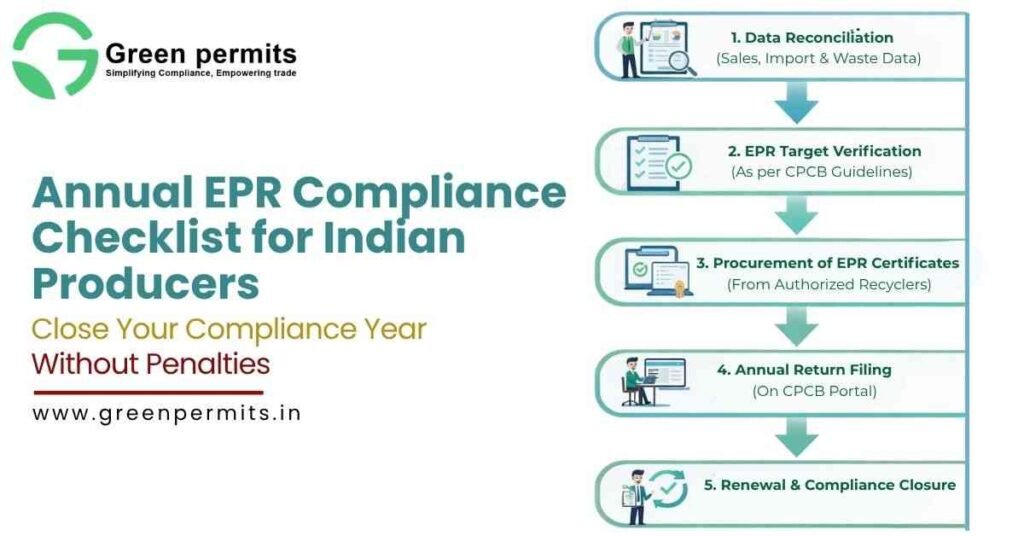
Step-by-Step Annual EPR Compliance Checklist (2026)

Ensure Valid EPR Registration

Every producer, importer, or brand owner must have active registration on CPCB or SPCB portal.

You must ensure:

  • Registration validity is active (typically 1–5 years depending on category)
  • Correct category selection (Producer / Importer / Brand Owner)
  • Separate registration if operating in multiple roles

Required documents include:

  • PAN, GST, CIN, IEC
  • Authorized signatory details
  • Consent from SPCB (if manufacturing involved)

Failure at this stage can result in complete application rejection within 30 days.

Calculate EPR Targets Based on Accurate Data

EPR targets are calculated using:

  • Previous financial year sales/import data
  • Waste category classification
  • Material composition

For example:

  • If you introduced 1,000 MT of plastic packaging, your obligation could range between 70%–100% depending on category
  • For batteries, obligations are calculated based on metal recovery efficiency (kg basis)
  • For vehicles, targets are based on steel weight percentages (8%, 13%, 18%)

Incorrect data reporting is one of the top 3 reasons for CPCB rejection.

Procure EPR Certificates Strategically

Certificates must be:

  • Purchased from registered recyclers or RVSFs
  • Linked to actual processed waste
  • Uploaded on CPCB portal

Key practical insights:

  • Certificate prices fluctuate between ₹8–₹35 per kg depending on waste type
  • Last-minute purchase increases cost by 15–30%
  • Over-purchase may lead to financial inefficiency

A structured procurement strategy helps reduce compliance cost significantly.

Complete Quarterly Filings Without Error

Quarterly filings are no longer optional.

You must:

  • File Q1 → Q2 → Q3 → Q4 in sequence
  • Ensure consistency across all quarters
  • Upload awareness and compliance documents where required

Important facts:

  • Missing even one quarter blocks annual submission
  • Data mismatch between quarters and annual filing triggers automatic flags
  • Correction windows are limited to 7–15 days

File Annual Return Before 30 June Deadline

The annual return consolidates:

  • Total sales/import data
  • EPR target assigned vs achieved
  • Certificates submitted
  • Awareness and compliance activities

Key compliance facts:

  • Filing deadline: 30 June every year
  • Delay beyond deadline may trigger environmental compensation
  • Portal auto-lock may occur in some cases after deadline

This is the most critical stage of EPR compliance.

Maintain Documentation for 5+ Years

Documentation is essential for audits and verification.

Maintain records such as:

  • EPR certificates and invoices
  • Recycler agreements
  • Waste processing reports
  • Quarterly and annual filings

Authorities may conduct:

  • Digital audits within 30–60 days
  • Physical inspections post-registration

Lack of documentation can result in retroactive penalties.

Common Compliance Mistakes Businesses Make

Many companies assume EPR is only about registration. In reality, most penalties arise from operational mistakes.

Common issues include:

  • Incorrect waste category declaration
  • Delayed certificate procurement
  • Using unregistered recyclers
  • Mismatch between quarterly and annual data
  • Underestimating target quantities

A packaging company in Gujarat faced a 60-day delay due to wrong category selection, affecting production approvals.

Compliance Risks and Penalties You Must Understand

Non-compliance carries serious operational and financial consequences.

Key risks include:

  • CPCB registration rejection
  • Environmental compensation (₹1 lakh+ base penalty)
  • Daily penalties for continued non-compliance
  • Import shipment holds
  • SPCB consent refusal
  • Production or sales disruption

Penalties are imposed under Section 15 of the Environment Protection Act, 1986, which allows both financial penalties and closure directions.

CPCB Portal Process: What Businesses Must Know

The CPCB EPR portal integrates:

  • Registration
  • Certificate trading
  • Return filing
  • Compliance tracking

Typical processing timelines:

  • Application review: 30 working days
  • Correction window: 7 days
  • Audit trigger: Within 60 days post filing

Businesses must treat the portal as a real-time compliance monitoring system, not just a submission tool.

Real Business Insight

A battery importer delayed certificate purchase by just 45 days.

Impact:

  • Certificate price increased by 22%
  • Target deficit carried forward
  • Compliance cost increased significantly in next financial year

This is a common pattern seen across industries.

Conclusion

EPR compliance in 2026 is a structured, data-driven regulatory obligation.

It directly impacts:

  • Cost of operations
  • Import and production approvals
  • Brand credibility

Businesses that delay compliance:

  • Pay higher costs
  • Face regulatory friction
  • Risk operational disruption

Businesses that plan early:

  • Optimize compliance cost
  • Avoid penalties
  • Maintain smooth regulatory approvals

The difference lies in having a clear checklist, timely execution, and accurate reporting.

📞 +91 78350 06182
📧 wecare@greenpermits.in

Book a Consultation with Green Permits

Book a Technical Call with Expert