
A mid-sized electronics importer in Delhi planned to launch a new line of smart LED products before the festive season. Everything was ready—distribution network, inventory, marketing budget of over ₹25 lakh—but one mistake changed the entire timeline. The company applied for BIS FMCS instead of CRS.
The result was immediate and costly. Their shipment was held at customs for 31 days, distributors cancelled pre-orders, and the business suffered a loss of nearly ₹4.2 lakh in demurrage and missed sales.
This is no longer an isolated case. With stricter enforcement under the Bureau of Indian Standards Act, 2016, and increased scrutiny at ports and marketplaces, choosing between BIS FMCS vs CRS certification India is now a business-critical decision in 2026.
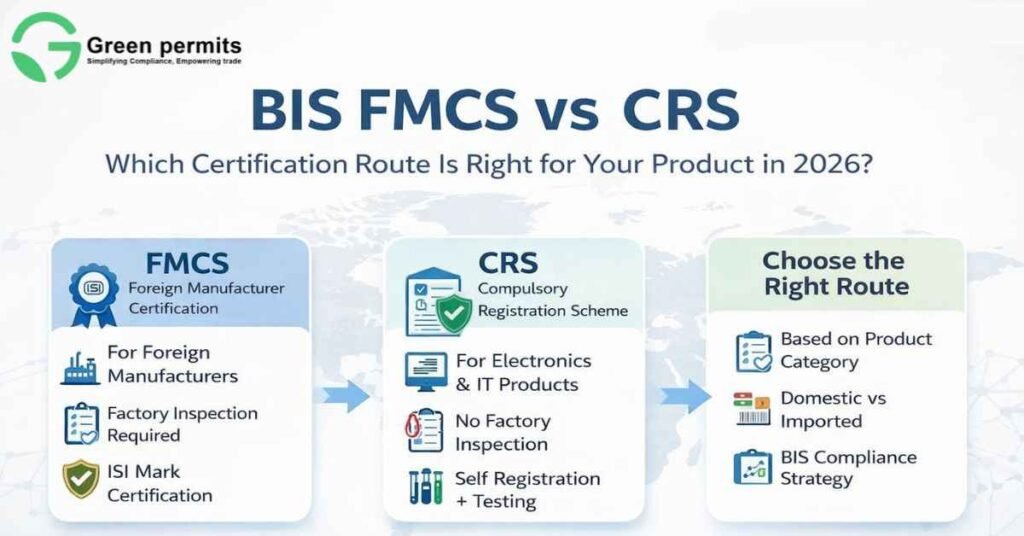
BIS certification is not just a regulatory requirement—it directly impacts your ability to sell, import, and scale your business in India. Over the last 3 years (2023–2026), enforcement actions have increased significantly, especially for imported goods.
Businesses today are facing more frequent inspections, digital verification through portals, and stricter compliance checks at customs.
From a practical standpoint, BIS certification acts as a market entry license. Without it, products cannot legally enter or circulate in the Indian market.
Many companies still treat BIS certification as a backend activity. However, in reality:
CRS is designed specifically for electronics and IT goods, making it one of the fastest and most commonly used certification routes in India.
For most startups and importers, CRS is the preferred option because of its speed and relatively lower cost.
However, despite its simplicity, errors in product classification or documentation can still lead to delays.
CRS follows a test-and-register model, where compliance is based on laboratory testing rather than factory inspection.
Once the product passes testing, the manufacturer or brand owner can obtain registration and start selling in India.
In 2025, nearly 70% of BIS applications under CRS were processed within 25 days, but:
FMCS is a more detailed and compliance-intensive route designed for foreign manufacturers exporting regulated products to India.
Unlike CRS, FMCS focuses on verifying the entire manufacturing process, not just the final product.
FMCS involves direct inspection by BIS officials, making it a longer but more comprehensive certification process.
The certification is issued only after the manufacturing facility meets BIS standards.
| Parameter | CRS Certification | FMCS Certification |
|---|---|---|
| Applicable Products | Electronics & IT goods | Industrial & regulated products |
| Applicant Type | Manufacturer / Importer | Foreign Manufacturer |
| Inspection | Not required | Mandatory |
| Approval Time | 15–30 days | 6–9 months |
| Validity | 2 years | 1–2 years |
| Cost | ₹50K–₹1L | ₹3L–₹8L |
| Regulation | Key Requirement | Deadline | Applicable To | Risk if Ignored |
|---|---|---|---|---|
| BIS Act, 2016 | Mandatory certification | Before market entry | All businesses | Product ban |
| CRS Order | Product registration | 15–30 days | Electronics | Customs hold |
| FMCS Scheme | Factory audit | 6–9 months | Foreign manufacturers | Import rejection |
In practical terms, regulatory non-compliance does not just create legal issues—it directly impacts business operations.
A delay of even 30 days can disrupt inventory planning, distributor relationships, and cash flow cycles.
| Step | Authority | Timeline | Documents Required | Risk Area |
|---|---|---|---|---|
| Product classification | BIS | 2–5 days | Product details | Wrong scheme |
| Testing | BIS Lab | 7–10 days | Samples | Failure |
| Application | BIS | 3–5 days | Business documents | Rejection |
| Audit (FMCS) | BIS | 30–90 days | Factory data | Delay |
| Approval | BIS | 15–180 days | Complete file | Market delay |
A critical insight here is that most delays happen not during approval—but during wrong classification and documentation stage.
Many businesses underestimate the seriousness of BIS compliance until they face operational disruption.
A Noida-based startup importing smart wearables chose CRS for a product that required FMCS.
This highlights a simple but critical lesson:
Correct certification selection saves both time and capital.
Before applying, every business should evaluate:
The decision between BIS FMCS vs CRS certification India is no longer just regulatory—it is operational, financial, and strategic.
CRS offers speed and cost efficiency, making it ideal for fast-moving consumer products. FMCS, on the other hand, ensures deeper compliance and is essential for regulated industrial goods.
In 2026, businesses that plan certification early can avoid delays of 30–180 days and financial losses ranging from ₹2 lakh to ₹10 lakh.
The real advantage lies in understanding your product, selecting the right route, and executing compliance with precision.
📞 +91 78350 06182
📧 wecare@greenpermits.in