
In early 2025, several toy importers saw their consignments stuck at Nhava Sheva and Chennai ports for over 40 days. The reason was simple—missing BIS certification. Despite having valid invoices and import documents, shipments were held because the toys did not carry a valid ISI mark license.
The enforcement of toy safety regulations in India has moved from advisory to strict execution. Authorities now verify BIS compliance at the customs level itself, making certification a pre-condition for market entry.
For importers, foreign brands, and distributors, BIS registration is no longer a procedural step—it is a business-critical compliance requirement.
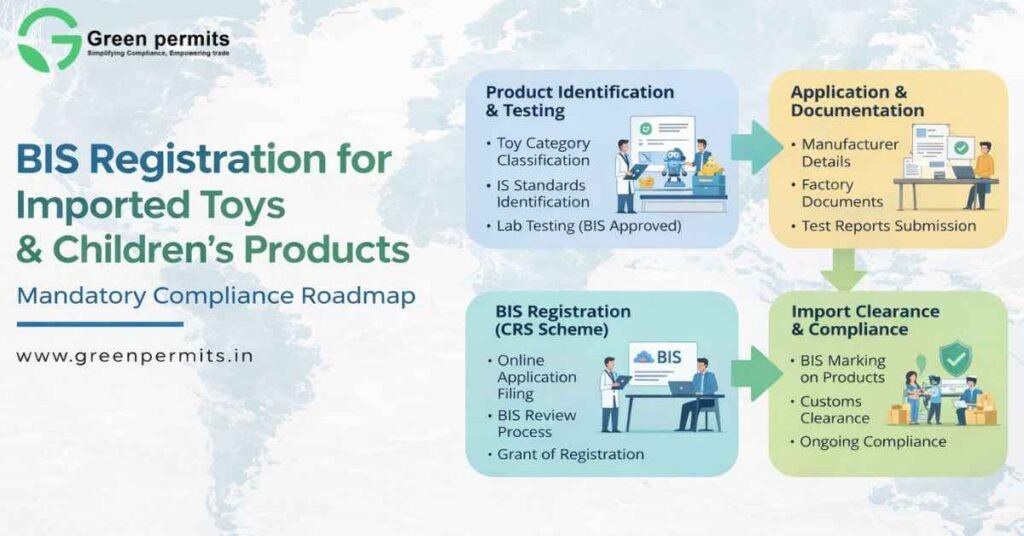
BIS Registration for Imported Toys in India is a mandatory certification requirement under the Toys (Quality Control) Order, 2020 issued under the BIS Act, 2016.
This regulation ensures that all toys sold in India meet defined safety standards before reaching consumers.
Key regulatory requirements include:
Under Section 16 of the BIS Act, 2016, no notified product can be imported without certification. Non-compliance attracts penalties under Section 29.
The regulation covers both electric and non-electric toys with specific safety benchmarks.
Imported toys must be certified under the Foreign Manufacturer Certification Scheme (FMCS).
The BIS certification process for imported toys involves multiple regulatory checkpoints.
| Regulation | Key Requirement | Deadline | Applicable To | Risk if Ignored |
|---|---|---|---|---|
| BIS Act, 2016 | Mandatory certification under Section 16 | Before import | Importers & manufacturers | Penalty + seizure |
| Toys (QCO), 2020 | ISI mark compulsory | Continuous | All toy sellers | Customs rejection |
| IS 9873 / IS 15644 | Safety compliance | Pre-sale | Manufacturers | Product ban |
| BIS FMCS Scheme | Certification for imports | Pre-import | Foreign manufacturers | Shipment hold |
Business Implication:
The regulatory framework directly links BIS certification with import clearance. Any delay in certification results in shipment hold, increased logistics cost, and loss of market timing.
| Step | Authority | Timeline | Documents Required | Risk Area |
|---|---|---|---|---|
| Product Testing | BIS Lab | 20–45 days | Samples, specs | Test failure |
| Application Filing | BIS | 5–10 days | GST, IEC, factory docs | Rejection |
| Factory Inspection | BIS | 15–30 days | QA records | Delay |
| License Approval | BIS | 15–30 days | Final submission | Non-compliance |
Interpretation:
The complete BIS registration cycle takes approximately 45–90 days, making early planning essential for importers dealing with seasonal demand cycles.
Every toy must carry:
Marking must be present on:
Failure to meet marking requirements can lead to rejection even if certification exists.
Ignoring BIS Registration for Imported Toys in India exposes businesses to both regulatory and operational risks.
A Delhi-based importer sourcing battery-operated toys from China applied for BIS certification after shipment dispatch. The result:
This highlights a critical compliance rule-BIS certification must be completed before import dispatch.
BIS Registration for Imported Toys in India has become a strict regulatory gateway controlling market entry. With enforcement now active at customs checkpoints, non-compliance leads to immediate financial and operational impact.
Businesses that plan certification in advance-typically 60–90 days before import gain a clear advantage by avoiding shipment delays, penalties, and lost revenue cycles.
Structured compliance is no longer optional. It is a prerequisite for sustainable import operations in India’s regulated toy market.
📞 +91 78350 06182
📧 wecare@greenpermits.in