
A few months ago, an IT company managing over 8 metric tonnes of electronic waste annually flagged a serious issue during its internal audit. Old laptops, servers, and networking equipment had been disposed of through a local scrap vendor.
On paper, everything looked routine. But when auditors asked for recycler authorization, disposal manifests, and traceability records, there was nothing available.
Within weeks, the company’s compliance team was dealing with documentation gaps, vendor verification failures, and potential environmental liability exposure.
This situation is becoming increasingly common.
E-waste disposal is no longer an operational activity. It is now a regulated, traceable, and audit-driven compliance function for corporates.
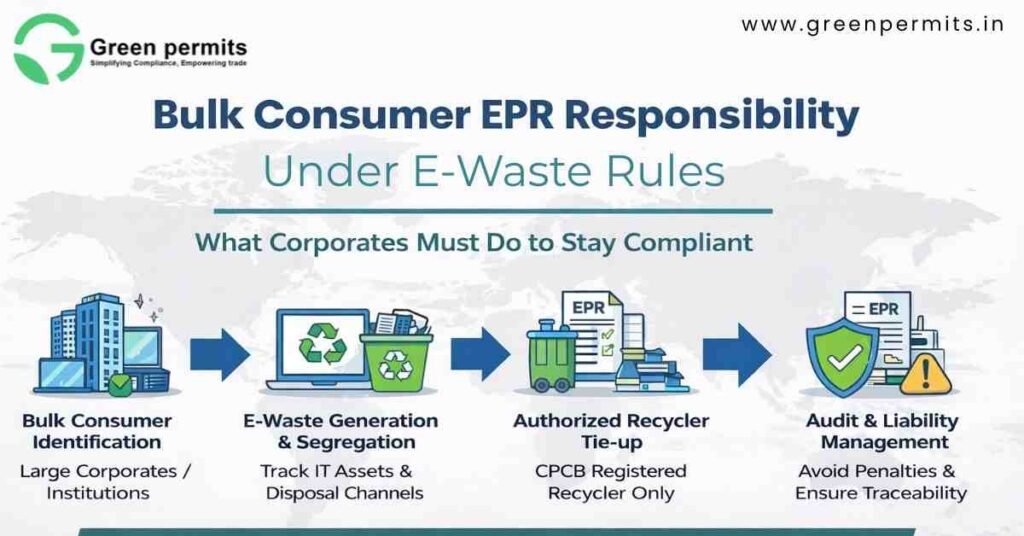
The E-Waste Management framework has shifted from focusing only on producers to covering the entire lifecycle of electronic waste. Bulk consumers are now a critical part of this system.
As per regulatory definitions, bulk consumers include companies, institutions, government bodies, and organizations handling large volumes of electronic equipment.
In practical terms, any entity generating 1 MT to 20+ MT of e-waste annually is expected to follow structured compliance procedures.
This means disposal is no longer about clearing inventory. It is about ensuring that every unit of waste is accounted for, documented, and processed through authorized channels.
Bulk consumers are required to ensure that e-waste is handled in an environmentally sound manner. The responsibility lies not just in disposal, but in maintaining a complete compliance trail.
In most corporate setups, this involves coordination between IT teams, admin departments, procurement, and compliance officers.
Bulk consumers are identified not just by legal classification but also by operational scale and waste volume.
Many organizations underestimate their classification until they face compliance checks.
| Regulation | Key Requirement | Deadline | Applicable To | Risk if Ignored |
|---|---|---|---|---|
| E-Waste Rules | Disposal through authorized recycler | Continuous | Bulk Consumers | Legal exposure |
| CPCB Compliance Framework | Traceable waste flow | Ongoing | Corporates | Audit failure |
| Environment Protection Act | Penalty for violations | Immediate | All entities | Financial + legal risk |
| Record Retention | Maintain 3–5 years data | Continuous | Bulk Consumers | Compliance rejection |
For corporates, e-waste compliance is now directly linked with audit readiness, ESG reporting, and regulatory inspections. Even a single missing document can raise serious compliance questions.
Even though bulk consumers may not always register directly on regulatory portals, they are part of a structured compliance ecosystem.
The recycler plays a central role in this process, but the responsibility of documentation remains with the bulk consumer.
In most cases, compliance failures happen not due to lack of disposal, but due to lack of documentation and traceability.
| Step | Authority | Timeline | Documents Required | Risk Area |
|---|---|---|---|---|
| Waste Identification | Internal | Monthly | Asset register | Under-reporting |
| Recycler Selection | CPCB | Immediate | Authorization certificate | Unauthorized vendor |
| Disposal Execution | Recycler | 30–60 days | Invoice, manifest | Traceability gap |
| Record Maintenance | Internal | 3–5 years | Disposal logs | Audit failure |
| Audit & Reporting | Internal/External | Annual | Compliance summary | ESG risk |
Compliance is continuous and process-driven. Delays, missing records, or incorrect vendor selection can disrupt the entire compliance chain.
Ignoring structured compliance can result in direct financial and operational consequences.
Most risks emerge during audits, vendor verification checks, or regulatory inspections.
A manufacturing unit generating approximately 12 MT of e-waste annually relied on informal scrap vendors for disposal.
During a compliance audit:
The company had to halt disposal activities, onboard a new recycler, and rebuild its documentation system.
The entire correction process took nearly 3 months, delaying operations and increasing compliance costs.
The shift required is from informal disposal practices to structured compliance systems.
This requires coordination, documentation, and periodic monitoring.
Bulk consumer responsibility under e-waste regulations is no longer indirect.
It is now a fully traceable, documentation-driven compliance requirement that directly impacts audits, ESG reporting, and regulatory standing.
Non-compliance can lead to financial penalties, audit failures, and operational disruptions.
On the other hand, structured compliance ensures smoother operations, stronger reporting credibility, and reduced regulatory risk.
📞 +91 78350 06182
📧 wecare@greenpermits.in