Several recycling entrepreneurs in Noida and Ghaziabad invested ₹3–₹8 crore in e-waste facilities expecting fast approvals. However, many faced CPCB portal rejections because their plant capacity declarations, metal recovery estimates, and documentation did not match regulatory expectations. In some cases, commissioning was delayed by 60–120 days, directly impacting working capital and investor confidence.
As regulatory enforcement becomes stricter in 2026, setting up an E-Waste Recycling Plant in Uttar Pradesh is no longer a simple industrial activity. It is a compliance-driven infrastructure project that requires precise planning, regulatory alignment, and technical clarity from day one.
Why E-Waste Recycling Plant Setup is Growing Rapidly in Uttar Pradesh
Uttar Pradesh has emerged as one of India’s fastest-growing e-waste hubs due to a combination of industrialization, population density, and electronics consumption.
Over the last 5 years:
India’s e-waste generation has crossed 1.6–2 million tonnes annually
Uttar Pradesh contributes approximately 8–10% of total e-waste
NCR regions like Noida, Ghaziabad, and Lucknow dominate collection volumes
This growth is further driven by mandatory EPR compliance, where producers must ensure recycling through registered recyclers.
Key growth drivers
Rapid increase in mobile, laptop, and appliance usage
Mandatory recycling targets under EPR
Expansion of formal recycling sector
Crackdown on informal scrap markets
Business implication
A well-planned 5 MT/day plant can process 1,500–1,800 MT annually, creating steady revenue through metal recovery and EPR certificate trading.
Regulatory Framework Governing E-Waste Recycling Plants in 2026
The regulatory structure is now centralized, digital, and data-driven. Businesses must align with both CPCB (Central) and UEPPCB (State).
The E-Waste (Management) Rules, 2022 have replaced earlier frameworks and introduced a stricter compliance mechanism.
Key compliance requirements
Mandatory registration on CPCB EPR portal
Authorization from Uttar Pradesh Pollution Control Board (UEPPCB)
Tracking of waste processed (in kg/MT)
Reporting of material recovery (gold, copper, aluminium, iron)
Annual and quarterly return filing
Important regulatory numbers
Registration validity: typically 5 years
Application review timeline: 30 working days
Query response window: 7 days
Annual reporting deadline: 30 June (for previous FY)
Practical reality
Even a minor mismatch in production capacity or recovery percentage can delay approval by 30–60 days, making regulatory accuracy critical.
Regulatory Overview for E-Waste Recycling Plant
Regulation
Key Requirement
Deadline
Applicable To
Risk if Ignored
E-Waste Rules 2022
Mandatory registration
Before operation
Recyclers
Plant shutdown
CPCB Portal
Online compliance & returns
Continuous
All entities
Rejection
UEPPCB Authorization
Consent to Establish & Operate
Before setup
Plant owners
License delay
EP Act 1986
Environmental compliance
Continuous
All
Penalty & closure
EPR Framework
Certificate-based compliance
Annual
Producers & recyclers
Financial liability
Business interpretation
Without CPCB registration and UEPPCB approval, a plant cannot legally process even 1 kg of e-waste, making compliance the foundation of the entire business model.
Step-by-Step Compliance Timeline for Plant Setup
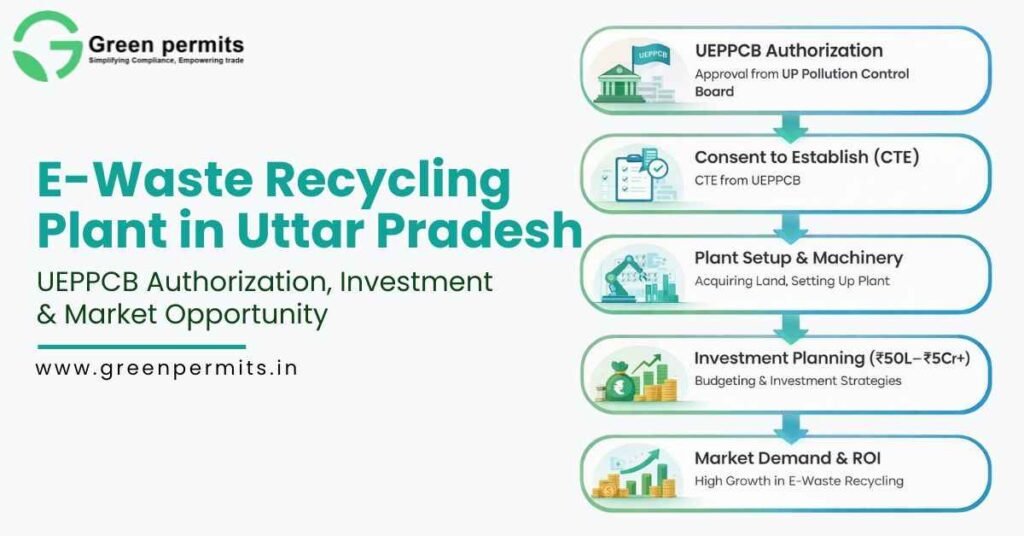
Setting up an e-waste recycling plant is a structured process that typically takes 6 to 9 months.
Step
Authority
Timeline
Documents Required
Risk Area
DPR & planning
Consultant
30–45 days
Project report
Cost error
Consent to Establish
UEPPCB
45–60 days
Land, layout
Delay
CPCB Registration
CPCB
30–45 days
GST, PAN, capacity
Rejection
Plant installation
Internal
60–90 days
Machinery details
Technical issues
Consent to Operate
UEPPCB
30–60 days
Compliance report
Shutdown risk
Key observations
Total approvals involve 2 major authorities
Minimum documentation: 10–15 critical documents
Average delay risk: 15–30 days per stage
Plant Capacity, Layout & Technical Infrastructure
The success of a recycling plant depends heavily on correct capacity planning and infrastructure design.
Ignoring compliance is one of the biggest financial risks in this industry.
Major risks
CPCB registration rejection
Portal suspension
Environmental compensation charges
UEPPCB refusal of Consent to Operate
Customs hold (for imported scrap)
Production shutdown
Legal implications
Penalty under Environment Protection Act, 1986
Financial liability per violation
Possible imprisonment in severe cases
Real-world impact
A delay of just 60 days in approval can result in:
₹10–₹30 lakh operational loss
Idle machinery cost
Staff and maintenance expenses
Real Business Example
A recycler in Greater Noida installed a 5 MT/day plant with ₹6 crore investment. However, due to incorrect reporting of metal recovery percentages and incomplete documentation, CPCB raised queries twice.
Delay: 75 days
Financial loss: ~₹25 lakh
Additional compliance cost: ₹5–₹8 lakh
This highlights how technical accuracy directly impacts business viability.
Market Opportunity & Future Growth (2026–2030)
The next 5 years present strong growth potential.
Market projections
India e-waste expected to reach 3 million tonnes by 2030
Formal recycling share expected to grow from 20% to 50%
Increasing enforcement of EPR targets
Opportunity for recyclers
Long-term contracts with producers
Stable demand for EPR certificates
Expansion into multi-waste recycling (battery, plastic)
Conclusion
Setting up an E-Waste Recycling Plant in Uttar Pradesh in 2026 offers a strong business opportunity, but only for those who approach it with regulatory precision.
Investment ranges from ₹1.5 crore to ₹25 crore
Setup timeline is 6–9 months
Compliance determines operational success
Revenue depends on both recycling efficiency and EPR participation
Businesses that plan documentation early, align plant design with CPCB norms, and understand compliance timelines will reduce risk and improve long-term profitability.