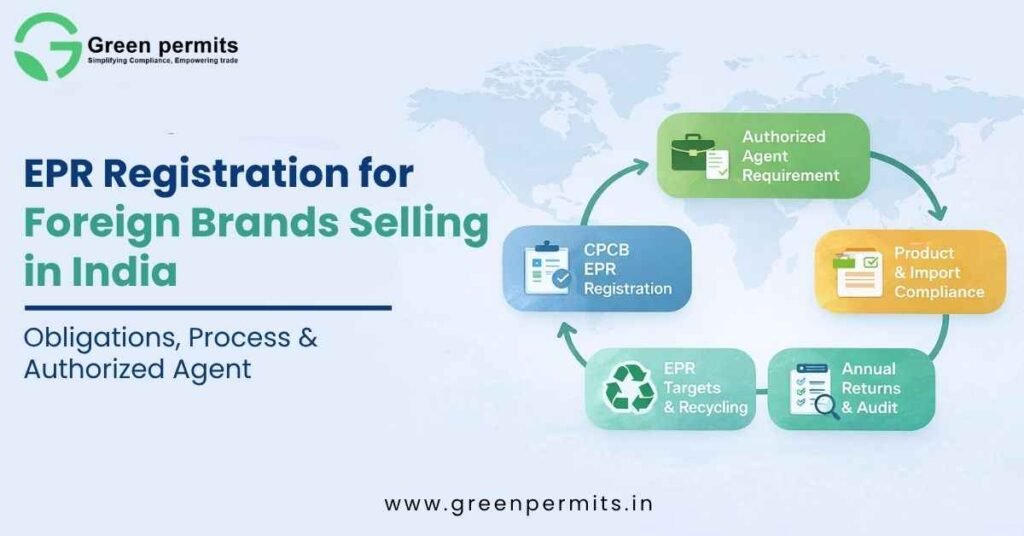
EPR Registration for Foreign Brands Selling in India 2026: Obligations, Process & Authorized Agent
Many foreign brands entering the Indian market assume that selling through distributors or e-commerce platforms eliminates their regulatory responsibility. However, under India’s environmental framework, the moment a product is introduced into the domestic market, the responsibility shifts to the brand owner or importer.
With the 2025 amendments and stricter enforcement expected in 2026, CPCB has moved toward a fully digital, traceable, and target-based EPR system. This means every kilogram of product introduced into India must be accounted for, tracked, and offset through recycling.
For foreign brands, this is not just a compliance requirement—it directly impacts imports, customs clearance, and market access.
What is EPR Registration for Foreign Brands in India
Extended Producer Responsibility (EPR) is a regulatory mechanism where producers are made responsible for the end-of-life management of their products.
For foreign brands, this responsibility applies when:
Products are imported into India
Goods are sold under a brand name in India
Packaging, batteries, or electronics are introduced into the Indian market
Key Compliance Scope
Foreign brands must comply under multiple waste categories:
Plastic packaging waste
E-waste (electronics and electrical equipment)
Battery waste (portable, EV, industrial)
End-of-life vehicles (if applicable)
Practical Insight
If a foreign brand imports 50 MT of packaged goods annually, it must ensure equivalent recycling through EPR compliance.
If 10,000 units of electronics are sold, corresponding e-waste responsibility is calculated based on weight and category.
Core Compliance Requirements
Mandatory CPCB registration before sales
Annual EPR target fulfillment
Quarterly and annual reporting
Purchase of EPR certificates from registered recyclers
Why Foreign Brands Must Comply in 2026
The regulatory landscape has evolved significantly between 2022 and 2025. The focus has shifted from basic registration to strict compliance tracking and digital verification.
Key Changes Applicable in 2026
Mandatory QR/barcode-based traceability on packaging
Centralized CPCB portal integration across all waste streams
Automated target calculation based on sales data
Real-time monitoring of EPR certificate transactions
Numerical Compliance Impact
100% product traceability expected for registered entities
Up to 3–5 times increase in compliance checks compared to 2023
Processing timelines reduced to 30–45 days, but rejection rates increased due to stricter scrutiny
Business Implications
Non-compliance can delay imports by 15–60 days
Incorrect filings may lead to 2–3 month approval delays
Non-registered brands may face complete sales restriction in India
Who is Considered a “Producer” for Foreign Brands
Under Indian EPR rules, the definition of “Producer” is broader than most international regulations.
A foreign entity is treated as a producer if it:
Imports goods into India
Sells products under its brand name
Introduces packaged products into the Indian market
Categories of Producers
Importer-based producer
Brand owner (selling via distributors)
Online marketplace sellers (cross-border)
Example Scenarios
A foreign cosmetics brand selling via Indian distributor → Producer
A Chinese electronics manufacturer selling via Amazon India → Producer
A global battery supplier exporting to India → Producer
Important Note
Even if manufacturing is outside India, liability remains within India
Responsibility cannot be transferred to retailers or marketplaces
EPR Registration Process for Foreign Brands
The registration process is fully digital and managed through CPCB portals.
Step-by-Step Process
Create login credentials on CPCB portal
Select category (Plastic, E-Waste, Battery, ELV)
Fill application in 4–5 sections
Upload mandatory documents
Submit EPR action plan
Pay registration fee
CPCB/SPCB review and approval
Processing Timelines
Application review: 30 working days
Clarification response window: 7 days
Final approval timeline: 30–45 days
Application Sections
General company details
Product and waste category data
Sales and import quantity
Waste generation estimation
EPR fulfillment plan
Documents Required for EPR Registration
Foreign brands must ensure complete documentation before filing to avoid rejection.
Mandatory Documents
GST certificate of Indian entity
PAN of company
IEC (Import Export Code)
CIN (if applicable)
Authorized agent agreement
Product details and specifications
Packaging composition details
Additional Supporting Documents
Consent from SPCB (if manufacturing involved)
Process flow diagram (for producers)
Covering letter and declarations
Practical Insight
Around 40–50% of applications face delays due to incomplete documentation
Incorrect IEC or GST mapping is one of the top rejection reasons
Role of Authorized Agent for Foreign Brands
Foreign brands cannot directly interact with CPCB systems. They must appoint an authorized Indian entity.
Who Can Be an Authorized Agent
Indian subsidiary
Importer
Distributor
Compliance consultant
Responsibilities of Authorized Agent
Filing EPR registration
Maintaining compliance records
Filing quarterly and annual returns
Managing EPR certificate transactions
Handling CPCB communication
Key Compliance Rule
Authorized person must be officially linked with GST and PAN
Third-party consultants cannot be listed as primary authorized persons
Numerical Insight
100% legal liability rests with the authorized agent in India
Non-compliance may lead to penalties exceeding ₹5–25 lakh, depending on scale
EPR Targets & Obligations (Numerical Insight)
EPR obligations are calculated based on quantity introduced into the market.
Example Target Structure
Initial compliance: 8% recycling target
Mid-phase: 13% target
Long-term: 18% and above
Battery Waste Example
If 1,000 kg batteries imported:
Minimum 400–600 kg recycling obligation
Targets depend on battery chemistry and recovery efficiency
E-Waste Example
Metals like copper, aluminum, and iron must be recovered
Recovery targets can reach 100% for certain metals
Key Factors Affecting Targets
Product category
Material composition
Financial year of sale
Recycling infrastructure availability
CPCB Portal Filing & Compliance Timeline
Compliance is not limited to registration. Continuous reporting is mandatory.
Compliance Cycle
Quarterly returns (every 3 months)
Annual return (by 30 June)
Target declaration (by 30 April)
Filing Process
Select reporting period
Validate obligation data
Upload supporting documents
Submit through CPCB portal
Key Risks
Late filing leads to penalties
Incorrect data leads to portal suspension
Missing reports blocks renewal
Compliance Risks & Penalties
Non-compliance has direct financial and operational consequences.
Major Risks
CPCB registration rejection
Suspension of EPR account
Environmental compensation charges
Import clearance delays
SPCB consent denial
Product sales restriction
Legal Exposure
Liability under Environment Protection Act, 1986
Penalties may include:
Monetary fines
Business restrictions
Legal notices
Real Impact
Import shipments can be held for 30–60 days
Compliance failure can increase operational costs by 10–15%
Real Business Scenarios
A European electronics brand faced rejection due to incorrect EPR category mapping. The delay of 45 days resulted in:
Missed festive season sales
Additional logistics cost of ₹8 lakh
Re-submission of entire application
Another battery importer:
Under-reported annual quantity by 20%
Faced additional compliance liability in next financial year
Required purchase of extra EPR certificates
Practical Compliance Checklist for Foreign Brands
To ensure smooth market entry and operations:
Appoint authorized Indian agent before import
Complete CPCB registration before first shipment
Accurately declare product categories
Estimate annual sales and waste generation
Tie up with registered recyclers
Purchase EPR certificates regularly
File returns on time (quarterly + annual)
Conclusion
EPR compliance in India has evolved into a structured, data-driven, and enforcement-heavy system. For foreign brands, this is no longer a procedural requirement—it is a critical business function.
Delays, incorrect filings, or lack of understanding can result in:
Market entry delays
Financial penalties
Supply chain disruption
On the other hand, early and structured compliance ensures: