
Over the past 12 months, one pattern has been consistent across the automotive industry—most OEMs underestimate ELV compliance until they face CPCB queries. What begins as a routine registration quickly turns into a complex exercise involving steel calculations, EPR targets, and certificate procurement.
By the time notices arrive or deadlines approach, teams are forced into reactive compliance, often increasing both cost and operational risk.
In 2026, the Vehicle Scrappage Policy is no longer a policy discussion—it is a time-bound legal obligation backed by environmental law.
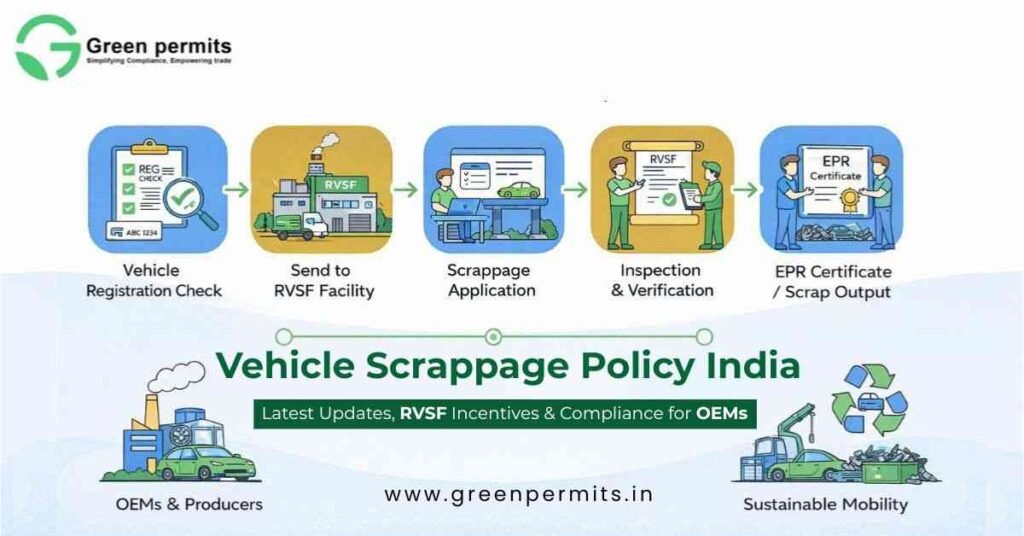
The shift from policy to regulation happened with the introduction of ELV Rules 2025. Before this, scrappage was largely driven by incentives and voluntary participation. Now, it is governed by strict timelines, targets, and reporting obligations.
The most important change is that vehicle manufacturers are now directly responsible for the end-of-life disposal of their products through an Extended Producer Responsibility framework.
For many companies, this means building an entirely new compliance system within their operations.
The ELV Rules apply to multiple stakeholders, but the highest burden lies on producers.
A producer is not just a manufacturer. It includes:
This broad applicability ensures that the entire vehicle lifecycle is regulated—from manufacturing to disposal.
The introduction of measurable targets is one of the most critical aspects of the new framework.
For a manufacturer producing 10,000 vehicles annually:
This means companies must ensure equivalent recycling through RVSFs every year.
Most businesses assume compliance is a paperwork activity. In reality, it is a data-driven operational system.
A delay in even one step can affect the entire compliance cycle.
| Regulation | Key Requirement | Deadline | Applicable To | Risk if Ignored |
|---|---|---|---|---|
| ELV Rules 2025 | Mandatory EPR system | From April 2025 | OEMs, Importers | Legal liability |
| CPCB Registration | Portal registration | Before operation | Producers | Business halt |
| EPR Targets | 8%–18% compliance | Annual | OEMs | Compensation charges |
| EPR Declaration | Annual declaration | 30 April | Producers | Notice issuance |
| Annual Return | Filing obligation | 30 June | Producers | Portal suspension |
This regulatory structure introduces a fixed compliance calendar. Missing deadlines does not just delay compliance—it directly impacts operational continuity and regulatory standing.
Registered Vehicle Scrapping Facilities are not just recyclers—they are compliance partners.
They generate the EPR certificates required by producers to meet targets.
A single medium-sized RVSF can process:
This capacity directly affects certificate availability in the market.
| Step | Authority | Timeline | Documents Required | Risk Area |
|---|---|---|---|---|
| Registration | CPCB | 30–45 days | GST, PAN, CIN | Delay in approval |
| EPR Declaration | CPCB | 30 April | Sales data | Non-compliance notice |
| Certificate Purchase | RVSF | Ongoing | Agreements | Target shortfall |
| Internal Review | Company | Quarterly | Internal data | Data mismatch |
| Annual Filing | CPCB | 30 June | Return forms | Penalty |
Companies must align internal compliance teams with this timeline. A delay of even 30 days can lead to cascading compliance issues across the financial year.
The CPCB portal is the central system managing all ELV compliance activities.
Companies with incomplete applications often face multiple rounds of queries, delaying approval.
The regulatory shift brings real financial and legal exposure.
Under environmental law:
A vehicle OEM in North India delayed EPR declaration due to incorrect steel data reporting.
Outcome:
This highlights how data accuracy directly impacts compliance cost.
While compliance adds pressure, it also opens new opportunities.
The Vehicle Scrappage Policy India 2026 represents a clear shift from incentive-driven policy to enforcement-driven compliance.
Companies that invest early in structured compliance systems will not only reduce risk but also gain long-term operational efficiency.
📞 +91 78350 06182
📧 wecare@greenpermits.in