
The company had valid CPCB registration. Their filings were completed on time and internal teams assumed compliance was under control. However, during a routine audit, CPCB flagged a mismatch between declared sales and EPR certificates purchased. In addition, quarterly returns were filed out of sequence and the annual return lacked mandatory disclosures.
Within a short period, the situation escalated from a documentation issue to a business risk. The company faced immediate system restrictions, financial exposure, and internal operational disruption.
The outcome was not isolated. It reflected how EPR compliance now functions in India – as a system-driven, data-validated regulatory framework where even small gaps can trigger major consequences.
EPR compliance is no longer limited to basic registration or annual filings. It is a structured system where enterprises are responsible for managing the lifecycle of their products even after sale. This includes tracking waste generation, ensuring recycling, and proving compliance through measurable data.
For large enterprises, the complexity increases significantly due to scale. A company operating across multiple product lines and states must manage compliance across different rules simultaneously. Each category has separate reporting formats, timelines, and calculation methodologies.
EPR obligations are not calculated only on current production or sales. Instead, they are based on historical data, often covering 5 to 7 previous financial years. This creates a rolling liability that must be tracked continuously.
In practical terms, a business introducing 10,000 tonnes of material annually may need to track and fulfill obligations across multiple years at the same time. This requires structured systems and accurate data alignment.
EPR compliance has evolved into a strategic function because it directly impacts business continuity. For enterprises with high turnover and large operational footprints, compliance gaps can affect imports, production, and regulatory approvals.
Large organizations typically operate across 5 to 10 states and manage multiple product categories. This creates a multi-layered compliance structure where different teams must coordinate effectively. Finance, operations, legal, and supply chain teams all play a role in ensuring compliance accuracy.
The financial impact is also significant. Certificate procurement, penalty exposure, and delayed compliance can increase operational costs by 20 percent to 40 percent over time.
For example, a company handling 5,000 tonnes of plastic annually may need to plan compliance for increasing targets while managing fluctuating certificate costs.
The regulatory framework for EPR in India operates through multiple rules under the Environment Protection Act, 1986. Each rule addresses a specific waste stream and defines the responsibilities of producers.
Enterprises dealing in electronics, batteries, plastics, or vehicles must comply with respective rules. This creates a scenario where one organization may have to manage 3 to 4 parallel compliance frameworks at the same time.
Each regulation defines how obligations are calculated, how reporting is done, and what penalties apply in case of non-compliance. This makes it essential for enterprises to understand not just the rules but also how they interact with each other.
Compliance is structured in layers. Registration is the first step, followed by obligation calculation, certificate procurement, and reporting. All layers must align to ensure successful compliance.
EPR targets are defined in a phased manner and increase over time. This ensures that producers gradually take responsibility for a higher percentage of the waste generated from their products.
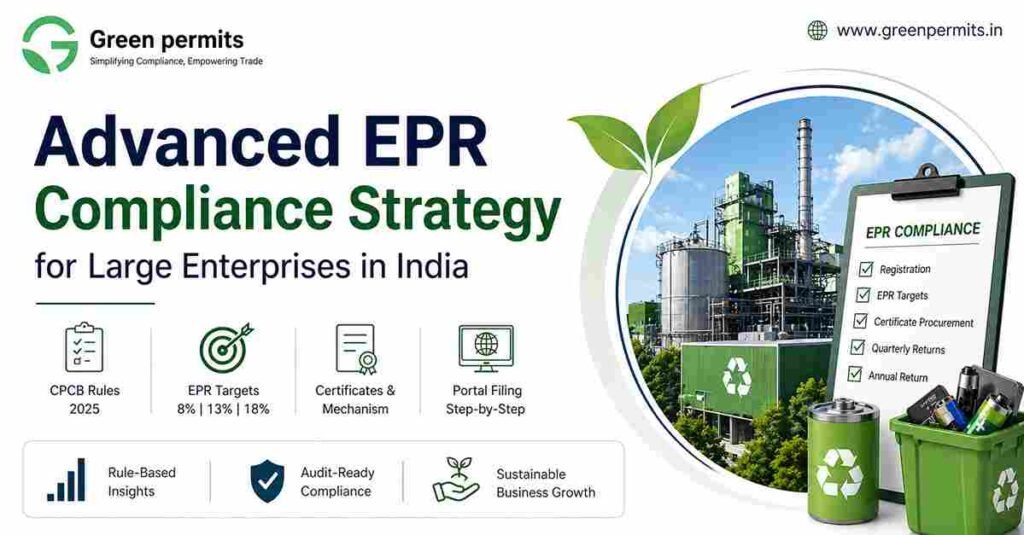
The target structure typically begins at 8 percent and increases to 18 percent over time. These targets are applied to products introduced in earlier financial years, creating a rolling compliance cycle.
This means that even if a company maintains constant sales, its compliance burden will increase due to rising targets. Enterprises must plan for this increase in advance to avoid sudden financial impact.
For example, a company introducing 1,000 tonnes of material annually may initially need to process 80 tonnes. Over time, this requirement can increase to 180 tonnes or more.
The certificate mechanism is the backbone of EPR compliance. Instead of directly recycling waste, producers fulfill their obligations by purchasing certificates generated by authorized recyclers.
These certificates represent the quantity of waste processed and are measured in kilograms. The entire system is designed to ensure traceability and accountability through digital records.
For enterprises, this introduces a new dimension of compliance. Certificate procurement must be planned carefully, taking into account pricing, availability, and vendor reliability.
If certificates are not available at the required time, enterprises may face delays or increased costs. This makes procurement planning a critical part of EPR strategy.
The CPCB portal is the central system through which all EPR compliance activities are executed. It is designed to standardize reporting, ensure transparency, and enable real-time monitoring.
The workflow begins with registration and continues through obligation declaration, return filing, and certificate submission. Each step is interconnected, and delays in one step affect the entire compliance cycle.
Enterprises must ensure that data entered in the portal is accurate and consistent with other records such as GST filings and internal reports. Any mismatch can trigger audit flags.
The portal operates on strict timelines, and there is limited flexibility once deadlines are missed. This requires disciplined internal processes.
Producers are legally responsible for managing the waste generated from their products. This responsibility extends beyond compliance filings to include actual waste management and awareness initiatives.
Enterprises must maintain detailed records of production, sales, and recycling. These records must be available for audit and verification at any time.
Operationally, this requires coordination across departments and alignment of internal systems with compliance requirements. Data accuracy is critical, as errors can lead to rejection or penalties.
Non-compliance with EPR regulations can result in both financial penalties and operational disruption. Enforcement mechanisms have become stricter, with increased monitoring and digital validation.
Penalties are calculated based on the extent of non-compliance and can be substantial for large enterprises. In addition to monetary penalties, operational restrictions can impact business continuity.
Enterprises must treat compliance as a risk management function rather than a routine activity. Preventive measures are more effective than corrective actions.
An enterprise delayed certificate procurement until the final quarter. Due to increased demand, certificate prices rose significantly, and availability became limited.
This resulted in higher compliance cost and partial liability carry forward. The company had to adjust its financial planning and procurement strategy for the next year.
o manage EPR effectively, enterprises must adopt a structured and proactive approach. This involves integrating compliance into business operations and planning for long-term obligations.
A centralized system helps in managing data and ensuring consistency across departments. Forecast-based planning allows enterprises to anticipate obligations and manage costs effectively.
Vendor management is another critical area. Working with reliable and registered recyclers ensures smooth certificate procurement and reduces compliance risk.
Data reconciliation should be done regularly to avoid mismatches during audits. Enterprises should also plan compliance over multiple years to optimize costs and avoid sudden financial impact.
EPR compliance for large enterprises is a complex and evolving process. It requires a combination of regulatory understanding, operational discipline, and strategic planning.
Enterprises that approach compliance proactively can reduce costs, avoid penalties, and ensure smooth operations. On the other hand, delayed or fragmented compliance can lead to financial losses and operational disruptions.
A structured approach with accurate data, timely filing, and strategic planning is essential for long-term compliance success.
📞 +91 78350 06182
📧 wecare@greenpermits.in