
A Delhi-based importer handling electronics shipments worth ₹25 crore per month applied for AEO certification expecting faster clearance and lower inspection rates. Instead, the application stayed under review for over 120 days due to missing SOP documentation and weak compliance mapping.
During this period:
The issue was not eligibility. The issue was applying without a structured understanding of AEO levels and upgrade strategy.
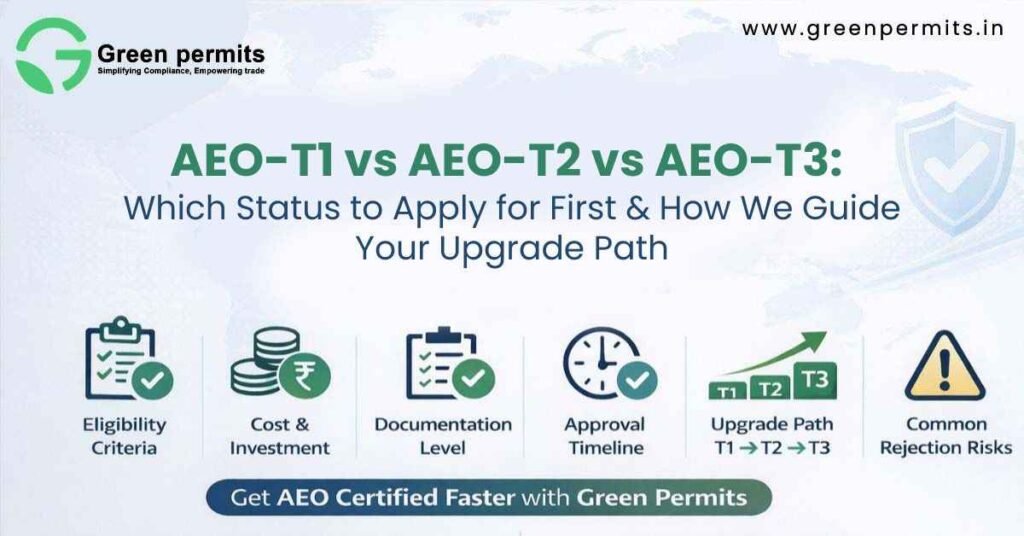
Authorized Economic Operator (AEO) certification is a trust-based program issued by CBIC that recognizes businesses with strong compliance, secure supply chains, and reliable documentation systems. It is designed to reduce customs intervention and improve trade efficiency.
The certification is structured into three levels, each representing a different stage of compliance maturity.
Businesses typically start with T1 and progressively move toward T3 as their compliance systems mature.
AEO is aligned with global standards and enables Indian businesses to benefit from mutual recognition agreements with international customs authorities.
The regulatory environment in India has shifted significantly toward digital compliance and integrated monitoring. Customs clearance is no longer based only on documents but on overall risk profiling of businesses.
Companies with structured compliance systems experience:
At the same time, authorities are increasingly linking customs trust with other compliance areas such as environmental regulations, EPR filings, and supply chain traceability.
Businesses that lack structured compliance face:
This is why AEO certification is moving from a “benefit” to a “necessity” for serious importers and exporters.
| Regulation | Requirement | Timeline | Applicable To | Risk |
|---|---|---|---|---|
| AEO-T1 | Basic compliance verification | 30–60 days | New applicants | Rejection if incomplete |
| AEO-T2 | Process audit and validation | 90–120 days | Growing businesses | Audit failure |
| AEO-T3 | Full system audit and trust certification | 6–12 months | Large corporates | Suspension risk |
AEO certification is not a one-time approval. It reflects how well a business is structured operationally.
T1 validates documents.
T2 validates processes.
T3 validates systems and governance.
Most businesses fail not because they are non-compliant, but because they apply for the wrong level at the wrong time.
| Parameter | AEO-T1 | AEO-T2 | AEO-T3 |
|---|---|---|---|
| Verification Type | Document-based | Process audit | Full system audit |
| Approval Timeline | 30–60 days | 90–120 days | 6–12 months |
| Inspection Rate Reduction | 10–20% | 40–60% | 70–90% |
| Compliance Depth | Basic | Moderate | Advanced |
| Ideal For | MSMEs | Mid-size exporters/importers | Large enterprises |
AEO-T1 works as an entry point, but the real operational benefits begin at AEO-T2.
AEO-T3 is not just a certification. It is a recognition of a fully compliant, low-risk organization.
Key practical insights:
AEO eligibility is based on both financial credibility and operational compliance. Authorities evaluate not just documents but the consistency of business operations over time.
Businesses must demonstrate:
In 2026, compliance expectations have expanded beyond customs.
Companies are increasingly expected to show:
Businesses that maintain structured compliance systems experience faster approvals and smoother audits.
Typical compliance gaps observed:
| Step | Authority | Timeline | Documents | Risk |
|---|---|---|---|---|
| AEO-T1 Application | CBIC | 30–60 days | Basic compliance docs | Rejection |
| Internal Strengthening | Internal | 3–6 months | SOPs, controls | Weak systems |
| AEO-T2 Upgrade | CBIC | 90–120 days | Audit documents | Audit failure |
| AEO-T3 Application | CBIC | 6–12 months | Full system records | Suspension risk |
The correct approach is phased, not direct.
Step 1
Apply for AEO-T1 with complete documentation and zero gaps
Step 2
Strengthen internal compliance systems over 3–6 months
Step 3
Upgrade to AEO-T2 after ensuring audit readiness
Step 4
Move to AEO-T3 only when systems are fully mature
Important execution insights:
Documentation plays a central role in AEO approval. Authorities expect consistency, traceability, and accuracy across all records.
Core documents include:
For businesses linked with regulated sectors, additional compliance documents are often required.
These include:
Practical challenges faced by businesses:
AEO certification comes with continuous compliance responsibility. Failure to maintain standards can lead to immediate operational impact.
Common risks include:
Under environmental laws and regulatory frameworks, non-compliance may also lead to:
Operational consequences are often more severe than penalties because they affect daily business flow.
We treat AEO certification as part of a broader compliance system rather than a standalone approval.
Our approach focuses on:
We also integrate AEO with:
This ensures long-term compliance sustainability, not just approval.
AEO certification is a strategic tool for businesses involved in international trade. However, the benefits depend entirely on how the certification is approached.
Businesses that:
achieve faster clearance, lower costs, and improved global credibility.
Businesses that rush the process face delays, rejections, and operational losses.
A structured and advisory-driven approach is essential for successful AEO certification.
📞 +91 78350 06182
📧 wecare@greenpermits.in