
A lithium-ion battery importer finalizes a ₹1.2 crore shipment for India. The goods reach port, but clearance is stopped due to missing EPR registration. Within the next 30–45 days:
This is now a routine regulatory situation because enforcement is digital, centralized, and increasingly strict.
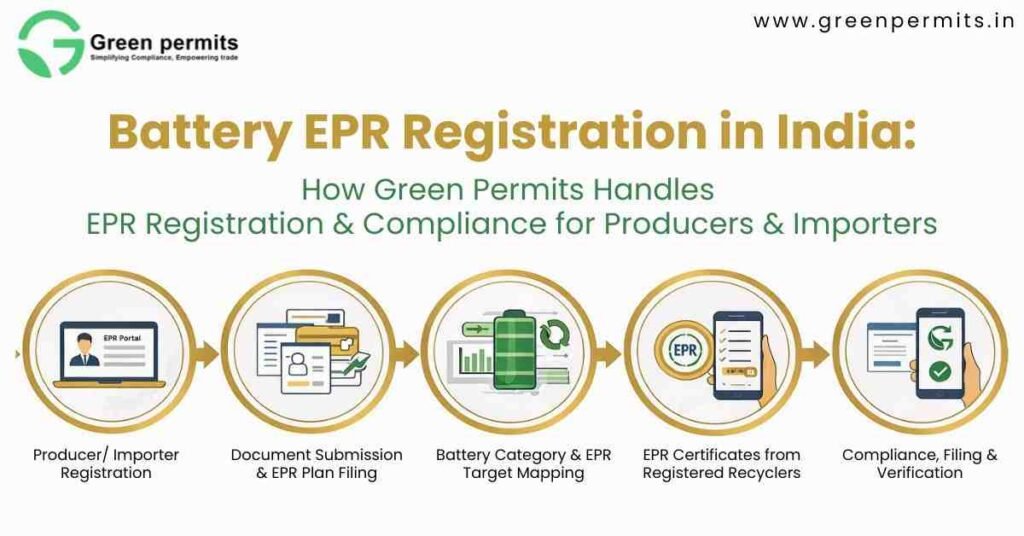
Battery EPR Registration in India is governed by the Battery Waste Management Rules, 2022, with a major amendment introduced in 2025. These rules impose a legal obligation on businesses to manage battery waste through a structured recycling system.
The shift in compliance is significant. Earlier, businesses focused on approvals. Now, compliance is measured through:
For companies dealing in batteries, this is directly linked to business continuity. A delay of even 30–60 days in registration can impact sales cycles, imports, and supply chain commitments.
Battery EPR Registration is a mandatory authorization issued by CPCB that allows companies to legally sell batteries in India while ensuring that they meet recycling obligations.
It is not a one-time process. It is a continuous compliance cycle involving data tracking, target fulfillment, and reporting. Most businesses underestimate this and treat it as a documentation step, which leads to compliance gaps.
The system works on a lifecycle responsibility model. Once a battery is introduced into the market, the producer remains responsible until it is recycled and material is recovered.
From a regulatory perspective, EPR registration connects three layers:
The scope of applicability is broad and covers almost every entity dealing with batteries or battery-operated products.
Manufacturers, importers, and brand owners are all considered producers under the rules. Even if a company is only importing finished goods containing batteries, the obligation still applies.
For example, an electronics importer bringing 10,000 units of battery-powered devices into India automatically becomes liable for EPR compliance.
In practical terms, companies fall into these categories:
The classification depends on business activity, and many companies fall under multiple categories simultaneously.
Key implications include:
The regulatory structure is built under the Environment Protection Act, 1986 and supported by specific waste management rules.
Battery Waste Management Rules, 2022 established the foundation, while the 2025 amendment introduced stricter tracking and accountability measures.
The focus has shifted from intent-based compliance to data-based enforcement. Authorities now track:
This creates a transparent system where non-compliance becomes immediately visible.
Key regulatory requirements include:
| Regulation | Requirement | Deadline | Applicable To | Risk |
|---|---|---|---|---|
| BWMR 2022 | EPR Registration | Before sales | Producers/Importers | Market restriction |
| Amendment 2025 | Barcode + EPR ID | Immediate | All sellers | Penalty |
| CPCB Portal | Return filing | Quarterly + Annual | Registered entities | Suspension |
| EPA 1986 | Enforcement | Continuous | All entities | Legal action |
The regulatory system is designed to ensure that compliance is not optional. Each step is linked to operational permissions such as import clearance, product sales, and environmental approvals.
EPR targets are calculated based on the quantity of batteries introduced into the market in previous financial years. This means that obligations increase as business grows.
For example, if a company sells 100 metric tonnes of batteries in a year, its obligation in subsequent years will be calculated based on that volume.
India follows a progressive compliance structure where targets increase over time. This ensures gradual scaling of recycling infrastructure.
A typical target progression framework includes:
These percentages may vary depending on battery type and category, but the principle remains consistent.
Key compliance points include:
The EPR certificate system is the backbone of compliance. Without understanding this mechanism, businesses cannot meet their obligations effectively.
Instead of physically collecting waste batteries themselves, producers fulfill compliance by purchasing certificates generated by registered recyclers.
The value of these certificates depends on the quantity of metals recovered during recycling. This ensures that compliance is linked to actual recycling output rather than theoretical estimates.
For example:
A producer with an obligation of 500 kg must purchase certificates equal to that quantity.
This creates a structured market where:
Important operational aspects include:
The CPCB portal is the central platform for all EPR activities. It handles registration, tracking, certificate transactions, and return filings.
The process begins with registration, where companies must provide detailed information about their operations. Any mismatch in data can lead to rejection or delay.
After registration, the system assigns obligations based on declared data. Companies must then track their compliance through the portal.
The workflow typically follows this sequence:
One critical requirement is that quarterly returns must be filed in sequence. Missing one quarter can block the entire compliance cycle.
Key risks in portal handling include:
| Step | Authority | Timeline | Documents | Risk |
|---|---|---|---|---|
| Registration | CPCB | 30 days | GST, PAN, CIN | Rejection |
| Query Response | CPCB | 7 days | Clarifications | Delay |
| Quarterly Filing | CPCB | Every 3 months | Sales data | Portal block |
| Annual Return | CPCB | Once a year | Full compliance data | Penalty |
The timeline is strict and system-driven. Even a delay of 10–15 days can disrupt the entire compliance cycle.
The documentation process is straightforward but requires accuracy. Most delays occur due to incorrect or incomplete submissions.
Companies must prepare:
Consistency across all documents is critical. Even minor mismatches in company name or address can result in rejection.
Return filing is one of the most sensitive parts of compliance. Authorities use these filings to verify whether obligations are being met.
Quarterly returns provide ongoing tracking of:
Annual return acts as final verification and includes additional requirements such as awareness initiatives.
Companies often face issues in:
Key filing requirements include:
Non-compliance is no longer limited to warnings. It has direct financial and operational consequences.
Regulatory authorities can impose penalties under the Environment Protection Act, 1986. These penalties can be significant depending on the scale of violation.
Typical consequences include:
In many cases, companies experience delays ranging from 60 to 120 days, which impacts revenue cycles and market positioning.
Case 1 – Import Delay
A company importing EV batteries without registration faced a delay of 90 days. The shipment remained at port, and additional compliance cost increased by ₹18 lakh.
Case 2 – Certificate Shortfall
A manufacturer failed to purchase sufficient certificates. The shortfall was carried forward, increasing next year’s liability by 25 percent.
Case 3 – Filing Error
Incorrect quarterly filing led to portal lock. The company required 20 days to resolve the issue, delaying further compliance activities.
Battery EPR compliance involves multiple moving parts, including regulatory interpretation, documentation, and continuous tracking.
Businesses often struggle due to lack of clarity on targets, certificates, and portal workflows.
Green Permits approaches compliance through a structured system:
This reduces approval timelines and minimizes the risk of rejection or penalty.
Battery EPR Registration in India is directly linked to business operations. It affects imports, manufacturing, and market access.
The 2025 amendment has made compliance more data-driven and enforceable. Authorities now rely on digital tracking rather than manual verification.
Businesses that plan compliance early benefit from:
Delays, on the other hand, lead to financial loss, operational disruption, and regulatory exposure.
📞 +91 78350 06182
📧 wecare@greenpermits.in