
A lithium-ion battery recycler invests ₹12 Crores to establish a 25 MT/day plant expecting operations to begin within 6 months. Machinery is installed, manpower is recruited, and supplier contracts are signed. However, the CPCB application gets rejected due to incorrect EPR linkage and missing SPCB consent details. The plant remains idle for nearly 120 days, resulting in monthly fixed costs of ₹8–12 lakhs and loss of business opportunities.
This is not an isolated case. Battery recycling in India is regulated through a strict compliance ecosystem where even a small documentation gap can delay approvals by 60–90 days.
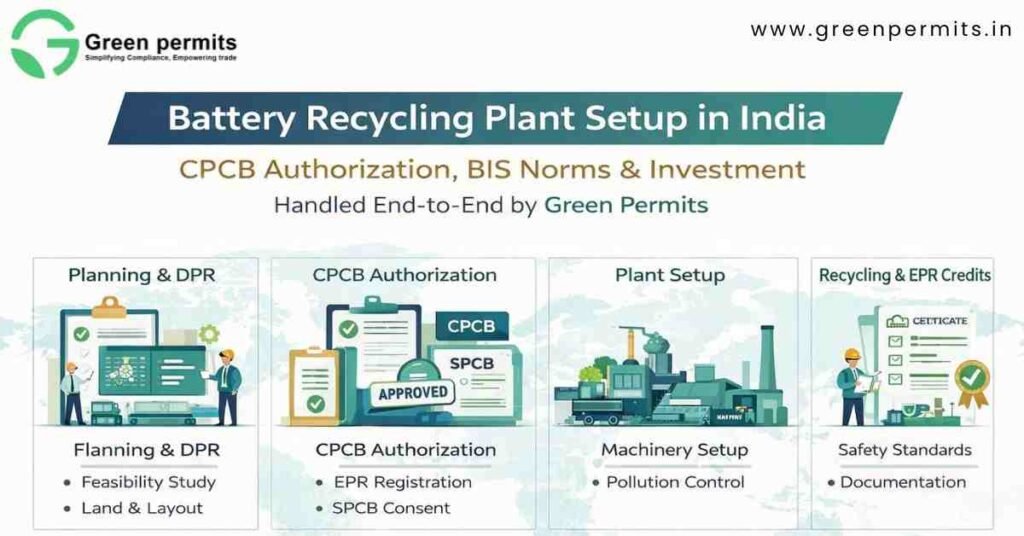
Battery recycling plant setup in India is governed under the Battery Waste Management Rules, 2022, along with the 2025 amendment. These rules operate under the Environment Protection Act, 1986 and introduce a structured system of Extended Producer Responsibility.
The regulatory environment has evolved rapidly in the last 2–3 years. Today, a recycling plant is not just a manufacturing unit. It is a compliance-driven business model where approvals, EPR certificate generation, and reporting are interconnected.
For businesses entering this sector, success depends on how well they align plant setup with CPCB registration, SPCB approvals, and EPR obligations from day one.
Battery recycling operations are governed by multiple laws and regulatory bodies. These rules define how waste batteries are collected, processed, and reported through centralized systems.
The framework is designed to ensure environmental protection, traceability, and accountability. Regulators now focus on data verification, recovery efficiency, and compliance tracking instead of only physical inspections.
| Regulation | Requirement | Timeline | Applicable To | Risk |
|---|---|---|---|---|
| Battery Waste Management Rules 2022 | EPR compliance and recycling obligation | Annual | Producers & recyclers | Penalty |
| Battery Waste Amendment 2025 | Barcode-based traceability | Immediate | Producers | Product rejection |
| Environment Protection Act 1986 | Legal compliance | Continuous | All entities | Legal action |
| SPCB Consent (CTE/CTO) | Operational approval | Before operation | Recyclers | Shutdown |
The regulatory system ensures that every kilogram of battery sold in the market is eventually accounted for through recycling.
Extended Producer Responsibility is the central mechanism of battery waste management. It shifts the responsibility of recycling from the government to producers.
Producers are required to ensure that a defined quantity of batteries is recycled every year. This obligation is fulfilled by purchasing EPR certificates from registered recyclers.
From a business perspective, this creates a structured demand for recycling services.
A producer selling 10,000 kg of lithium-ion batteries in a financial year must ensure equivalent recycling through EPR certificates. If the metal composition is 5 percent lithium, the obligation is calculated accordingly.
This makes compliance measurable and enforceable.
EPR creates a direct revenue stream for recyclers. The more efficient the recycling process, the higher the certificate generation.
The EPR certificate system is based on actual recovery of battery materials. It is not estimated or assumed. It is calculated based on measurable output.
This ensures transparency and prevents over-reporting.
EPR certificates are issued based on the weight of key metals recovered during recycling.
For example:
Certificate generated = 50 kg
The value of certificates depends on market demand and supply.
The certificate mechanism directly affects profitability.
CPCB registration is mandatory before starting any recycling operation. Without it, the plant cannot legally operate.
The registration process is documentation-heavy and requires accurate data submission.
Each stage requires validation, and incorrect data leads to delays.
The approval process typically takes 30–45 working days. However, if queries are raised, it can extend to 60–90 days.
The CPCB portal is the central system for all compliance activities. Every recycler and producer must use this platform for reporting and certificate management.
The system is designed to ensure complete transparency.
The filing system follows a strict sequence.
Many businesses face issues due to lack of understanding of the portal system.
Setting up a battery recycling plant requires both technical planning and environmental compliance.
The scale of the plant determines investment, land, and infrastructure requirements.
The recycling process involves multiple steps to ensure safe extraction of metals.
Environmental compliance is critical for approval.
Battery recycling plant investment varies significantly based on capacity and technology.
A small-scale plant may require ₹2–5 Crores, while a large facility can go beyond ₹30–50 Crores.
The business model depends on two major revenue sources.
Return on investment depends on efficiency and compliance.
| Step | Authority | Timeline | Documents | Risk |
|---|---|---|---|---|
| Feasibility study | Internal | 30 days | DPR | Delay |
| SPCB Consent to Establish | SPCB | 60–90 days | Layout | Rejection |
| Plant installation | Internal | 90–180 days | Machinery | Cost overrun |
| CPCB Registration | CPCB | 30–45 days | Application | Delay |
| SPCB Consent to Operate | SPCB | 30–60 days | Compliance report | Shutdown |
The total project timeline ranges between 6 to 12 months depending on approvals and execution speed.
The 2025 amendment introduced traceability through barcode or QR code linked to EPR registration.
This ensures that every battery can be tracked from production to recycling.
Non-compliance in battery recycling can lead to serious consequences.
The regulatory system is now strict and data-driven.
Businesses may face action under environmental laws.
Battery recycling plant setup in India requires a structured approach combining technical planning and regulatory compliance. The system is now driven by data, traceability, and accountability.
Businesses that invest in proper documentation, efficient technology, and compliance systems achieve faster approvals and stable operations.
On the other hand, delays and errors can lead to financial loss, penalties, and operational shutdown. The difference between success and failure in this sector lies in how early and accurately compliance is handled.
📞 +91 78350 06182
📧 wecare@greenpermits.in