
A Delhi-based importer planned to launch a new range of smart home devices including Wi-Fi cameras and smart plugs. Inventory worth ₹42 lakh arrived at Nhava Sheva port, marketing campaigns were already live, and distributor commitments were in place.
However, customs stopped clearance due to absence of BIS CRS registration.
The consequences were immediate and measurable. The shipment remained stuck for 28 days, demurrage charges crossed ₹3.8 lakh, and the product launch was delayed by over 40 days. In addition, the importer had to rework packaging and documentation to comply with BIS marking rules.
This is not an isolated case. In 2025 alone, a significant number of electronics shipments faced delays due to missing CRS compliance, especially in the IoT segment where regulatory understanding is still evolving.
IoT products are growing at over 18–22 percent annually in India, but regulatory compliance has not kept pace with market expansion. One of the biggest misconceptions is that IoT devices fall under a separate regulatory category.
In reality, IoT devices are governed under existing electronics regulations. The Compulsory Registration Scheme (CRS), notified under the Electronics and IT Goods Order, mandates that certain electronic products must be registered with BIS before they are manufactured, imported, or sold in India.
This means that compliance is not optional or post-market. It is a pre-condition for entry into the Indian market.
For businesses, this directly impacts supply chain planning, product launch timelines, and import strategy. A delay of even 15–20 days can disrupt entire distribution cycles and lead to financial losses.
Key implications for businesses:
The regulatory structure for IoT devices in India is layered and requires careful interpretation. Most businesses fail because they treat BIS as a standalone requirement, whereas it is part of a broader compliance ecosystem.
The BIS CRS framework is enforced under the BIS Act, 2016, and implemented through MeitY notifications. These notifications define which categories of electronic products require mandatory registration.
IoT devices are indirectly covered under these notified categories based on their electrical and functional characteristics. For example, a smart speaker is treated as an electronic device under CRS, not as an IoT product.
Additionally, multiple authorities may be involved depending on the device configuration. A Wi-Fi enabled product may require both BIS and WPC approval, while electronics also fall under EPR obligations.
This layered compliance structure increases complexity but also increases enforcement.
Key regulatory components:
One of the most common questions from manufacturers and importers is whether their specific IoT product requires BIS registration. The answer depends on the product’s electrical functionality and its classification under notified CRS categories.
In India, more than 60+ product categories are already notified under CRS. A large portion of consumer IoT devices fall within these categories.
Devices such as smart lighting systems, CCTV cameras, routers, and display panels are clearly covered. Even if the device is marketed as “smart” or “connected,” its compliance requirement is determined by its hardware classification.
In contrast, purely software-driven IoT platforms or non-electrical sensors may not require BIS registration, but such cases are limited.
Businesses must carefully map their product specifications to notified categories to avoid misclassification.
Common IoT devices requiring BIS CRS:
Devices typically outside CRS scope:
The BIS CRS process starts with product testing, which is a mandatory step before application submission. Without a valid test report from a BIS-recognized laboratory, the application cannot proceed.
Testing typically takes 10 to 15 days depending on product complexity. The product must meet the relevant Indian Standard (IS code) applicable to its category.
Once testing is completed, the report is submitted on the BIS portal along with company documentation. BIS then reviews the application and may raise queries if any discrepancies are found.
On average, the complete certification process takes between 20 to 45 days. However, in cases of incorrect documentation or test failure, the timeline can extend beyond 60 days.
Key compliance metrics:
Major risks during certification:
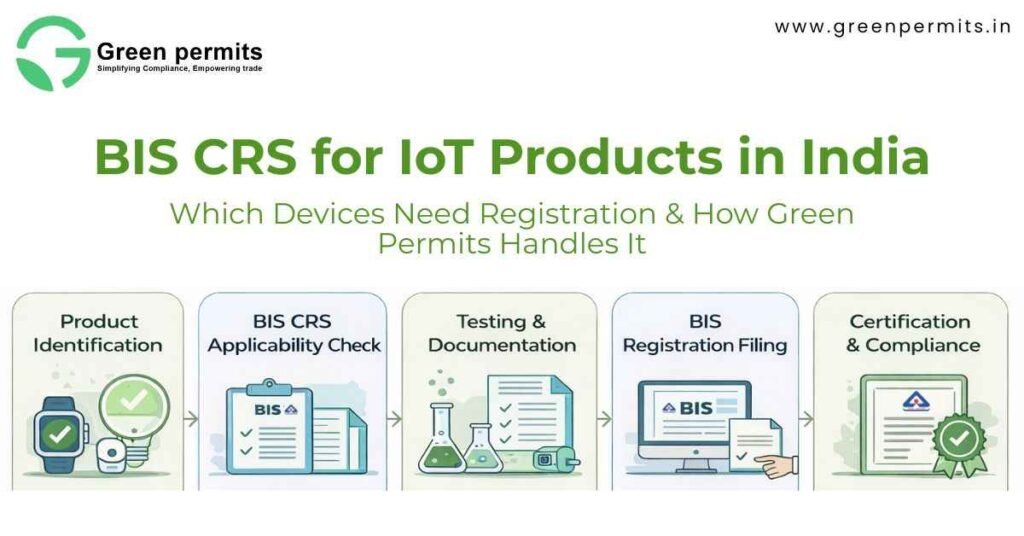
The BIS CRS process requires structured execution. Many applications get delayed or rejected due to incomplete understanding of the workflow.
The first step is identifying the correct product category and applicable IS standard. This is critical because incorrect classification leads to rejection.
Next, the product must be tested in a BIS-recognized laboratory. Once the test report is obtained, the applicant must register on the BIS portal and submit the application.
The application includes company documents such as GST, PAN, IEC (for importers), and incorporation certificates. After submission, BIS reviews the application and issues the Registration Number (R-number) upon approval.
The R-number must be printed on product packaging and labeling before sale.
Step-wise process:
Foreign manufacturers face additional compliance requirements when entering the Indian market. BIS mandates the appointment of an Authorized Indian Representative (AIR).
The AIR acts as the legal entity responsible for compliance in India. This includes handling documentation, responding to BIS queries, and ensuring adherence to regulations.
Many businesses make critical mistakes at this stage, such as appointing distributors instead of authorized representatives or submitting incomplete documentation.
These errors often lead to delays of 20 to 30 days and, in some cases, application rejection.
Key requirements for foreign manufacturers:
IoT devices rarely require only BIS compliance. In most cases, multiple approvals are needed depending on product features.
For example, a Wi-Fi enabled smart device will require WPC approval for wireless communication. Similarly, electronics fall under EPR obligations for end-of-life waste management.
This means businesses must plan compliance in an integrated manner rather than treating each approval separately.
Failure to align these approvals leads to operational bottlenecks and regulatory risk.
Typical compliance stack for IoT devices:
Non-compliance with BIS CRS can have immediate and long-term consequences. Regulatory enforcement has increased significantly in 2025 and 2026, especially for imported electronics.
Customs authorities are now actively verifying BIS registration numbers during clearance. Any mismatch or absence of certification leads to shipment detention.
In addition, e-commerce platforms are increasingly requiring compliance documentation before listing products. Non-compliant products are being removed from marketplaces.
From a legal standpoint, violations can attract penalties under environmental and product safety laws, including fines and operational restrictions.
Major risks businesses face:
A mid-sized importer dealing in smart home devices failed to obtain BIS certification before importing a new product line. The shipment was held at port for 22 days, leading to ₹2.6 lakh in additional costs and cancellation of distributor orders.
In another case, a startup launching wearable IoT devices faced test failure due to incorrect design parameters. The redesign and re-testing process delayed the product launch by 35 days.
A third example involves an online seller whose listings were removed from major e-commerce platforms due to missing BIS certification. Monthly revenue loss exceeded ₹8 lakh.
These scenarios highlight that compliance is not just a regulatory requirement but a business-critical function.
Businesses must approach BIS CRS compliance as part of product planning rather than as a post-production activity.
Early identification of compliance requirements helps reduce delays and ensures smoother market entry. It also allows businesses to align multiple approvals such as BIS, WPC, and EPR in a structured manner.
Proper documentation and testing preparation can reduce approval timelines by 30 to 40 percent and minimize rejection risk.
Recommended action steps:
BIS CRS compliance for IoT products is now a fundamental requirement for doing business in India. With increasing enforcement and digital tracking, non-compliance is no longer manageable through workarounds.
The cost of compliance is relatively controlled, typically ranging between ₹50,000 to ₹1.5 lakh depending on product complexity. In contrast, the cost of non-compliance can exceed ₹5 lakh due to delays, penalties, and lost revenue.
Businesses that invest in structured compliance processes gain a clear advantage in terms of faster product launches, smoother imports, and long-term scalability.
Early compliance is not just about avoiding penalties. It is about building a reliable and scalable business in a regulated market.
📞 +91 78350 06182
📧 wecare@greenpermits.in