
A mid-sized electronics importer in Delhi recently ordered 8,000 units of mobile chargers from overseas. The shipment reached Nhava Sheva port, but customs clearance was stopped because the products were not registered under BIS CRS. What followed was a 21-day delay, additional demurrage charges of nearly ₹6-8 lakh, and urgent testing costs.
Situations like this are becoming increasingly common as enforcement has tightened.
BIS CRS Registration in India is governed under the Electronics & IT Goods (Requirement of Compulsory Registration) Order, 2012 along with the BIS Act, 2016. It is a mandatory compliance requirement for manufacturers and importers dealing with notified electronic products.
For businesses, this is not just certification. It directly impacts whether your product can legally enter and operate in the Indian market.
The Compulsory Registration Scheme was introduced to ensure product safety, consumer protection, and quality standards across the electronics sector. Over the last decade, the scope has expanded significantly.
As of 2025, more than 75 product categories are covered, and enforcement is strictly linked with import clearance and market surveillance.
The regulation clearly states that no manufacturer, importer, or brand owner can sell, store, or distribute notified products without BIS certification. This requirement applies regardless of company size, whether it is a startup importing 500 units or a large manufacturer producing 50,000 units per month.
The certification is always product-specific, meaning each model and variant must be registered separately. This becomes critical for businesses dealing with multiple SKUs.
In practical terms, BIS CRS acts as a gatekeeper for the Indian electronics market. Without it, products cannot move beyond warehouses or ports.
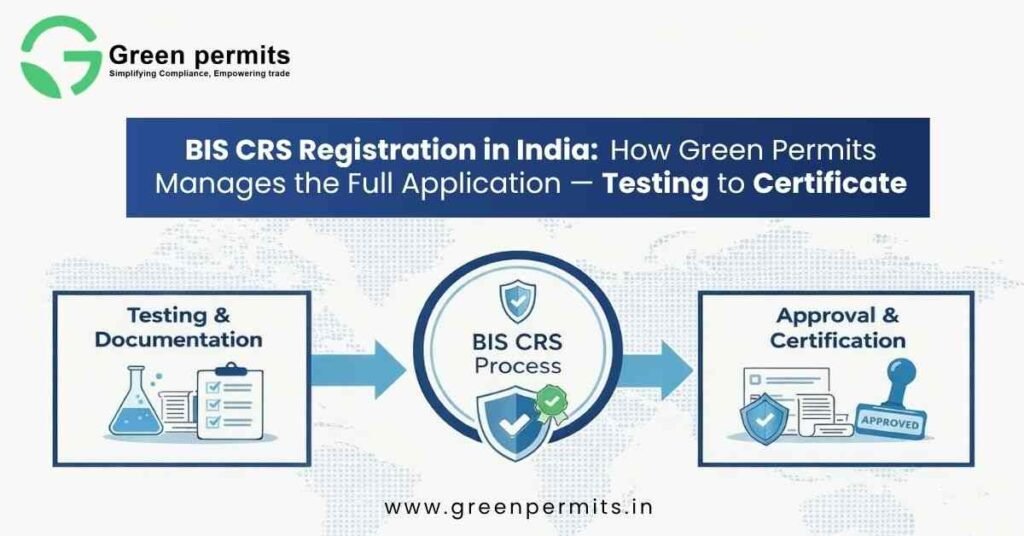
The BIS CRS process appears straightforward, but execution complexity lies in documentation accuracy and technical alignment. A typical approval cycle ranges between 30 to 60 days when done correctly.
Testing is the first and most critical stage. Products must be tested in BIS-recognized laboratories to ensure compliance with applicable Indian Standards such as IS 13252 or IS 10322.
The testing process evaluates electrical safety, performance parameters, and design conformity. Any mismatch between product design and test report can result in rejection at a later stage.
In most cases, companies underestimate the importance of selecting the correct standard and lab, which leads to re-testing and delays.
Once the product passes testing, the application is filed on the BIS CRS portal. This step involves uploading detailed information about the product, manufacturer, and supporting documents.
This stage is highly sensitive because even minor inconsistencies can trigger queries. For example, mismatch in model number formatting or incomplete authorization letters are common reasons for delays.
A properly structured application ensures faster processing and reduces back-and-forth with authorities.
After submission, BIS reviews the application. The scrutiny phase is where most delays occur due to documentation gaps or technical inconsistencies.
BIS may raise queries related to product details, test results, or authorization. Applicants are required to respond within a strict timeline, usually 7 working days.
Failure to respond within this window can lead to rejection, forcing the applicant to restart the process.
Once approved, BIS issues a unique registration number known as the R-number. This number is essential for product labeling and legal sale.
At this stage, the business can begin importing, manufacturing, or selling the product in India. However, compliance does not end here. Post-certification marking rules must be strictly followed.
| Regulation | Requirement | Deadline | Applicable To | Risk |
|---|---|---|---|---|
| BIS Act, 2016 | Mandatory certification | Before sale/import | Manufacturers & Importers | Legal penalty |
| CRS Order, 2012 | Product registration | Pre-market | Electronics sector | Market ban |
| BIS Portal SOP | Online filing | Immediate | All applicants | Rejection/delay |
The regulatory framework clearly establishes BIS CRS as a pre-condition for doing business in the electronics sector.
Documentation plays a decisive role in approval timelines. Most rejections happen due to incomplete or incorrect submissions rather than technical failure.
Businesses must ensure that all documents are aligned, consistent, and properly formatted. Even small errors like mismatch in company name across PAN and GST can delay approvals.
The documentation process also reflects operational credibility of the applicant, which is evaluated during scrutiny.
| Step | Authority | Timeline | Documents | Risk |
|---|---|---|---|---|
| Testing | BIS Lab | 15 to 25 days | Samples, specs | Failed test |
| Application | BIS Portal | 2 to 5 days | Documentation | Rejection |
| Review | BIS | 20 to 30 days | Clarifications | Delay |
| Certification | BIS | Immediate | Final approval | Compliance gap |
In real-world cases, businesses that manage documentation correctly complete the process within 35 to 45 days, while others may face delays exceeding 90 days.
Many companies assume BIS CRS is a simple documentation exercise, but errors at early stages often cascade into major delays.
Incorrect classification of product category is one of the most common mistakes. This leads to testing under the wrong standard, making the entire process invalid.
Another frequent issue is mismatch between test report and final product. Even minor changes in components can result in rejection.
Non-compliance with BIS CRS can have direct financial and operational consequences. Authorities have increased enforcement, especially at ports and during market inspections.
Products without BIS certification can be seized, and companies may face legal action under applicable laws.
For importers, the risk is immediate, as customs clearance is directly linked to BIS compliance.
A Bangalore-based startup imported 2,500 smart devices without BIS certification. The shipment was held for 14 days, resulting in ₹4 lakh in additional logistics costs.
In another case, a manufacturer tested products under an incorrect standard. The application was rejected, and retesting delayed market launch by 45 days.
Documentation errors are also common. Missing IEC or incorrect authorization can lead to repeated queries and 2 to 3 weeks delay.
These situations highlight how small compliance gaps can create significant business impact.
Green Permits approaches BIS CRS registration as a structured compliance project rather than a documentation task.
The process begins with correct product classification and standard identification, ensuring that testing is done under the right parameters. Lab coordination is handled efficiently to avoid delays.
Documentation is prepared in alignment with BIS expectations, reducing the chances of queries. During scrutiny, all communication with BIS is managed proactively to ensure timely approvals.
BIS CRS Registration in India is a critical compliance requirement that directly determines whether a product can enter and operate in the market.
Businesses that delay or ignore this requirement face shipment delays, financial losses, and regulatory action. On the other hand, companies that approach certification strategically can reduce timelines, avoid rework, and ensure smooth operations.
With increasing regulatory enforcement and expansion of product categories, BIS CRS compliance is no longer optional. It is a core part of business planning for manufacturers and importers in India.
📞 +91 78350 06182
📧 wecare@greenpermits.in