
A Noida-based electronics brand importing LED panels recently faced a compliance breakdown that cost them nearly ₹32 lakh in delayed shipments and penalties.
The issue was not lack of documentation. It was a mismatch between:
Their CPCB application was marked “query raised,” and since the response was delayed beyond 7 working days, the application moved toward rejection.
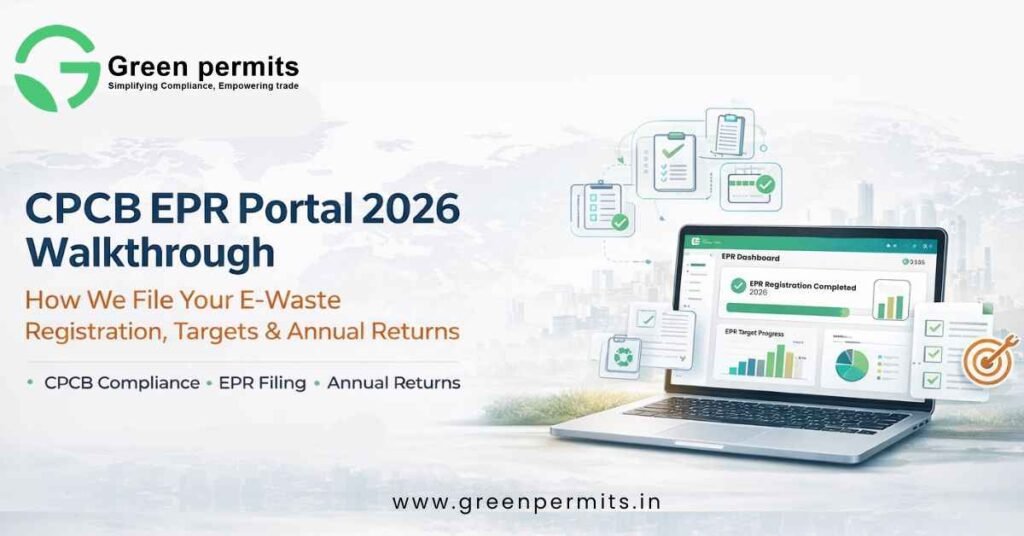
This is exactly how most companies fail—not because they ignore compliance, but because they don’t understand how the CPCB EPR portal actually works.
The CPCB EPR portal is now a central compliance backbone for all producers dealing with electrical and electronic equipment in India. It is not just a registration system—it is a live tracking mechanism for waste accountability.
Since the enforcement of the E-Waste (Management) Rules, 2022 from 1 April 2023, every producer is required to:
The system is designed in such a way that non-compliance becomes visible instantly, both to CPCB and State Pollution Control Boards.
For example, if a company introduces 10,000 units of electronic equipment in a financial year, the portal automatically calculates its recycling obligation. Failure to match this with EPR certificates leads to compliance gaps.
In practical terms, this directly affects:
The applicability of EPR is wider than most businesses assume. It is not limited to manufacturers—it extends across the entire supply chain.
Any entity introducing electrical or electronic equipment into the Indian market must register, including those operating in multiple roles.
If a company is both importing and branding products, it must often file separate registrations for each category, which is where most compliance errors begin.
Additionally, the rules strictly prohibit:
This creates a closed-loop compliance ecosystem.
The CPCB portal process is structured but highly detail-sensitive. Even a minor mismatch in data fields can delay approvals by 15–45 days.
The process begins with creating login credentials using:
Once registered, credentials are generated instantly, but actual compliance begins only after application submission.
The application is divided into multiple sections, typically 4–5 structured modules:
Each section must align internally. For example, if your declared production is 500 MT annually, your EPR plan must reflect equivalent recycling capacity.
Documents must be uploaded in specific formats and sizes. Any mismatch leads to portal queries.
Mandatory documents include:
CPCB reviews applications within 30 working days. If any discrepancy is found:
Failure to respond within this timeline often results in rejection or reprocessing.
Once approved:
EPR compliance is not just about registration—it is about meeting quantified recycling obligations.
Targets are calculated based on:
For example:
If a company sells 1,000 MT of electronic goods annually, its EPR obligation may require equivalent recycling or certificate purchase based on material recovery.
The CPCB system uses a certificate-based mechanism, where:
In early years, some materials have phased targets. For instance:
This phased approach reflects India’s current recycling capacity limitations.
Return filing is one of the most critical and commonly mishandled parts of EPR compliance.
The portal requires both quarterly tracking and annual reporting, ensuring continuous monitoring.
Quarterly returns are sequential. This means:
These returns include:
Annual return is mandatory and significantly more detailed. It includes:
The submission window typically falls between:
If returns are not filed correctly:
| Regulation | Requirement | Deadline | Applicable To | Risk |
|---|---|---|---|---|
| E-Waste Rules 2022 | EPR Registration | Before operation | Producers | Business halt |
| CPCB Portal System | Return Filing | Annual cycle | All entities | Penalty |
| EPR Certificates | Target Fulfillment | Financial Year | Producers | Compensation |
| EP Act 1986 | Legal Enforcement | Ongoing | All | Legal action |
The regulatory framework is tightly integrated. Registration, targets, and returns are not separate—they are interconnected compliance layers.
| Step | Authority | Timeline | Documents | Risk |
|---|---|---|---|---|
| Registration | CPCB | 30 days | GST, PAN, IEC | Delay |
| Query Response | CPCB | 7 days | Clarifications | Rejection |
| Target Compliance | Recycler | Annual | Agreements | Shortfall |
| Return Filing | CPCB | FY end | Reports | Penalty |
Even a single delay in this timeline can cascade into operational issues.
Non-compliance under EPR is not treated lightly. The system is structured to enforce accountability at multiple levels.
If a company fails to comply, it may face:
Under Section 15 of Environment Protection Act, 1986, penalties can include:
Most compliance failures happen due to lack of structured execution. The process requires alignment between legal, operational, and technical data.
Green Permits manages this end-to-end:
This reduces approval time, eliminates rejection risk, and ensures full compliance visibility.
The CPCB EPR portal has transformed environmental compliance into a data-driven, continuously monitored system.
For businesses, the choice is simple:
Companies that align early:
In today’s environment, compliance is no longer optional—it is operational infrastructure.
📞 +91 78350 06182
📧 wecare@greenpermits.in