
A mid-sized electronics importer in Mumbai secured an Import Export Code (IEC) within 2 days and started importing LED components worth ₹1.2 crore. However, the shipment was held at customs for 18 days.
The reason was not DGFT. It was missing environmental compliance under EPR.
The business faced:
This is now a common situation. In 2025–2026, DGFT approval is only the first step. Real compliance begins after that.
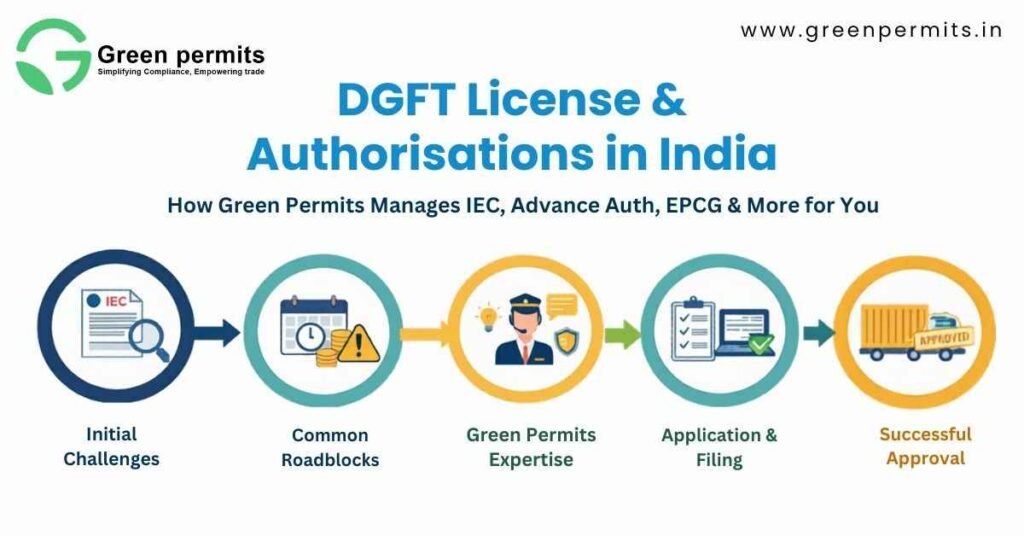
DGFT (Directorate General of Foreign Trade) regulates India’s import-export ecosystem under the Foreign Trade Policy and the FTDR Act, 1992. Every business engaged in international trade must comply with DGFT licensing requirements.
However, regulatory enforcement has changed significantly. Today, DGFT approvals are directly linked with environmental and operational compliance frameworks.
Businesses must now align three layers:
Ignoring any one layer increases the risk of rejection, delay, or penalty.
DGFT licenses are government authorisations that allow businesses to legally import or export goods. The most critical license is the Import Export Code.
Without DGFT authorization, no business can legally:
In practical terms, over 95% of cross-border trade transactions require IEC validation at customs level.
DGFT also ensures that restricted goods, hazardous materials, and regulated products are monitored through licensing.
IEC is a 10-digit unique identification number issued by DGFT. It is mandatory for all importers and exporters in India.
The approval process is digital and usually completed within 1 to 3 working days if documents are correct.
IEC does not require renewal, but incorrect details can lead to suspension.
Common issue: Around 20–25% of applications face delays due to PAN-GST mismatch.
Advance Authorization allows duty-free import of raw materials that are used in manufacturing export products.
This scheme is widely used by industries such as textiles, chemicals, and electronics.
The export obligation is strictly monitored and must be completed within a defined timeline.
EPCG scheme allows import of machinery at reduced or zero customs duty to boost export production.
The scheme is suitable for manufacturing businesses planning capacity expansion.
The export obligation is usually 6 times the duty saved, spread over 6 years.
Apart from IEC, AA, and EPCG, businesses may require additional approvals depending on product category.
These include restricted item licenses, SCOMET approvals, and export incentives registration.
In earlier years, DGFT approvals and environmental compliance operated separately. That is no longer the case.
Today, regulatory systems are interconnected.
For example:
This means DGFT approval alone does not guarantee business continuity.
In many cases, businesses lose 10–20% of shipment value due to compliance delays.
| Regulation | Requirement | Deadline | Applicable To | Risk |
|---|---|---|---|---|
| FTDR Act | IEC mandatory | Before import/export | All traders | Shipment hold |
| FTP Policy | Authorization compliance | Before transaction | Exporters | License rejection |
| EPR Rules | Environmental registration | Before sale/import | Importers | CPCB penalty |
| SPCB Norms | Pollution approvals | Before operation | Manufacturers | Plant shutdown |
| Waste Rules | Recycling compliance | Ongoing | Producers | Legal liability |
These regulations are interconnected. Missing one compliance can impact the entire business operation.
The DGFT process is digital but requires accuracy. Even small errors can delay approvals by 7 to 15 days.
Approximately 30% of applications require correction before approval.
| Step | Authority | Timeline | Documents | Risk |
|---|---|---|---|---|
| IEC Registration | DGFT | 1–3 days | PAN, GST | Delay in trade |
| Authorization | DGFT | 7–30 days | Application forms | Export delay |
| EPR Registration | CPCB | 15–30 days | GST, IEC | Shipment hold |
| Quarterly Filing | CPCB | Every quarter | Sales data | Portal rejection |
The timeline is critical because approvals must align. If IEC is approved but EPR is delayed, business operations get blocked.
After DGFT approval, many businesses must register on CPCB portals for environmental compliance.
This includes:
Filing must follow a strict sequence. Missing one quarter can block future submissions.
Companies that fail to maintain data face repeated rejections.
Non-compliance is no longer a minor issue. It directly impacts revenue and operations.
In extreme cases, businesses face operational shutdown.
Green Permits handles compliance as a complete system rather than isolated approvals.
The focus is on integrating DGFT with environmental and operational approvals.
This reduces rejection risk by more than 60% based on industry experience.
DGFT licensing is no longer a standalone regulatory requirement. It is part of a broader compliance ecosystem that includes environmental approvals and reporting obligations.
Businesses that treat DGFT as a one-time process often face:
On the other hand, structured compliance ensures:
Early planning and correct documentation are now essential for business continuity.
📞 +91 78350 06182
📧 wecare@greenpermits.in
Book a Consultation with Green Permits