
A mid-sized electronics importer acquires a smaller brand to expand its distribution network across 5 states. The acquisition closes in March, just before the financial year ends. By June, when annual EPR returns are filed, the company faces rejection from the CPCB portal.
The reason is not operational, financial, or legal documentation. The issue is purely compliance-related. The company assumed that EPR certificates and obligations would automatically transfer after acquisition.
In reality, EPR compliance in India is not designed around ownership. It is designed around legal entity, registration, and historical market introduction data.
This gap between business transactions and regulatory compliance is where most companies face delays, penalties, and operational disruptions.
EPR compliance is governed under multiple rules, including:
These regulations operate under the Environment Protection Act, 1986, which makes compliance legally binding. Non-compliance can result in financial penalties, operational restrictions, and even prosecution.
EPR obligations are calculated based on the quantity of products introduced in the market during previous financial years. This means that liability is not dependent on who owns the company today, but on what was sold earlier.
In practical terms, a company introducing 1,000 tonnes of plastic packaging in FY 2024-25 may have an EPR obligation of 8 percent in FY 2025-26, which translates to 80 tonnes of recycling compliance.
This obligation continues regardless of acquisition, restructuring, or ownership change.
Key compliance characteristics include:
Many businesses assume that EPR certificates and EPR liability are interchangeable. They are not.
EPR liability refers to the legal obligation of a producer to manage waste generated from its products. This is calculated based on sales or import data and defined targets such as 8 percent, 13 percent, and 18 percent across different time periods.
EPR certificates, on the other hand, are compliance instruments generated by registered recyclers based on actual recycling output. These certificates are measured in kilograms or tonnes and are used to offset liability.
The distinction becomes important during acquisition.
This means a company may acquire assets, brands, or operations, but it cannot assume that certificates will automatically align with the new entity.
Key differences include:
India’s EPR ecosystem is structured across multiple waste streams, each governed by specific rules but following a common compliance mechanism.
The E-Waste Management Rules, 2022 introduced a centralized digital system for tracking obligations and certificates. The Battery Waste Management Rules, amended in 2025, further strengthened traceability by linking certificates to metal recovery.
The Plastic Waste Management Rules mandate registration and annual return filing for Producers, Importers, and Brand Owners. The newly introduced End-of-Life Vehicle Rules, 2025 extend EPR obligations to automobile manufacturers with defined recycling targets.
Across all these frameworks, three elements remain consistent:
Failure to comply under these rules can trigger penalties under Section 15 of the Environment Protection Act, which includes fines and legal action.
The impact of acquisition on EPR compliance depends entirely on how the transaction is structured.
In a share purchase, the ownership of the company changes, but the legal identity remains the same. The GST, CIN, and CPCB registration continue unchanged.
In this case, EPR compliance remains intact. Certificates, liabilities, and portal records continue without interruption.
In an asset purchase, the acquiring company takes over operations, assets, or brand rights, but not the legal entity itself.
This creates a compliance break.
The new entity must:
At the same time, the old entity remains responsible for past liabilities, including pending returns and unmet targets.
In mergers, two entities combine into one, either by forming a new company or absorbing one into another.
This requires CPCB portal updates and regulatory approval.
The process typically involves:
Without proper transition, filings can be rejected due to mismatch in entity records.
There is no explicit provision under Indian regulations that allows direct transfer of EPR certificates from one legal entity to another.
Certificates are generated based on recycling activity and are tagged to the entity that procures them through the CPCB portal.
This creates a structural limitation.
Even if a company acquires another business, it cannot simply use its certificates unless the legal entity remains unchanged or CPCB approves modifications.
In practical terms:
This is one of the most overlooked compliance risks in mergers and acquisitions involving regulated industries.
The CPCB portal is the backbone of EPR compliance in India. Any ownership or structural change must be reflected here.
The process typically involves updating or re-registering the entity.
Steps include:
Supporting documents usually include:
Processing timelines can range from 15 to 30 working days depending on completeness of application.
EPR compliance operates on strict annual and quarterly timelines that do not change due to acquisition.
Key deadlines include:
If acquisition happens mid-year, the new entity must still align with these timelines without delay.
Failure to meet deadlines can result in:
Improper handling of EPR during acquisition can create both immediate and long-term risks.
Regulatory risks include:
Operational risks include:
Legal risks include:
In some cases, businesses have faced compliance costs exceeding 10 to 15 percent of their annual operational expenditure due to delayed corrections.
One company acquiring a plastic packaging business continued using the previous entity’s certificates without updating CPCB records. Their annual return was rejected, and they had to procure fresh certificates worth several lakhs.
Another case involved delayed registration after acquisition, resulting in a 3-month compliance gap. During this period, the company could not legally sell products in certain states.
In a third scenario, the acquiring company failed to conduct due diligence and inherited undisclosed EPR liabilities of over 200 tonnes, leading to significant environmental compensation.
These examples show that EPR compliance is not just a regulatory requirement but a financial and operational risk factor.
EPR targets are defined in a phased manner across waste categories.
These targets are calculated based on previous financial year sales or imports.
For example, a company selling 500 tonnes of electronic equipment may need to ensure recycling of 40 tonnes in the initial phase, increasing to 90 tonnes as targets scale up.
This makes long-term planning critical, especially during acquisition.
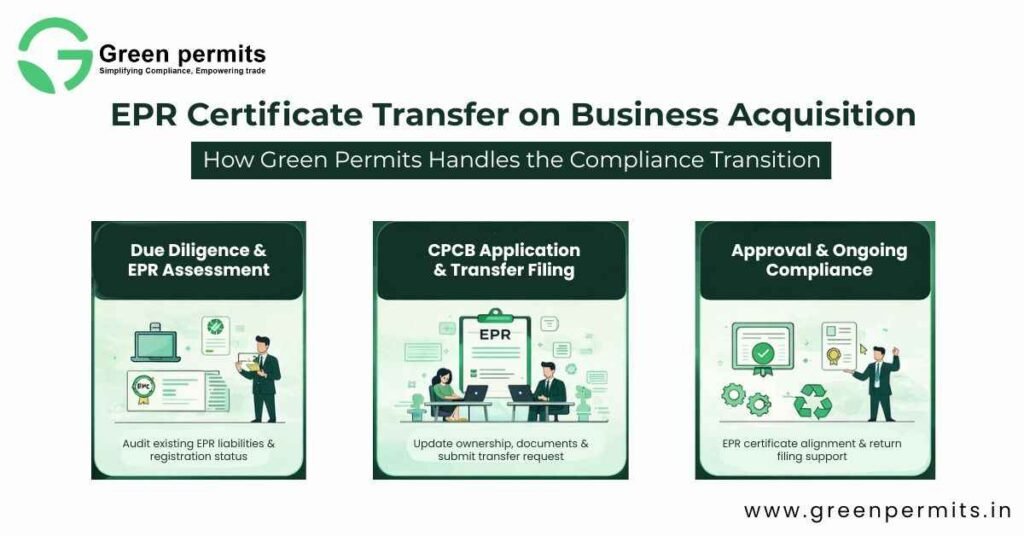
A structured approach can prevent most compliance issues during acquisition.
Before acquisition:
During acquisition:
After acquisition:
Companies that plan this transition in advance typically reduce compliance risks by more than 60 percent.
EPR compliance in India is deeply integrated with legal identity, regulatory filings, and digital tracking systems. It is not designed to automatically adapt to business transactions such as mergers or acquisitions.
EPR certificates cannot be treated as transferable assets in most cases. Liability remains tied to historical sales, and compliance must be aligned with the correct legal entity.
Businesses that ignore this distinction often face delays, penalties, and operational disruptions.
On the other hand, companies that approach acquisition with a structured compliance strategy can ensure smooth transitions, avoid regulatory issues, and maintain uninterrupted operations.
📞 +91 78350 06182
📧 wecare@greenpermits.in