
An EV startup imports lithium-ion battery packs worth ₹2.5 crore for domestic assembly. The products are ready for distribution, but within weeks, dealers begin asking for CPCB EPR registration proof. Without it, the company cannot legally place batteries in the market.
The result is immediate business impact:
This situation highlights a recurring issue across EV and battery businesses in India. Most companies do not clearly understand who is legally classified as a Producer and how their EPR liability is calculated.
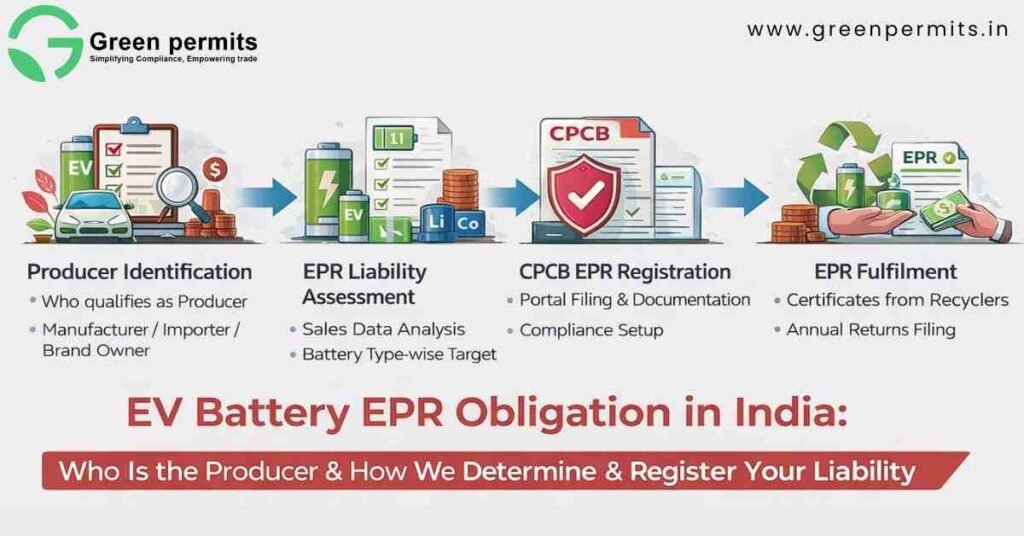
India’s battery ecosystem is no longer lightly regulated. With the rapid growth of EV adoption, the government has implemented strict Extended Producer Responsibility under the Battery Waste Management Rules, 2022 and its 2025 amendment.
India is expected to generate more than 2 lakh metric tonnes of lithium-ion battery waste annually by 2030. This scale of waste has forced regulators to shift from general compliance to a data-driven, traceable and enforceable system.
For businesses, this means EPR compliance is directly linked to:
Companies that delay compliance often face higher costs later due to penalties, backlog obligations and operational disruption.
Key regulatory expectations include:
The definition of Producer is intentionally broad to ensure full accountability across the supply chain. Many businesses assume only manufacturers are liable, but the law clearly extends responsibility beyond manufacturing.
A Producer is any entity that introduces batteries into the Indian market, either directly or indirectly.
| Category | Example | Liability Level |
|---|---|---|
| Manufacturer | EV OEM assembling vehicles | Full EPR obligation |
| Importer | Importing lithium-ion battery packs | Full EPR obligation |
| Brand Owner | Selling batteries under own brand | Full EPR obligation |
| Private Label Seller | Outsourced manufacturing with own branding | Full EPR obligation |
In real business scenarios, a single company can fall into multiple categories. For example, an EV company importing battery packs and selling under its own brand will carry dual compliance responsibility.
This classification is critical because incorrect identification leads to under-reporting and future penalties.
EPR liability is triggered the moment a battery enters the Indian market ecosystem. It does not depend on whether the battery is used, sold or stored.
The trigger points include:
The liability is calculated using a combination of operational and technical parameters:
For example, a company introducing 5,000 kg of lithium-ion batteries in FY 2025-26 will have a defined EPR obligation linked to recovery targets over subsequent years.
EPR compliance for EV batteries is fundamentally different from traditional waste management. It is based on material recovery rather than total waste volume.
This makes the system more scientific but also more complex for businesses.
The obligation is calculated based on the recovery of specific metals present in the battery.
For lithium-ion batteries, the key metals include lithium, cobalt, nickel and copper. Each metal has a percentage composition in the battery, and the obligation is derived accordingly.
Consider a company that imports 10,000 kg of lithium-ion batteries:
This means the company must ensure that recyclers recover an equivalent quantity of lithium and generate certificates for compliance.
The government has adopted a metal-based approach because:
The 2025 amendment has made compliance more strict and traceable. The focus has shifted from reporting to real-time monitoring.
These changes have practical implications:
Businesses now need to treat EPR as part of product design and supply chain planning, not just regulatory filing.
All EPR compliance activities are managed through the CPCB centralized portal. Understanding the workflow is essential for avoiding delays and errors.
| Regulation | Requirement | Deadline | Applicable To | Risk |
|---|---|---|---|---|
| Battery Waste Rules 2022 | EPR Registration | Before market entry | Producers | Sales restriction |
| Amendment Rules 2025 | QR code traceability | Immediate | All producers | Product rejection |
| CPCB Filing | Quarterly and annual returns | Ongoing | Registered entities | Portal suspension |
| EPA 1986 Section 15 | Penalty provisions | Continuous | All entities | Financial penalty |
This framework shows that compliance is directly linked to business continuity. Missing even one requirement can disrupt operations.
| Step | Authority | Timeline | Documents | Risk |
|---|---|---|---|---|
| Registration | CPCB | 15 to 30 days | GST, PAN, IEC, CIN | Rejection |
| Obligation Declaration | CPCB | By 30 April | Sales data | Non-compliance |
| Quarterly Returns | CPCB | Every quarter | Operational data | Filing block |
| Annual Return | CPCB | By 30 June | Certificates and reports | Penalty |
Preparing documentation in advance reduces delays and rejection risk.
Key documents include:
Incomplete or incorrect documents are one of the top reasons for rejection.
Recyclers play a central role in the EPR ecosystem. They are responsible for processing waste batteries and generating certificates.
Non-compliance is no longer a minor issue. It has direct financial and operational consequences.
Under Section 15 of the Environment Protection Act, 1986:
A company imports EV batteries worth ₹1 crore without CPCB registration. The products are held at the distributor level.
Result:
A manufacturer calculates obligation based on total battery weight instead of metal composition.
Result:
A company skips one quarterly return.
Result:
Despite clear rules, businesses face challenges due to:
EV Battery EPR compliance is now directly linked to business operations. It affects imports, sales, regulatory approvals and long-term sustainability goals.
Companies that act early benefit from:
On the other hand, delayed compliance leads to higher costs, penalties and operational disruptions.
📞 +91 78350 06182
📧 wecare@greenpermits.in
Book a Consultation with Green Permits