
A manufacturer applies for BIS certification assuming approval in 30–40 days. Instead, the application gets delayed beyond 90 days due to failed lab testing and incomplete factory readiness.
This situation is not rare. In fact, a large number of Indian manufacturers face delays because they treat ISI certification as a documentation exercise, whereas it is actually a technical compliance process involving inspection, testing, and regulatory validation.
The impact is immediate. Production timelines get disrupted, shipments are delayed, and in some cases, products cannot legally enter the market.
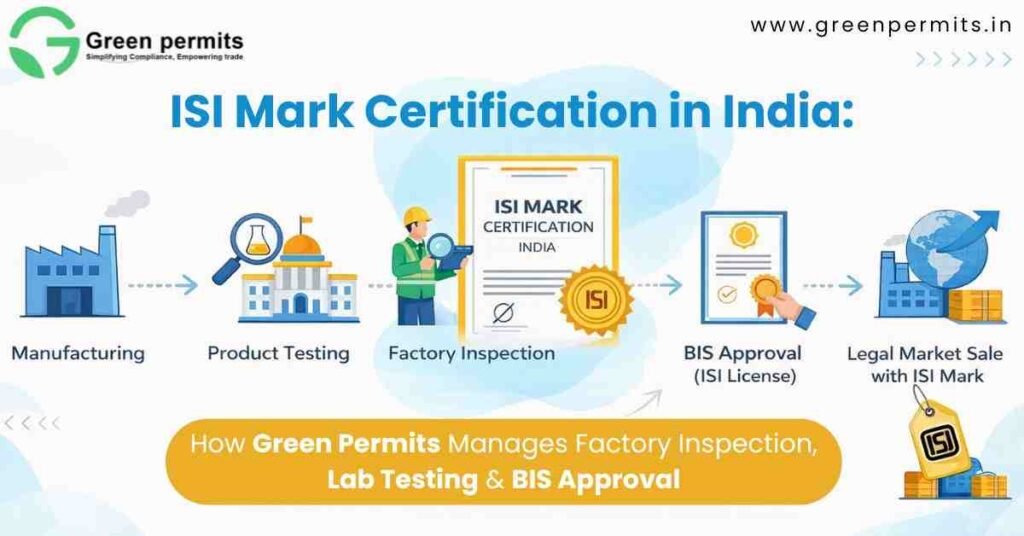
ISI Mark Certification in India operates under the Bureau of Indian Standards (BIS) Act, 2016, supported by BIS Rules and Conformity Assessment Regulations. It is enforced through Quality Control Orders (QCOs) issued by various ministries.
As of 2025–2026, more than 400+ product categories require mandatory BIS certification, covering sectors such as steel, electrical appliances, chemicals, and construction materials.
This makes certification not just a regulatory formality but a market entry requirement. Without BIS approval, products cannot be legally manufactured, sold, or imported.
ISI Mark Certification ensures that a product complies with a specific Indian Standard (IS Code). It is issued under Scheme-I, which applies to both domestic and foreign manufacturers.
For manufacturers, this certification validates product quality, safety, and consistency. For regulators, it ensures that only compliant products are allowed in the market.
This requirement applies across industries where safety, performance, and public use are involved.
The BIS certification process follows a structured regulatory flow. Each stage has its own technical and compliance requirements, and delays in one stage directly impact the entire timeline.
The overall process typically takes 45 to 120 days, depending on readiness and compliance level.
The certification process begins with submitting an application on the BIS portal. This step requires accurate technical and business information about the product and manufacturing unit.
At this stage, many applications fail because businesses select the wrong IS standard or submit incomplete documentation.
The application must clearly define the product scope, manufacturing process, and compliance framework.
Once submitted, BIS reviews the application for completeness and correctness. This is a technical validation stage where the authority checks whether the product falls under the declared standard.
This stage usually takes 7–15 days, but delays occur if deficiencies are identified.
Applicants must respond quickly to avoid rejection or delay.
Factory inspection is one of the most decisive stages in the entire process. BIS officials visit the manufacturing unit to verify whether it is capable of producing compliant products.
This is not just a physical visit but a technical audit of the manufacturing ecosystem.
The inspection evaluates whether the declared process is actually being followed in production.
After inspection, product samples are collected and sent for testing in BIS-approved or NABL-accredited laboratories. This stage ensures that the product meets all parameters defined in the IS standard.
Testing typically takes 20–45 days, depending on product complexity.
Even minor deviations can lead to failure, requiring re-testing and additional time.
Once testing is successful, BIS grants the certification license and allows the use of the ISI mark. This marks the completion of the approval process.
The final approval usually takes 15–30 days after successful testing.
However, any unresolved issues in earlier stages can delay this step significantly.
BIS certification is not a one-time process. Regular surveillance is conducted to ensure ongoing compliance with standards.
This includes inspections, sample testing, and audit checks.
Manufacturers must maintain consistent quality to retain certification.
| Regulation | Requirement | Deadline | Applicable To | Risk |
|---|---|---|---|---|
| BIS Act 2016 | Mandatory certification | Before sale | Manufacturers | Product ban |
| BIS Rules 2018 | Inspection & testing | During process | Applicants | Rejection |
| QCO Orders | Mandatory ISI mark | Immediate | 400+ products | Market restriction |
| EPA 1986 | Penalty provision | Ongoing | All units | Financial penalty |
This framework shows that certification is legally enforced and non-compliance directly impacts business operations.
| Step | Authority | Timeline | Documents | Risk |
|---|---|---|---|---|
| Application | BIS | 7–15 days | Company docs | Rejection |
| Inspection | BIS | 15–30 days | Factory setup | Delay |
| Testing | BIS/NABL | 20–45 days | Samples | Failure |
| Approval | BIS | 15–30 days | Complete file | Delay |
The timeline highlights how each stage contributes to the overall approval period.
Factory inspection is where BIS validates real operational capability. It is not limited to documentation but includes actual verification of systems and processes.
The inspection ensures that the manufacturer can consistently produce products that meet IS standards.
Many businesses underestimate this stage and prepare only partially.
Lab testing is a decisive stage where compliance is technically proven. If the product fails, the entire process may need to be repeated.
This leads to additional cost and time delays, affecting business operations.
Testing failures are often due to raw material issues or inconsistent production quality.
Failure to obtain or maintain BIS certification exposes businesses to serious risks. These risks are both regulatory and operational.
Authorities can take strict action under existing laws, including penalties and product restrictions.
Under Section 15 of the Environment Protection Act, penalties and legal action may also apply
BIS certification is closely linked with environmental and operational compliance. In many cases, approvals such as SPCB consent and waste management compliance are required alongside BIS.
Regulatory systems in India are increasingly integrated through online portals and structured documentation.
This makes compliance a multi-layered requirement rather than a single approval.
ISI Mark Certification in India is a structured regulatory process that demands technical accuracy and operational readiness. It is not just about filing documents but about aligning manufacturing, testing, and compliance systems.
Businesses that approach certification strategically can reduce timelines and avoid costly delays.
Those that do not often face rejection, penalties, and operational disruption.
📞 +91 78350 06182
📧 wecare@greenpermits.in
Book a Consultation with Green Permits