
A lithium-ion battery recycler invests ₹25 crore into a 20 MT/day facility expecting steady returns from EPR certificates and metal recovery. The machinery is installed, trial runs are completed, and procurement contracts are in place. However, the project faces a critical delay of 4 months because the CPCB rejects the application due to incomplete hazardous waste compliance and improper process documentation.
During this delay, the company incurs a monthly loss of ₹20-30 lakh in fixed operational expenses while also losing potential EPR revenue. This situation highlights a fundamental truth in this industry – success depends less on machinery and more on compliance precision and regulatory sequencing.
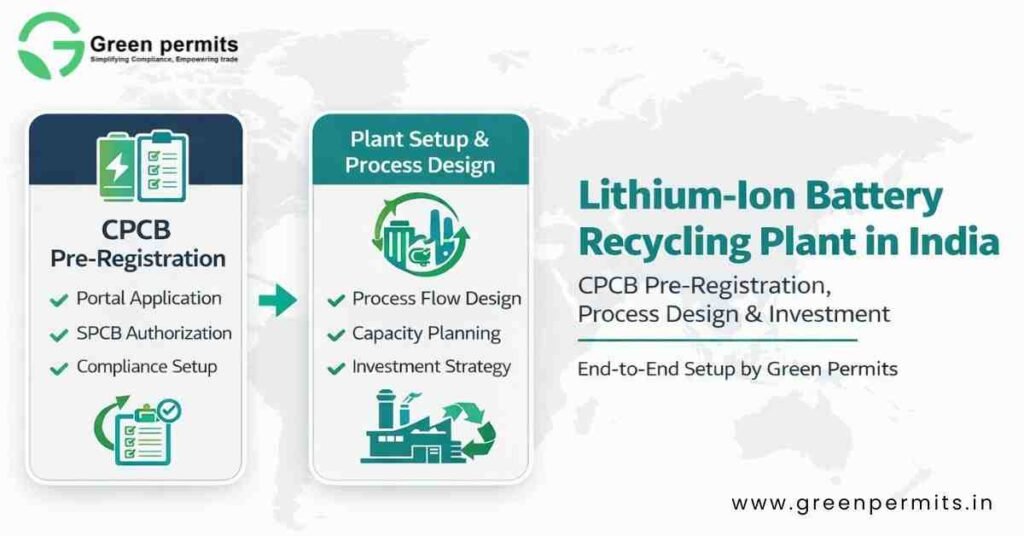
Lithium-ion battery recycling in India is rapidly emerging as a high-potential industrial segment due to the exponential growth in electric vehicles, renewable energy storage, and consumer electronics. India is expected to generate more than 2 lakh tonnes of lithium-ion battery waste annually by 2030, creating a significant opportunity for recycling infrastructure.
However, unlike traditional manufacturing businesses, a Lithium-Ion Battery Recycling Plant in India operates within a tightly regulated compliance ecosystem. The entire business model is governed by the Battery Waste Management Rules, 2022, along with its 2025 amendment, and enforced under the Environment Protection Act, 1986.
What makes this industry unique is that revenue is not directly linked to processing volume alone. It is linked to verified recovery, CPCB approvals, and EPR certificate generation.
Key fundamentals every business must align from day one:
The regulatory structure governing lithium-ion battery recycling is layered and interconnected. A recycling plant must comply simultaneously with CPCB, SPCB, and environmental regulations, each addressing different operational risks.
At the core lies the Extended Producer Responsibility framework, where producers must ensure end-of-life recycling of batteries. Recyclers act as execution partners and generate compliance certificates.
Lithium-ion batteries are categorized as hazardous waste due to their chemical composition. This classification requires strict adherence to storage, transportation, and disposal norms.
From a business perspective, approvals are not parallel but sequential. Missing even one approval can delay the project by 3-6 months.
The revenue model of a Lithium-Ion Battery Recycling Plant in India is fundamentally driven by the EPR ecosystem. This creates a structured demand for recycling output rather than raw processing.
Recyclers generate EPR certificates based on actual recovery of metals such as lithium, cobalt, nickel, and copper. These certificates are then sold to producers who must meet their regulatory obligations.
In practical terms, revenue depends on how efficiently the plant converts waste into recoverable material.
Even a 10% drop in efficiency can reduce revenue by 10-15%, making process optimization critical.
Setting up a lithium-ion recycling plant involves more than installing machinery. It requires structured planning across land, utilities, process design, and environmental compliance.
A medium-scale plant typically requires 3-5 acres of land, divided into operational zones for safe and efficient functioning.
The recycling process involves multiple stages, each contributing to recovery efficiency and compliance.
Environmental infrastructure is equally important.
A plant may be technically sound but still get rejected if environmental compliance is weak.
The approval process follows a structured and time-bound sequence. Each step builds on the previous one, making sequencing critical.
A typical project goes through company setup, SPCB approvals, hazardous authorization, and finally CPCB registration.
In practice, projects take 90-150 days when executed properly, but delays can extend timelines to 6 months.
The CPCB portal is the backbone of compliance management. It controls registration, certificate generation, and reporting.
Once registered, recyclers must continuously upload operational data and track recovery.
Accuracy in documentation is critical because the portal validates every submission.
Post-registration compliance is continuous and structured. Recyclers must file quarterly and annual returns through the CPCB portal.
Quarterly filings are sequential, meaning skipping one filing blocks the entire chain.
Compliance should be treated as an operational function, not an administrative task.
The financial investment required depends on plant capacity and technology.
Hidden costs such as delays and re-approvals can significantly impact financial outcomes.
Non-compliance in lithium-ion recycling has direct and severe consequences. Regulatory authorities have the power to shut down operations and impose penalties.
Early compliance is one of the biggest differentiators in this industry. Businesses that align regulatory requirements during planning avoid delays and build faster execution timelines.
Delayed compliance leads to operational inefficiencies, capital blockage, and missed market opportunities.
A Lithium-Ion Battery Recycling Plant in India is not just an industrial investment but a compliance-driven business ecosystem. Technical capability alone is not sufficient to ensure success.
The projects that succeed are those where:
In this industry, the difference between success and failure is not the size of investment but the accuracy of compliance execution.
📞 +91 78350 06182
📧 wecare@greenpermits.in