
A mid-sized electronics manufacturer planned to scale production by importing components worth ₹80 crore annually under the MOOWR scheme. The financial model showed a clear advantage – nearly ₹12 crore in deferred duty and improved cash flow.
But the reality turned different.
Due to incomplete warehouse documentation and delayed CPCB registration, their first shipment was held at customs for 28 days. Production schedules collapsed, vendor commitments were missed, and working capital got locked.
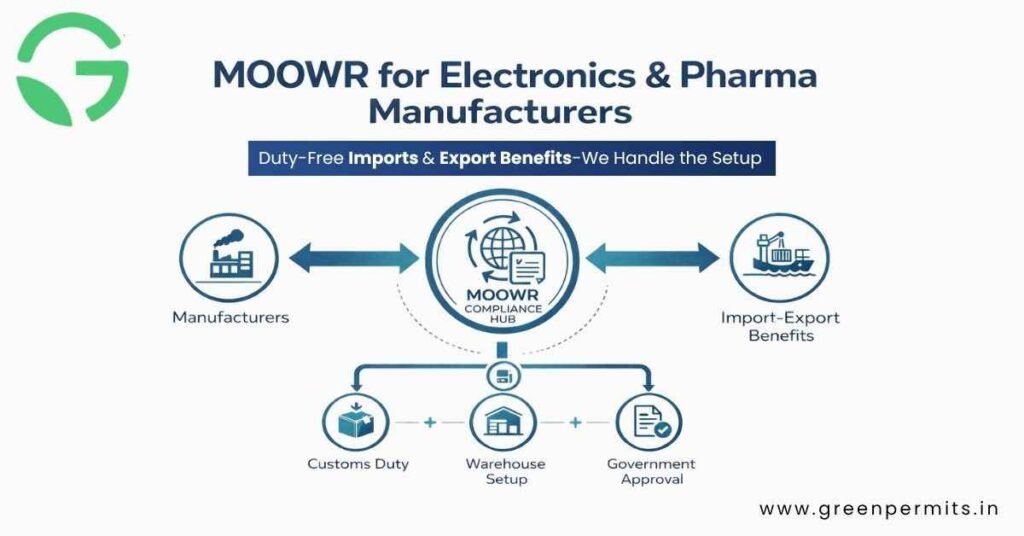
This is where most businesses go wrong. MOOWR is not just a financial strategy – it is a compliance-driven execution model.
The MOOWR scheme – Manufacture and Other Operations in Warehouse Regulations, 2019 – is one of the most underutilized but powerful frameworks available to manufacturers in India.
It enables companies to import raw materials without paying customs duty upfront, manufacture within bonded warehouses, and optimize working capital significantly.
For industries like electronics and pharmaceuticals, where 60–80% of inputs are imported, this creates a direct financial advantage.
However, MOOWR does not operate in isolation. It is tightly linked with environmental compliance, CPCB registrations, SPCB approvals, and continuous reporting obligations. Businesses that ignore this integrated framework often face delays of 30–60 days, penalties, or even operational shutdown.
MOOWR operates under the Customs Act, 1962, specifically Section 58 for warehouse licensing and Section 65 for manufacturing permissions. It allows businesses to defer customs duty until the final sale of goods in the domestic market.
In practical terms, this means a company importing ₹100 crore worth of raw material does not pay duty upfront. Instead, the duty is paid only when finished goods are cleared for sale.
This creates a major financial shift. Instead of blocking capital at the import stage, businesses can deploy that capital into operations, expansion, or inventory.
For export-oriented production, the benefit becomes even stronger. If goods are exported, no customs duty is paid at all.
This structure makes MOOWR highly attractive for electronics assembly units and pharmaceutical manufacturers importing APIs or intermediates.
Key operational advantages include:
Many businesses assume that once customs approval is obtained, operations can begin immediately. This assumption leads to major compliance failures.
In reality, MOOWR sits within a larger regulatory ecosystem that includes environmental laws and pollution control frameworks.
A manufacturer must comply with at least 4 parallel regulatory systems:
These layers are interconnected. For example, an electronics manufacturer under MOOWR must also comply with e-waste rules, while a pharma manufacturer must comply with hazardous waste regulations.
Failure in any one area can stop the entire operation.
Typical regulatory overlap includes:
Setting up under MOOWR is not a single-step approval. It is a coordinated process involving multiple authorities and documentation layers.
The process starts with applying for a private bonded warehouse license. This requires a detailed layout, security measures, and inventory tracking systems.
Once the warehouse is approved, the manufacturer must obtain permission to carry out operations under Section 65. This involves submitting manufacturing processes, input-output ratios, and compliance plans.
Parallel to this, environmental approvals must be secured. These include Consent to Establish and Consent to Operate from the State Pollution Control Board.
If the product category falls under EPR – such as electronics, batteries, or plastic packaging – registration on the CPCB portal becomes mandatory before operations begin.
A realistic execution flow looks like this:
This brings the total setup timeline to around 45 to 90 days in real scenarios.
Most consultants promise approvals within 30 days. In reality, compliance timelines are longer due to multi-department coordination.
A typical timeline includes multiple checkpoints where delays can occur due to incomplete documentation or regulatory queries.
Here is a realistic breakdown:
Key risks that delay timelines:
Electronics manufacturing in India heavily depends on imported components such as semiconductors, PCBs, and lithium batteries. In many cases, imports account for 70–85% of total production cost.
Under MOOWR, this creates a direct opportunity to defer customs duty and improve margins significantly.
However, electronics also fall under strict environmental regulations, especially e-waste management.
Manufacturers must ensure that:
Regulatory authorities typically review applications within 30 working days, and any deficiencies must be corrected within 7 days. Failure to comply can lead to registration rejection or suspension.
Operational requirements include:
Pharmaceutical manufacturers benefit from MOOWR due to high import dependency on Active Pharmaceutical Ingredients and intermediates.
In many cases, duty deferment leads to savings of 10–20% in operational cost, especially for bulk drug manufacturers.
However, pharma operations generate hazardous waste, making environmental compliance critical.
Companies must obtain:
Additionally, water consumption and waste generation must be documented and reported regularly.
Key operational factors include:
One of the most overlooked aspects of MOOWR setup is CPCB compliance. Many businesses focus only on customs approval and ignore environmental registration.
This leads to operational risks after setup.
The CPCB portal requires manufacturers to register and submit detailed information about their operations, products, and waste generation.
The process involves:
Once registered, companies must maintain continuous compliance.
Important compliance requirements include:
Non-compliance can result in portal suspension, which directly impacts business operations.
Compliance failures under MOOWR do not just lead to minor delays. They can result in significant financial and operational losses.
Authorities have the power to suspend licenses, block imports, and impose environmental compensation.
Common risks include:
Under the Environment Protection Act, violations can lead to penalties, legal action, and operational restrictions.
In one case, an electronics importer started operations without completing CPCB registration. Within 40 days, regulatory authorities flagged the issue, and operations were halted until compliance was completed.
In another case, a pharmaceutical company submitted an incorrect plant layout for MOOWR approval. The application was returned, causing a delay of 35 days and impacting production timelines.
A third example involved a manufacturer who imported raw materials under MOOWR but had not obtained SPCB consent. The unit was not allowed to begin production despite having customs approval.
These scenarios highlight a common pattern – incomplete compliance leads to delays, not just at the approval stage but during operations as well.
MOOWR is not just about saving duty. It is about building a compliant manufacturing ecosystem.
Successful businesses approach MOOWR as a coordinated strategy involving multiple approvals and continuous compliance.
They focus on:
On the other hand, businesses that treat MOOWR as a tax-saving scheme often face delays, penalties, and operational disruptions.
MOOWR offers a strong opportunity for electronics and pharma manufacturers to reduce import costs, improve working capital, and scale operations efficiently.
However, the real advantage comes only when compliance is handled correctly.
Companies that align customs approvals with CPCB registration and SPCB permissions create a stable and scalable operational model.
Those who ignore these layers face delays, financial losses, and regulatory risks.
Early planning, structured documentation, and integrated compliance are the key factors that determine success under MOOWR.
📞 +91 78350 06182
📧 wecare@greenpermits.in