
A mid-sized electronics importer in India recently faced a 21-day delay at customs. The issue was not related to taxation or incomplete documentation. The company had already submitted all paperwork and believed it was compliant.
However, when authorities checked the CPCB portal, the company’s EPR registration was either inactive or incorrectly reflected. This single mismatch triggered a shipment hold, financial penalties, and eventually a loss of business worth over ₹35 lakhs.
This situation is no longer rare. Across industries, businesses are realizing that compliance today is not judged by documents – it is judged by what appears on the CPCB digital system.
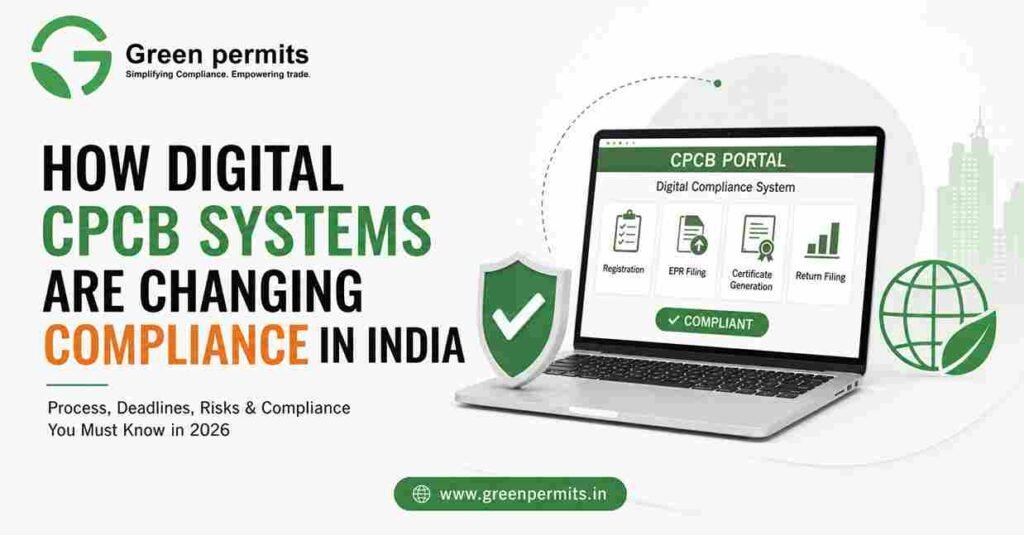
India’s environmental compliance ecosystem has evolved significantly over the last few years. The Central Pollution Control Board has shifted from manual and paper-based approvals to fully digital compliance systems that operate in real time.
Regulations such as E-Waste Management Rules 2022, Battery Waste Management Rules 2022 (amended 2025), Plastic Waste Management Rules 2016 (amended 2025), and End-of-Life Vehicle Rules 2025 now rely heavily on centralized CPCB portals.
This shift means that businesses must continuously maintain their compliance status online rather than relying on one-time approvals.
The move toward digital systems was introduced to solve long-standing issues in India’s compliance framework such as delays, data inconsistencies, and lack of traceability.
Earlier, businesses could operate with partial compliance or delayed filings. Today, the system does not allow such flexibility. Every entity must be registered and active on CPCB portals before conducting operations.
From April 2023 and April 2025 onwards, digital compliance became enforceable across major waste management sectors. This has fundamentally changed how regulators monitor businesses.
The transformation is not only regulatory but also operational. Companies now need structured compliance systems to match the digital framework.
After digitization, these issues have been significantly reduced.
The CPCB portal operates through a defined workflow where each step is structured, monitored, and time-bound. Businesses must follow this process carefully to avoid delays or rejection.
The process begins with registration, where companies are required to provide detailed information about their operations, products, and legal identity. Even minor errors at this stage can result in delays.
After submission, CPCB reviews the application and may raise queries. These queries must be addressed within a limited timeframe, usually 7 days. Failure to respond leads to automatic rejection in many cases.
Once approved, the company receives a digital registration certificate. This certificate is not static. It must be supported with regular filings and updates.
After registration, the compliance cycle continues through obligation declaration and return filing.
The introduction of the EPR certificate system has fundamentally changed how compliance is measured. Earlier, compliance was based on reporting. Now, it is based on measurable output.
In this system, recyclers generate certificates based on actual recycling activity. These certificates are then purchased by producers to fulfill their obligations.
This ensures that compliance is directly linked to real environmental impact rather than theoretical claims.
For example, in battery waste management, certificates are generated based on the weight of metals recovered during recycling. This includes materials like lithium, cobalt, and lead.
This mechanism has improved accountability significantly.
The government has introduced progressive EPR targets to ensure long-term environmental sustainability. These targets increase over time, making compliance more stringent in future years.
For example, under recent frameworks, targets are defined in phases across financial years. Businesses must align their operations accordingly.
If a company sells 10,000 units of a product, it must ensure that a certain percentage of those products are collected and recycled through authorized channels.
These targets are not optional. They are mandatory and directly monitored through digital systems.
The year 2025 marked a major shift in compliance requirements across sectors. Multiple amendments were introduced to strengthen digital monitoring and traceability.
These updates have made compliance more granular and data-driven. Businesses now need to track product-level and material-level information.
Plastic waste rules introduced barcode and QR code requirements. This allows regulators to track packaging at a detailed level.
Battery rules introduced stricter tracking mechanisms for producers and recyclers. ELV rules introduced a new compliance framework for vehicles.
These changes are expected to impact thousands of businesses across India.
Digital systems have unified multiple regulations under a common compliance framework. Each regulation has specific requirements, deadlines, and risks.
Missing even one requirement can lead to enforcement action, as systems are interconnected.
This interconnected system ensures that compliance is monitored at every stage of the business lifecycle.
Compliance is now driven by strict timelines. These timelines are monitored digitally, and delays are automatically flagged.
Businesses must align their operations with these timelines to avoid disruptions.
Most compliance failures occur due to missed timelines rather than lack of intent.
Digital CPCB systems have made enforcement faster and stricter. Non-compliance is now detected instantly, and action is initiated without delay.
Businesses can no longer rely on delayed enforcement or manual adjustments.
The risks are both financial and operational. Even a small error can escalate into a major issue if not corrected quickly.
Legal risks are also significant.
Real-world cases highlight how digital compliance impacts businesses directly. These scenarios are increasingly common across industries.
In one case, a startup delayed its CPCB registration and faced shipment delays worth ₹18 lakhs. In another case, a battery importer miscalculated its EPR obligation and faced a 20 percent shortfall penalty.
These examples show that compliance errors are no longer minor issues. They have direct financial consequences.
Understanding these risks helps businesses prepare better.
To succeed in the current environment, businesses must shift from reactive compliance to proactive compliance management.
This requires building systems, processes, and teams that can handle continuous compliance requirements.
Companies need to treat compliance as a core operational function rather than a one-time activity.
Adopting these practices provides long-term benefits.
Digital CPCB systems have completely transformed compliance in India. The shift from manual to digital has made the system more transparent, accountable, and strict.
Businesses must now ensure that their compliance is accurate, timely, and continuously updated on CPCB portals.
Those who adapt to this change are able to operate smoothly and avoid disruptions. Those who delay face increasing risks and operational challenges.
Compliance today is not just a legal requirement. It is a business necessity.
📞 +91 78350 06182
📧 wecare@greenpermits.in