
A business may invest in land, sheds, machinery, dismantling tables, shredders, separators and pollution-control systems, but still face approval delays if the E-Waste Recycling Plant DPR is not prepared correctly. In India, e-waste recycling is not only a plant setup activity. It is a regulated environmental compliance activity.
The biggest challenge for many recycling entrepreneurs is not buying machinery. It is matching the DPR with Consent to Establish, Consent to Operate, Hazardous Waste authorization and CPCB recycler registration. If the DPR mentions one capacity, CTO mentions another and portal filing shows a third number, the application can face objections.
A proper E-Waste Recycling Plant DPR explains the project cost, plant capacity, process flow, machinery, approvals, raw material sourcing, utilities, manpower, profitability and compliance risks. It also helps banks, investors and authorities understand whether the project is technically feasible and legally workable.
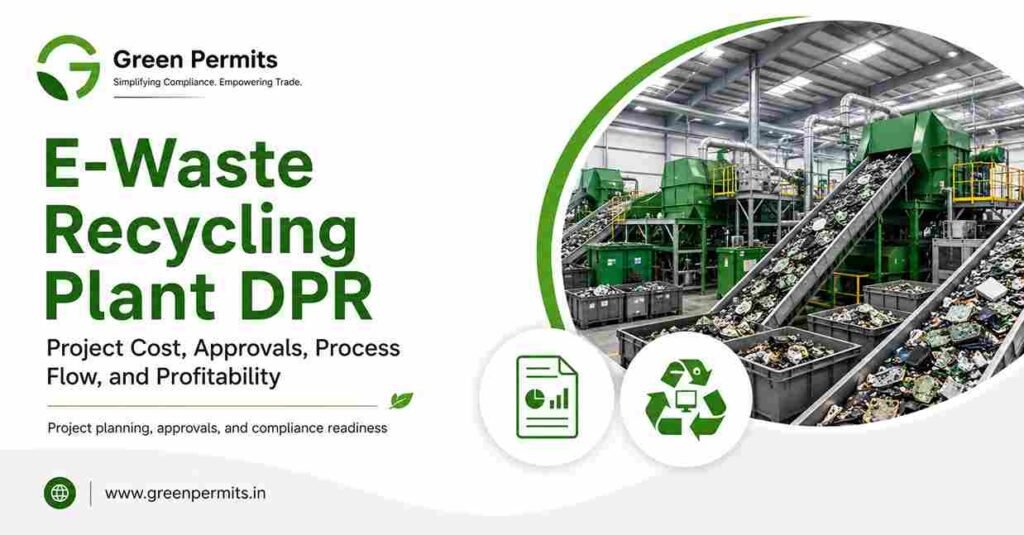
For example, if a recycler plans a 5 MT/day plant and operates for 300 days per year, the annual capacity becomes around 1,500 MT/year. This number should be supported by plant layout, machinery capacity, manpower, power load, storage space and pollution-control systems.
An E-Waste Recycling Plant DPR is a detailed project report prepared before setting up an authorized e-waste recycling facility. It works as a technical, financial and compliance document.
The DPR explains what type of e-waste will be processed, how much capacity the plant will handle, what machinery will be installed, how recovered materials will be sold and how hazardous fractions will be managed.
A good DPR should not be generic. It must clearly state whether the plant is only for dismantling or for full recycling with shredding, separation and recovery. A dismantling plant has lower cost and simpler operations, while an integrated recycling plant requires higher investment, stronger pollution-control systems and better technical manpower.
The DPR should include land details, plant layout, project cost, machinery list, process flow, utility requirement, manpower, approval requirement, waste management plan and financial projections.
Key points covered in the DPR include:
An e-waste recycling plant cannot operate legally only because the promoter has purchased machinery. The business requires environmental approvals and CPCB registration.
The DPR helps prove that the project is planned properly. It explains how e-waste will be collected, stored, dismantled, processed and recovered. It also shows how hazardous components such as batteries, lamps, capacitors, dust, residues and printed circuit board fractions will be handled.
For SPCB and CPCB review, the DPR supports the approval file. It shows the proposed capacity, pollution-control systems, storage arrangement, process flow and compliance plan. For banks and investors, it shows whether the project can generate revenue and manage operating costs.
A weak DPR may look attractive on paper but fail during approval review. A strong DPR connects business planning with compliance requirements.
The DPR helps avoid:
The main regulation for e-waste recycling in India is the E-Waste (Management) Rules, 2022, effective from 1 April 2023. These rules created a stronger Extended Producer Responsibility framework and brought manufacturers, producers, refurbishers and recyclers under a formal registration system.
An e-waste recycler generally needs Consent to Establish before setting up the plant and Consent to Operate before starting commercial operations. If the unit handles hazardous fractions, Hazardous Waste authorization is also required.
CPCB recycler registration is another important requirement. The registration is generally valid for 5 years. If an application is incomplete, portal shortcomings may be communicated within around 30 working days, and the applicant may need to respond within around 7 working days.
This means documentation must be accurate from the beginning. The company name, address, capacity, machinery, process flow and authorization details should be consistent across all documents.
| Approval / Regulation | Requirement | Timeline / Validity | Main Risk |
|---|---|---|---|
| E-Waste Rules, 2022 | Formal compliance and registration | Effective from 1 April 2023 | Non-compliance |
| Consent to Establish | Approval before setup | Before construction / installation | Project delay |
| Consent to Operate | Approval before operation | Before commercial production | Production halt |
| Hazardous Waste Authorization | Handling hazardous fractions | Before hazardous waste handling | Penalty risk |
| CPCB Recycler Registration | Portal registration | Usually valid for 5 years | Rejection or suspension |
| EPR Certificate Mechanism | Recovery-based certificate value | Financial year based | Revenue loss |
The most important point is consistency. The DPR, CTE, CTO, Hazardous Waste authorization and CPCB portal filing should all reflect the same plant capacity, address and activity.
The project cost depends on capacity, land model, machinery, automation level, pollution-control systems and recycling depth.
A small dismantling unit may require lower investment because it mainly needs tools, dismantling tables, weighing systems, storage space and safety equipment. A medium or large recycling plant requires shredders, crushers, conveyors, magnetic separators, eddy-current separators, dust collectors, storage bins, electrical panels and pollution-control systems.
A full recovery plant with precious metal processing requires higher technical investment. It may need advanced recovery systems, chemical handling, air pollution control, wastewater management, trained manpower and stronger safety systems.
A practical DPR should include all project cost heads, not only machinery cost. Land, civil work, utilities, compliance cost, working capital, fire safety and contingency must also be included.
| Cost Head | Includes |
|---|---|
| Land and site development | Land, boundary wall, internal roads, drainage |
| Civil construction | Shed, office, storage area, dismantling area |
| Machinery | Dismantling tables, conveyors, shredders, separators |
| Pollution control | Dust collector, scrubber, ETP if required, hazardous storage |
| Utilities | Power, water, compressed air, lighting |
| Safety systems | Fire equipment, PPE, emergency systems |
| Compliance cost | CTE, CTO, authorization, CPCB registration |
| Working capital | Raw material, salary, logistics, electricity |
| Contingency | Cost escalation and additional compliance needs |
For financial planning, the DPR should prepare at least 3 scenarios. A conservative scenario may assume 40% to 50% capacity utilization in the first year. A moderate scenario may assume 60% to 75% utilization. An optimistic scenario may assume 80% to 90% utilization after stable sourcing contracts.
Capacity planning is one of the most important sections of an E-Waste Recycling Plant DPR. Capacity affects land, machinery, manpower, power load, storage, working capital and revenue.
A plant with 1 MT/day capacity and 300 operating days will process around 300 MT/year. A 10 MT/day plant can process around 3,000 MT/year if operated for 300 days. A 25 MT/day plant can reach around 7,500 MT/year.
The DPR should justify capacity with machinery rating and operational assumptions. If a shredder has theoretical capacity of 1 MT/hour, the practical daily output may still be lower because of sorting time, downtime, maintenance and manpower limitations.
The plant layout should separate incoming material, dismantling area, hazardous waste storage, recovered material storage and finished goods dispatch. Incoming e-waste should not mix with recovered materials. Hazardous fractions should be stored safely in a designated area.
A good layout should include:
The process flow explains how e-waste enters the plant and how recovered materials are generated.
The process begins with collection from authorized sources such as bulk consumers, producers, collection centres, aggregators, institutions and OEM partners. After receipt, material is weighed and recorded.
The next step is segregation. E-waste is sorted into categories such as computers, laptops, printers, cables, mobile phones, appliances, telecom equipment, circuit boards and screens.
Manual dismantling is then carried out. Workers remove reusable components, wires, printed circuit boards, plastics, metals and hazardous components. Batteries, lamps, capacitors, cartridges and screens require special care.
After dismantling, material may go through shredding, crushing and separation. Ferrous metals are recovered through magnetic separation. Non-ferrous materials such as aluminium and copper may be recovered through eddy-current or other separation systems.
The final stage is storage, sale or authorized disposal. Recovered materials are sold to authorized buyers or downstream recyclers. Hazardous residues are sent to authorized disposal or recycling facilities.
| Stage | Activity | Output |
|---|---|---|
| 1 | Collection | Incoming e-waste |
| 2 | Weighing | Quantity record |
| 3 | Segregation | Category-wise material |
| 4 | Dismantling | Metals, plastics, PCBs, wires |
| 5 | Hazardous removal | Batteries, lamps, capacitors |
| 6 | Shredding / crushing | Size-reduced material |
| 7 | Separation | Iron, aluminium, copper, plastics |
| 8 | Recovery | Saleable fractions |
| 9 | Storage | Finished material and residues |
| 10 | Dispatch / disposal | Sale or authorized disposal |
The DPR should clearly mention whether precious metal recovery is done in-house or through authorized downstream facilities. If the plant does not have refining capability, it should not show high precious metal revenue.
Machinery selection depends on capacity and process depth. A dismantling unit needs simpler equipment. A full recycling plant needs mechanical processing and pollution-control systems.
The DPR should mention machinery quantity, capacity, power load and purpose. This helps authorities and investors verify whether the proposed plant can actually process the stated capacity.
Common machinery includes:
Machinery cost should be separated from civil cost, utility cost and compliance cost. This makes the project cost more transparent.
CPCB recycler registration is filed through the designated online system. The recycler must provide company details, facility details, statutory approvals, process details, capacity details and geotagged evidence.
The recycler generally needs PAN, GST, CTE, CTO, Hazardous Waste authorization, facility geo-coordinates, geotagged photos, geotagged video, machinery list, process flow and self-declaration.
Capacity should be entered carefully. If CTO mentions capacity in MT/year, the same number should be used in CPCB registration. Overstating capacity can create objections.
| Step | Action | Risk if Incorrect |
|---|---|---|
| 1 | Portal login / registration | Communication delay |
| 2 | Enter company details | Identity mismatch |
| 3 | Enter facility address | Address mismatch |
| 4 | Upload CTE, CTO and authorization | Incomplete file |
| 5 | Add process and capacity details | Capacity objection |
| 6 | Upload geotagged photos and video | Inspection issue |
| 7 | Submit declaration | Liability for false data |
| 8 | Respond to shortcomings | Delay or rejection |
The uploaded photos and videos should show the actual facility and installed machinery. Incomplete installation evidence can delay approval.
E-waste recycling profitability comes from recovered materials, service income and EPR certificate-linked opportunities where applicable.
Main revenue may come from iron, aluminium, copper, printed circuit board fractions, plastics and reusable components. Higher-value e-waste such as IT equipment and telecom scrap may offer better recovery potential than low-grade mixed appliances.
However, revenue should be estimated carefully. Not every plant can recover precious metals. A dismantling unit may sell PCB fractions to authorized downstream recyclers instead of recovering gold in-house.
A realistic DPR should create separate revenue lines for:
Operating costs include raw material purchase, labour, electricity, logistics, maintenance, compliance, hazardous waste disposal and administration.
A new plant may operate at 40% to 50% utilization in year 1. It may reach 60% to 75% in year 2 and 80% to 90% after stable sourcing contracts. This ramp-up makes the financial model more realistic.
E-waste recycling involves environmental, safety and documentation risks. The DPR should identify these risks clearly.
The most common risk is mismatch between DPR, CTO and portal filing. Another common risk is missing hazardous-waste storage or weak material balance. Fire safety is also critical because e-waste may include batteries and combustible plastic fractions.
Poor documentation can affect EPR certificate revenue and compliance audits. If invoices, material balance, recovery records and dispatch records are weak, the recycler may face disputes or regulatory questions.
Major risks include:
The DPR should include a risk mitigation plan with safe storage, proper records, worker training, fire systems and authorized disposal arrangements.
A recycler prepares a DPR for 10 MT/day, but CTO is granted for 6 MT/day. During CPCB filing, the recycler enters 10 MT/day. This mismatch may lead to objections and delay the project by 30 to 60 days.
Another recycler installs dismantling tables and tools but does not create a separate hazardous-waste storage area. During review, the authority may question how batteries, lamps, capacitors and residues will be handled. This can delay CTO or Hazardous Waste authorization.
A third recycler assumes high precious metal revenue even though the plant only has dismantling equipment. This makes the financial model unrealistic and may create investor concerns.
These cases show why the DPR must be practical, numerical and compliance-aligned.
Green Permits supports businesses in preparing compliance-ready DPRs for e-waste recycling plants. The focus is on practical plant planning, approval alignment and realistic financial assumptions.
Green Permits can assist with DPR preparation, project cost estimation, plant layout, process flow, CTE, CTO, Hazardous Waste authorization, CPCB recycler registration and EPR compliance advisory.
This helps entrepreneurs and recycling companies reduce rejection risk, avoid wrong investments and build a formal, scalable recycling business.
An E-Waste Recycling Plant DPR is the foundation of a successful e-waste recycling project. It connects project cost, approvals, process flow, plant capacity, machinery, pollution control, profitability and compliance.
A weak DPR can lead to approval delay, investor doubt, capacity mismatch, wrong machinery purchase and compliance risk. A structured DPR helps the business plan correctly and operate legally.
Businesses planning an e-waste recycling plant should prepare the DPR before finalizing machinery. The DPR should be aligned with CTE, CTO, Hazardous Waste authorization and CPCB recycler registration requirements.
A compliance-backed DPR helps recyclers build a profitable and responsible business in India’s growing e-waste management sector.
📞 +91 78350 06182
📧 wecare@greenpermits.in
Book a Consultation with Green Permits