
Starting a recycling plant in India looks simple from the outside. Many entrepreneurs think the process begins with buying machinery, renting land and collecting waste. But in reality, most recycling projects face delays because compliance planning is not done at the right stage.
A common example is a promoter planning a 10 MT/day plastic recycling plant. The machinery is finalized, the shed is prepared and the business model is ready. But when the file goes to the State Pollution Control Board, the authority may ask for land-use documents, water balance, effluent treatment details, waste storage plan, Consent to Establish and process flow. If these documents are not aligned, the project can get delayed by 30 to 90 days.
This is why Recycling Plant Setup in India must be planned as both a business project and a regulatory project. A recycling plant is not only about shredders, washing lines, dismantling tables, separators or furnaces. It also needs Consent to Establish, Consent to Operate, CPCB or SPCB registration, waste authorization, EPR portal registration and return filing.
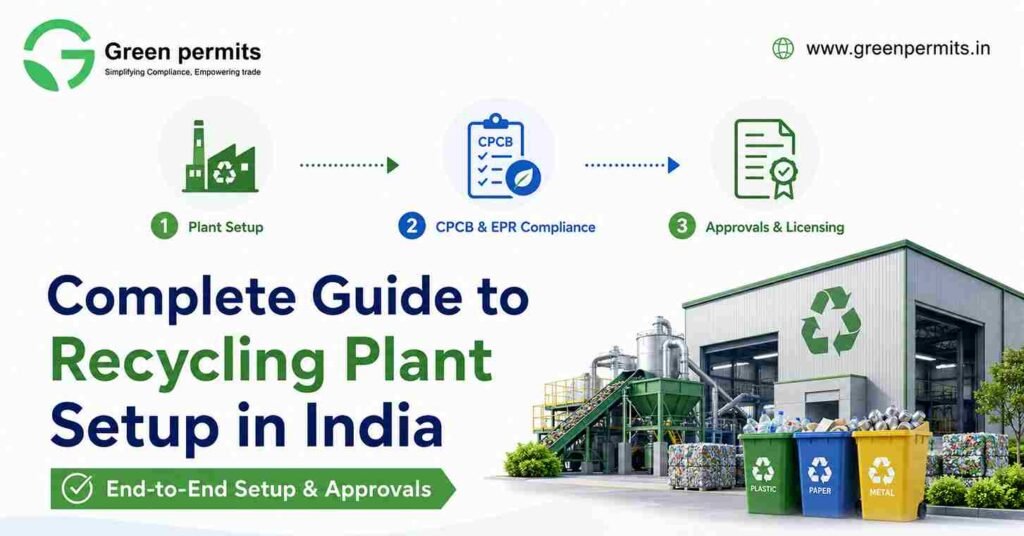
India has separate compliance frameworks for plastic waste, e-waste, battery waste and end-of-life vehicles. Each waste category has its own documentation, approval process and portal requirement. If a plant owner treats all recycling projects the same, the approval process becomes difficult.
A well-planned recycling project can operate legally, generate EPR certificates where applicable and build trust with producers, brand owners, investors and regulators. A poorly planned project may face rejection, portal suspension, environmental compensation or production stoppage.
Recycling Plant Setup in India means establishing a facility that collects, stores, segregates, processes and converts waste into reusable material. The plant may process plastic waste, e-waste, battery waste, vehicle scrap, tyre waste, metal scrap or other recyclable materials.
From a business point of view, the goal is to recover value from waste. For example, plastic waste can be converted into flakes, granules or pellets. E-waste can be dismantled and processed for metals such as copper, aluminium, iron and precious metals. Battery waste can be processed for lead, lithium, nickel, cobalt and other recoverable materials. Vehicle scrapping facilities recover steel, aluminium, spare parts, rubber, plastic and other recyclable fractions.
From a compliance point of view, a recycling plant is a regulated waste processing unit. This means the plant cannot operate only on commercial permission. It must comply with environmental laws, pollution control norms and waste-specific rules.
A 5 MT/day plastic recycling plant, a 2,000 MT/year e-waste recycling unit and a 50 MT/day battery recycling plant will not follow the same approval route. Their land, machinery, pollution control systems, waste storage requirements and portal filing documents will be different.
Before investing, the promoter should clearly define 6 things:
This clarity helps avoid mistakes during CPCB or SPCB filing.
Compliance planning should start before land finalization and machinery purchase. If a promoter first buys machinery and then checks regulatory requirements, the project may need redesign.
For example, if a plastic recycling plant includes washing operations, it will generate wastewater. This means the project must include an effluent treatment plant or water recycling system. If the DPR does not include ETP details, the SPCB may raise queries.
Similarly, an e-waste recycling plant may generate hazardous fractions such as batteries, capacitors, lamps, dust and contaminated components. These must be stored and disposed of through authorized channels. A battery recycling plant may require hazardous waste authorization, air pollution control system, scrubber, safe storage and proper worker safety measures.
In many cases, compliance planning saves both time and money. A project that is planned correctly may get approvals faster. A project with missing documents may face repeated queries.
Compliance planning helps in:
For a serious recycling business, compliance is not an extra cost. It is risk protection.
Recycling plants are governed by multiple laws depending on the waste category. The major regulations include Plastic Waste Management Rules, E-Waste Management Rules, Battery Waste Management Rules, End-of-Life Vehicle Rules, Air Act, Water Act, Hazardous and Other Wastes Rules and Environment Protection Act.
Plastic recycling plants generally come under Plastic Waste Management Rules, 2016 and later amendments. Plastic Waste Processors need registration and may become part of the EPR certificate system. Producers, importers and brand owners depend on registered processors to meet their EPR targets.
E-waste recycling plants come under E-Waste Management Rules, 2022. The framework covers producers, manufacturers, refurbishers and recyclers. Entities must register on the CPCB portal and cannot deal with unregistered entities.
Battery recycling plants come under Battery Waste Management Rules, 2022 and amendments. The rules cover all types of batteries regardless of chemistry, shape, weight, volume or use. Producers, manufacturers, recyclers and refurbishers must register through the online system.
Vehicle scrapping facilities are covered under the Environment Protection End-of-Life Vehicles Rules, 2025 and MoRTH RVSF framework. These rules became effective from 1 April 2025. They cover producers, registered owners, bulk consumers, RVSFs, collection centers and entities involved in handling, testing and scrapping of end-of-life vehicles.
Apart from category-specific rules, almost every recycling plant needs Consent to Establish and Consent to Operate from the SPCB or PCC. If hazardous waste is generated, separate authorization may also be required.
| Regulation | Requirement | Applicable To | Main Risk |
|---|---|---|---|
| Plastic Waste Management Rules | PWP registration and EPR-linked processing | Plastic recyclers and processors | Portal rejection or certificate blockage |
| E-Waste Management Rules 2022 | Registration of recycler, producer, manufacturer and refurbisher | E-waste stakeholders | Invalid business activity |
| Battery Waste Management Rules 2022 | Registration and EPR certificate compliance | Battery producers, importers and recyclers | EPR filing risk |
| ELV Rules 2025 | Producer, RVSF and bulk consumer registration | Vehicle producers and scrapping facilities | EPR non-compliance |
| Water Act 1974 | Consent for wastewater control | All plants using water | CTO refusal |
| Air Act 1981 | Consent for air emission control | Plants with dust, fumes or emissions | Closure action |
| Hazardous Waste Rules 2016 | Authorization for hazardous waste handling | Battery, e-waste and ELV plants | Illegal waste handling |
| Environment Protection Act 1986 | Legal liability for non-compliance | All regulated units | Penalty or prosecution |
This table clearly shows that a recycling plant is not approved through one document. It requires a chain of approvals. If one link is missing, the project can face delays.
The first step is identifying the waste category. This decides the approval route, machinery, investment, land requirement and compliance process.
Plastic recycling may involve sorting, washing, shredding, drying and pelletizing. E-waste recycling may involve collection, segregation, dismantling, shredding, separation and material recovery. Battery recycling may involve dismantling, crushing, separation, refining and hazardous waste handling. Vehicle scrapping may involve de-pollution, dismantling, fluid removal, steel recovery and certificate generation.
A promoter should not write “recycling plant” in a generic way. The project must clearly mention the exact waste type and process.
A DPR is one of the most important documents for a recycling plant. It explains the project from technical, financial and compliance angles.
A good DPR should include project capacity, land area, machinery list, process flow, raw material source, finished product, pollution control system, power requirement, water requirement, manpower, investment cost and revenue model.
For example, if the plant capacity is 20 MT/day, the DPR should explain how much waste will be received, how much will be processed, how much product will be recovered and how much residue will be generated.
A strong DPR helps in 4 areas:
Without a DPR, the project may face cost escalation and compliance confusion.
Land selection is critical. The site should ideally be in an industrial area or a permitted zone. A recycling plant should not be planned in a location where waste processing is restricted.
The land should have enough space for raw material storage, processing area, finished goods storage, hazardous waste storage, vehicle movement, office, utilities, fire safety and pollution control equipment.
Many promoters only calculate machine area. This is a mistake. In recycling projects, storage and movement area can take 30% to 50% of total site space.
For example, a vehicle scrapping facility needs space for vehicle parking, de-pollution bay, dismantling area, hazardous fluid storage, tyre storage, battery storage, spare part storage and scrap dispatch.
Consent to Establish is required before construction and installation in most cases. It is issued by the State Pollution Control Board or Pollution Control Committee.
The application usually includes project report, land documents, layout, process flow, water requirement, wastewater details, air emission details, solid waste details and pollution control plan.
CTE approval may take 30 to 90 days depending on the state, project type and document quality. If documents are incomplete, the timeline may increase.
After CTE approval, the promoter can start installation. Machinery should match the capacity mentioned in the DPR and CTE application.
Pollution control equipment must be installed before applying for CTO. This may include ETP, scrubber, dust collector, bag filter, oil trap, hazardous waste storage, fire safety system and wastewater recycling setup.
If the pollution control system is missing or under-designed, the CTO application can face rejection or delay.
Consent to Operate is required before commercial operations. The SPCB may verify whether the plant has been installed as per CTE conditions.
The CTO capacity is very important. Many CPCB registrations and EPR portal approvals depend on CTO capacity. If the CTO is issued for a lower capacity, the plant may not be able to claim higher processing capacity on the portal.
After CTE and CTO, waste-specific registration may be required. Plastic recyclers may register as Plastic Waste Processors. E-waste recyclers must register on the e-waste portal. Battery recyclers must register on the battery EPR portal. RVSFs must register on the ELV EPR portal.
The portal filing generally asks for company details, GST, PAN, CIN, IEC, authorized person details, plant address, geo coordinates, process flow, capacity, machinery details, consents and pollution control information.
| Step | Authority | Estimated Timeline | Main Document |
|---|---|---|---|
| Feasibility study | Consultant / internal team | 7 to 15 days | Waste category and capacity note |
| DPR preparation | Technical consultant | 15 to 30 days | Detailed Project Report |
| Land suitability check | Local authority | 7 to 30 days | Land and zoning proof |
| Consent to Establish | SPCB / PCC | 30 to 90 days | DPR and layout |
| Machinery installation | Project owner | 60 to 180 days | Installation proof |
| Consent to Operate | SPCB / PCC | 30 to 90 days | CTE compliance |
| Waste authorization | SPCB / CPCB | 30 to 90 days | CTO and waste details |
| Portal registration | CPCB / SPCB portal | 15 to 30 working days | KYC and plant documents |
For most small and medium recycling plants, a realistic setup timeline is 4 to 6 months. For battery recycling, chemical recovery and vehicle scrapping projects, the timeline may reach 6 to 12 months.
Capacity planning affects every part of the project. It affects land, machinery, electricity load, water requirement, waste generation, pollution control system and government approvals.
A small plastic recycling plant may operate at 1 to 5 MT/day. A medium plant may operate at 10 to 30 MT/day. E-waste units may be planned in MT/year because dismantling and recovery are more process-intensive. Battery recycling plants may be planned based on lead acid battery, lithium-ion battery, black mass or refining capacity.
The claimed capacity must be supported by machinery rating, storage area, power load, water balance and CTO capacity. If the plant claims 5,000 MT/year but machinery and CTO support only 2,000 MT/year, the portal registration may not accept the higher capacity.
A proper capacity plan should include input, output, reject percentage, working days, shift hours and expansion plan.
Documentation decides how smoothly the approval process moves. A project may be technically strong but still face delay due to document mismatch.
Common documents include PAN, GST, CIN, IEC, land documents, plant layout, process flow diagram, machinery list, CTE, CTO, hazardous waste authorization, electricity bill, geo-tagged photos and self-declaration.
For plastic waste processor registration, documents may include process flow, consents, geo-tagged pictures, machinery details, electricity bill, waste characterization, occupational safety details and pollution control documents.
For battery recycler registration, documents may include GST certificate, PAN, process flow diagram, consent under Air and Water Acts, hazardous waste authorization and DIC certificate where applicable.
For e-waste recycler registration, documents may include CTE, CTO, hazardous waste authorization, PAN, GST, geo-tagged video, geo-tagged pictures and recycling capacity details.
All documents should carry consistent information. The GST address, plant address, land address and consent address should match or be properly explained.
EPR has changed the recycling industry in India. Earlier, recyclers mainly earned revenue by selling recovered material. Now, in many sectors, registered recyclers also support producer compliance through EPR certificates.
Plastic Waste Processors can support PIBOs in meeting EPR obligations. E-waste recyclers can generate certificates based on recovered key metals. Battery recyclers can generate certificates based on recovered battery materials. RVSFs can generate certificates based on recovered steel from end-of-life vehicles.
For ELVs, the target structure is important. Producers have to meet minimum EPR targets of 8%, 13% and 18% of steel used in vehicles across defined financial year blocks. This creates a long-term opportunity for formal vehicle scrapping facilities.
However, certificate generation depends on proper registration and record-keeping. A recycler must maintain details of waste received, waste processed, material recovered, sales invoices and remaining stock.
Poor record-keeping can block EPR certificate generation even if the plant is physically operating.
The cost of a recycling plant depends on waste category, capacity, automation level, machinery quality, pollution control requirement and land cost.
A basic plastic shredding unit may require a lower investment. A full plastic washing and pelletizing plant needs more investment because it requires washing tanks, dryers, extruders, pelletizers, ETP and water recycling system.
An e-waste recycling plant may need dismantling tables, shredders, separators, dust collectors, storage systems and safety equipment. A battery recycling plant may require crushers, separators, furnaces or chemical recovery systems, scrubbers, ETP and hazardous waste storage. A vehicle scrapping facility may require land, vehicle lifts, de-pollution systems, dismantling tools, fluid recovery units, storage yards and fire safety systems.
Major cost heads include land, civil construction, machinery, pollution control equipment, electrical system, fire safety, DPR, approvals, manpower and working capital.
Promoters should keep 10% to 15% extra budget for compliance upgrades, installation changes and approval-related modifications.
The biggest risk is starting operations before approvals are complete. A recycling plant should not receive or process waste commercially without required consent, authorization and registration.
Non-compliance can lead to portal rejection, SPCB refusal, environmental compensation, certificate blockage, customs hold for importers, production halt and liability under environmental laws.
Another serious risk is false or inconsistent data. If portal filing shows one capacity, CTO shows another and machinery supports something else, the application may face queries.
Practical risks include:
A plastic recycler planned a 15 MT/day unit but submitted incomplete geo-tagged machinery photos and pollution control details. The file received repeated queries and approval was delayed by almost 45 days.
A battery recycler installed machinery for 3,000 MT/year but the CTO mentioned lower capacity. During portal registration, the lower CTO capacity became a bottleneck.
An e-waste recycler processed material but did not maintain proper recovered metal and invoice records. Later, EPR certificate generation became difficult.
An RVSF promoter planned the project like a normal scrap yard. The facility did not have proper de-pollution area, hazardous fluid storage and certificate workflow. This reduced its compliance and commercial value.
These cases show one thing clearly. A recycling plant should be planned from the approval stage, not corrected after installation.
Recycling Plant Setup in India is a strong business opportunity, but it must be handled with proper compliance planning. The Indian recycling sector is moving toward formal processing, traceable waste flow, EPR certificates, CPCB portals and stricter SPCB monitoring.
The success of a recycling plant depends on more than machinery. It depends on correct land selection, DPR, Consent to Establish, Consent to Operate, waste authorization, CPCB registration, EPR filing, capacity validation and regular return filing.
The cost of early compliance is much lower than the cost of rejection, delay, environmental compensation or plant shutdown. A well-planned recycling project can start faster, operate legally and generate long-term business value.
For entrepreneurs, recyclers, manufacturers and investors, the right approach is simple: plan the compliance before investing heavily in machinery.
📞 +91 78350 06182
📧 wecare@greenpermits.in