
A manufacturing unit may increase its production capacity by 20 to 30 percent within a year, but if its waste management system remains manual, compliance risks increase immediately. Many industrial plants in India face delays in approvals, rejection of CPCB filings, and SPCB observations not because of pollution levels, but due to poor waste tracking and documentation.
Smart waste management systems for industrial plants solve this gap by integrating plant operations with compliance requirements. These systems ensure that waste generation, handling, recycling, and reporting are aligned with CPCB rules, EPR obligations, and environmental approvals.
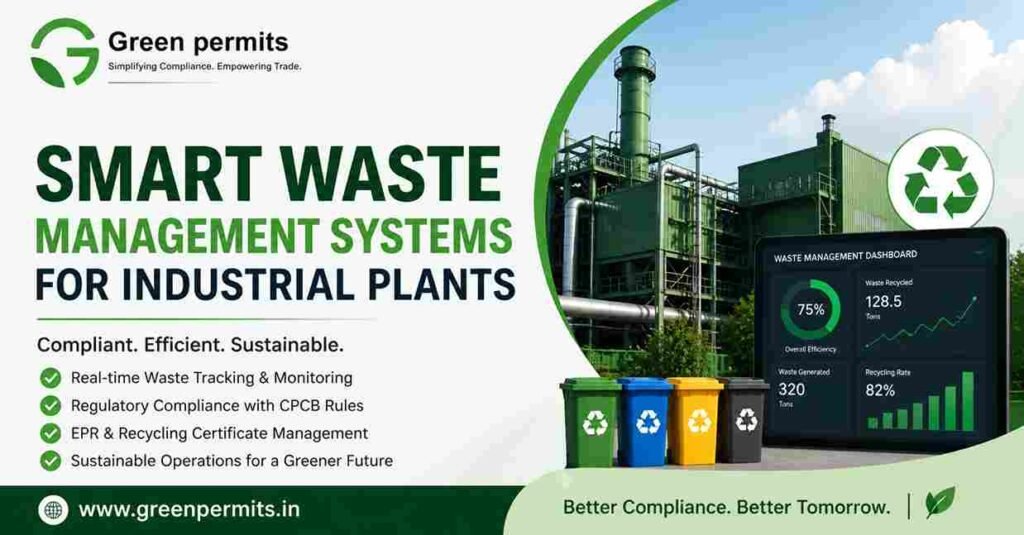
This blog supports: Licenses and Environmental Approvals, EPR Registration, Plant Setup, ESG and Sustainability.
Industrial waste management is no longer limited to disposal. It has evolved into a structured compliance function that directly impacts licensing, production continuity, and financial exposure. Regulators now expect industries to maintain accurate, real-time data across all waste categories.
In India, waste generation varies significantly depending on the industry. Manufacturing plants typically generate 2 to 10 percent waste relative to production output. Hazardous waste can range from 5 to 50 kg per ton of production. Large facilities may generate 500 to 1500 MT per day of wastewater. These numbers highlight the scale at which waste must be tracked and managed.
Without a structured system, different departments maintain separate records, leading to inconsistencies during audits. This results in CPCB portal mismatches, delayed approvals, and increased compliance scrutiny.
Smart waste management systems bring all data into a single framework. They connect production, waste generation, recycling, and reporting processes, ensuring consistency across all compliance layers.
Key reasons industries are adopting smart systems:
Core capabilities of a smart system:
Industrial plants in India operate under multiple waste management regulations. Each rule applies to specific waste streams, but compliance must be managed collectively at the plant level.
The regulatory framework has strengthened significantly in recent years, especially with the introduction of EPR-based compliance and digital reporting systems. Industries must now ensure that their waste management systems are aligned with these rules from the start of operations.
| Regulation | Requirement | Deadline | Applicable To | Risk |
|---|---|---|---|---|
| E-Waste Rules, 2022 | CPCB registration mandatory | Before operation | Producers, recyclers | Business restriction |
| PWM Amendment Rules, 2025 | Barcode and traceability | 01 July 2025 | PIBOs | Penalty under EPA |
| Battery Waste Rules, 2022 | EPR certificate compliance | Ongoing | Producers, importers | Portal suspension |
| ELV Rules, 2025 | EPR target compliance | From FY 2025 | Vehicle producers | Compensation |
These regulations are governed under the Environment Protection Act, 1986. Non-compliance can lead to penalties, operational restrictions, or legal action.
Industrial plants must treat compliance as a system rather than individual approvals. A single facility may be required to comply with 3 to 5 regulations simultaneously, depending on its product and waste profile.
Key regulatory expectations for industries:
EPR compliance requires precise data alignment between production, sales, and waste recovery. Any mismatch can result in additional liability or rejection during audit.
A smart system ensures that every unit of product introduced into the market is mapped against its corresponding waste obligation. This allows companies to calculate their EPR targets accurately and track compliance in real time.
For example, if a company introduces 1000 tons of product into the market annually, its EPR obligation may range from 8 to 20 percent depending on the category. This means the company must ensure recycling or recovery of 80 to 200 tons through authorized channels.
EPR certificates play a critical role in this system. These certificates are generated by registered recyclers based on the actual quantity of material processed. Producers must purchase these certificates to fulfill their obligations.
A smart waste management system integrates all these elements into one framework, ensuring that compliance is not handled manually.
Key integrations in a smart EPR system:
Benefits of implementing smart systems for EPR:
The introduction of ELV Rules, 2025 has expanded the scope of industrial compliance, especially for automotive and related sectors. These rules define long-term EPR targets that must be achieved progressively over financial years.
The targets are structured as follows:
These targets are linked to the quantity of steel used in vehicles placed in the market, making accurate data tracking essential.
In addition to ELV compliance, industries must also manage obligations under plastic waste, battery waste, and e-waste rules. Each category has its own requirements, targets, and reporting mechanisms.
Managing multiple waste streams without a centralized system leads to inefficiencies and compliance gaps. Smart systems help unify these requirements into a single dashboard.
Capabilities required for multi-waste compliance:
Designing an effective waste management system requires a combination of infrastructure, process design, and digital integration. The system must be tailored to the plant’s capacity, waste type, and regulatory requirements.
Industrial plants typically operate within defined capacity ranges. Land requirements can vary from 5 to 20 acres depending on the project scale. Water consumption may range between 500 to 1200 MT per day. Effluent generation can reach up to 1500 MT per day in large facilities.
These operational parameters must be considered while designing waste management infrastructure.
A comprehensive smart system includes both physical and digital components that work together to ensure compliance and efficiency.
Key infrastructure components:
Technology integration components:
Operational workflow components:
CPCB portal compliance is a critical step in industrial waste management. Many businesses face delays not due to lack of compliance, but due to incorrect filing or incomplete documentation.
The typical approval and filing process follows defined timelines. Registration usually takes 15 to 30 days, provided documents are complete. If queries are raised, companies must respond within 7 days to avoid delays.
| Step | Authority | Timeline | Documents | Risk |
|---|---|---|---|---|
| Registration | CPCB or SPCB | 15 to 30 days | GST, PAN, CIN, IEC | Rejection |
| Query response | Applicant | 7 days | Clarifications | Delay |
| Approval | CPCB | Post review | Final documents | Hold |
| Return filing | CPCB portal | Quarterly and annual | Sales and waste data | Penalty |
Filing requirements are strict and structured. Quarterly returns must be filed in sequence, and annual returns require additional data such as awareness activities.
Common filing issues include data mismatch, incorrect waste categorization, and missing recycler information. These errors often result in rejection or delay.
Smart systems address these challenges by automating the filing process and validating data before submission.
Key advantages of system-based filing:
Compliance risks in waste management directly affect business operations. Even minor inconsistencies in data can trigger regulatory action, especially during inspections or audits.
Industrial plants must understand that compliance is continuously monitored, and non-compliance can have immediate consequences.
Major risks faced by industries:
Legal implications:
Data inconsistency is one of the most common causes of penalties. Even when waste is managed properly, incorrect reporting can lead to compliance failure.
Smart waste management systems for industrial plants are essential for regulatory compliance, operational efficiency, and long-term sustainability. Businesses must transition from manual processes to integrated systems that connect plant operations with CPCB requirements.
A structured system reduces compliance risks, improves approval timelines, and ensures accurate EPR reporting. It also strengthens ESG performance and enhances credibility with regulators.
Delaying implementation increases both operational and financial risks. Early adoption ensures smoother approvals and sustainable growth.
📞 +91 78350 06182
📧 wecare@greenpermits.in