
A manufacturing company may have valid sales orders, a running plant and a good market reputation. But when a large buyer asks for ESG data, the situation can become difficult very quickly.
The buyer may ask for Scope 1 and Scope 2 emissions, waste disposal records, water consumption data, EPR registration status, consent copies, worker safety records and supplier declarations. Many Indian businesses have these records in different departments, but they are not maintained in one structured ESG file.
This creates delays. A response that should take 3 working days may take 30 days. A buyer audit may get delayed. A bank may ask for additional sustainability documents. An export customer may hold the purchase order until carbon and compliance data is clear.
This is why ESG sustainability consulting India is no longer just a branding activity. It has become a practical business requirement for manufacturers, importers, recycling companies, plant owners, exporters and growing MSMEs.
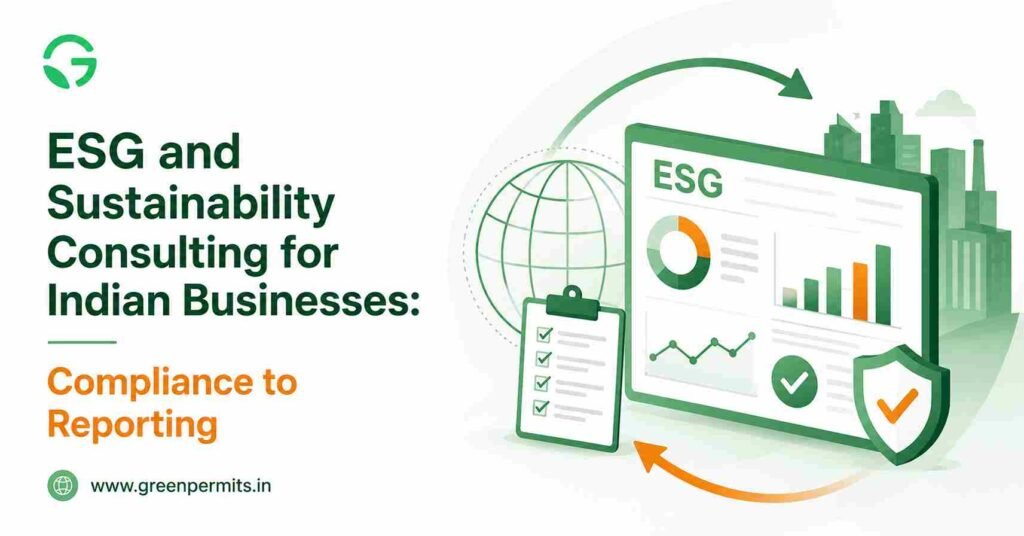
ESG sustainability consulting India helps a business identify, measure, improve and report its Environmental, Social and Governance performance. It connects legal compliance, environmental data, business risk, sustainability targets and reporting requirements into one practical system.
For Indian companies, ESG is not limited to listed companies anymore. SEBI’s BRSR framework directly applies to the top 1000 listed entities by market capitalization. However, the impact is much wider because listed companies now ask their suppliers, vendors and value-chain partners for ESG data.
This means an MSME that supplies parts, packaging, machinery, chemicals, batteries, electronics or recycled materials may also need ESG documentation. Even if the MSME is not directly filing BRSR, its buyer may ask for energy data, emissions data, waste records, labour policies, EPR compliance and pollution control approvals.
The role of ESG consulting is to make this process clear and practical. It helps the company understand what data is required, where the data is available, how it should be calculated, how records should be maintained and how gaps should be corrected before reporting.
A strong ESG system usually covers GHG accounting, BRSR support, sustainability reporting, materiality assessment, EPR compliance, environmental authorization, CPCB portal filings, supplier ESG checks and internal policy development.
Earlier, many businesses treated sustainability as a separate marketing activity. That approach no longer works. Buyers, banks, investors and regulators now expect data-backed sustainability claims.
If a company says it is reducing emissions, it should have electricity consumption data, fuel records and GHG calculations. If it claims circular economy performance, it should have EPR certificates, recycler invoices, waste manifests and disposal records. If it claims responsible manufacturing, it should have consent copies, monitoring reports, safety records and worker training data.
This shift is important because ESG is moving from self-declaration to evidence-based reporting. A company cannot build credible ESG reporting only with photos, CSR activities or general sustainability statements.
For many Indian businesses, the real challenge is not lack of intention. The challenge is lack of structured data. Electricity bills may be with accounts, waste records with the plant team, compliance certificates with consultants, employee data with HR and supplier details with procurement. ESG consulting brings these records into one system.
A practical ESG system helps businesses reduce audit delays, improve buyer confidence, prepare for BRSR-style disclosures and reduce regulatory risk.
Indian ESG compliance is connected with multiple rules, authorities and reporting frameworks. SEBI’s BRSR framework is one of the most important reporting requirements for listed entities. It covers business responsibility, sustainability performance, governance, employees, environment, consumers and community impact.
For environmental data, companies must also consider laws such as the Environment Protection Act, 1986, Water Act, Air Act, E-Waste Management Rules, Battery Waste Management Rules, Plastic Waste Management Rules, Hazardous Waste Rules and ELV Rules 2025.
For exporters, ESG is also linked with international requirements. The EU CBAM system is important for carbon-intensive sectors such as iron and steel, aluminium, cement, fertilisers, hydrogen and electricity. From 2026, exporters in covered sectors need stronger emissions data because buyers will focus more on embedded carbon.
India’s Carbon Credit Trading Scheme is also increasing the importance of emissions monitoring and decarbonisation planning. Energy-intensive sectors will gradually need better systems to track greenhouse gas emissions, reduction targets and carbon performance.
| Regulation / Framework | Requirement | Timeline / Deadline | Applicable To | Business Risk |
|---|---|---|---|---|
| SEBI BRSR | ESG disclosure in annual report | Annual reporting cycle | Top 1000 listed companies | Weak disclosure, investor concern |
| BRSR Core | Assessment-ready ESG KPIs | Phased implementation | Large listed entities | Data verification failure |
| Value-chain ESG disclosure | ESG data from suppliers and vendors | Phased applicability | Listed companies and value-chain partners | Supplier rejection, audit delay |
| Environment Protection Act, 1986 | Environmental compliance and enforcement | Ongoing | Industrial and waste-related businesses | Penalty, closure direction |
| CPCB / SPCB Consent | CTE and CTO approvals | Before setup and operation | Manufacturing and recycling units | Production halt, refusal of CTO |
| EPR Rules | Registration, targets, returns and certificates | Financial year based | Producers, importers, brand owners, recyclers | Portal suspension, compensation |
| ELV Rules 2025 | Vehicle EPR and scrapping targets | Effective from 1 April 2025 | Vehicle producers, importers, RVSFs | EPR liability, certificate gap |
| EU CBAM | Embedded carbon reporting | Definitive regime from 2026 | Exporters in covered sectors | Export cost increase, buyer risk |
A company cannot prepare reliable ESG reporting if its compliance records are incomplete. This is especially true for manufacturing units, importers, recyclers, plant owners and businesses dealing with regulated waste streams.
For example, a battery importer must check Battery EPR registration, import data, sales records, EPR targets, certificate procurement and return filing. A plastic packaging brand owner must check PIBO registration, plastic category, EPR certificates and annual filing. An e-waste producer must check EPR registration, product category, sales data and recycler certificate transactions.
For plant owners, ESG data starts even before production begins. The company needs land documents, DPR, CTE, CTO, pollution control systems, waste management plan, water balance, energy requirement and worker safety systems.
If these records are missing, the company may still be able to write an ESG report, but it will not be strong enough for buyer audits, investor review or assurance.
Important compliance records include consent to establish, consent to operate, hazardous waste authorization, EPR registration, annual returns, quarterly returns, electricity bills, fuel records, water bills, waste manifests, recycler agreements and emission monitoring reports.
A good ESG system is built on monthly data, not last-minute estimates. Businesses should create a simple ESG data tracker for every plant, warehouse, office and operating location.
Environmental data should include electricity consumption in kWh, diesel consumption in litres, fuel consumption in kg or MT, water withdrawal in KL, wastewater generation in KL, waste generation in kg or MT and recycling or disposal quantity.
Social data should include total employees, contract workers, safety incidents, training hours, grievance records, gender diversity, wages, health and safety measures and contractor compliance.
Governance data should include policies, board oversight, legal cases, anti-bribery controls, risk management systems, supplier code of conduct, whistle-blower mechanism and internal review process.
For a manufacturing unit, even 12 months of well-maintained data can significantly improve ESG reporting quality. For exporters and listed-company suppliers, monthly records are better because buyer questionnaires often ask for year-wise and site-wise data.
GHG accounting is one of the most important parts of ESG consulting. It helps a company calculate greenhouse gas emissions from its operations and value chain.
Scope 1 emissions are direct emissions from sources owned or controlled by the company. This includes diesel generators, boilers, furnaces, company vehicles and process emissions.
Scope 2 emissions come from purchased electricity, steam, heating or cooling. For many Indian factories, Scope 2 is a major part of the carbon footprint because electricity consumption is high.
Scope 3 emissions come from the value chain. This may include purchased raw materials, logistics, employee travel, waste disposal, product use and end-of-life treatment. Scope 3 is often the most difficult to calculate because it needs supplier and customer-side data.
A practical first step is to calculate Scope 1 and Scope 2 emissions for the last 12 months. After that, the company can gradually build Scope 3 data for priority categories such as purchased goods, transport and waste.
BRSR is India’s key ESG reporting format for listed companies. It includes disclosures on business ethics, product responsibility, employee wellbeing, human rights, environment, public policy, inclusive growth and customer responsibility.
BRSR Core focuses on selected ESG indicators that need stronger internal controls and assessment readiness. These indicators include areas such as greenhouse gas emissions, water, waste, employee wellbeing, gender diversity, business conduct and consumer complaints.
The value-chain reporting requirement is important for suppliers. When large listed companies need ESG data from their value chain, they ask vendors to share information on energy, emissions, waste, labour, safety, human rights and governance practices.
This creates a direct impact on MSMEs. A small or mid-sized manufacturer may not be listed, but it may still need ESG data because it supplies to a listed company. This is one of the biggest reasons why ESG sustainability consulting India is now relevant for non-listed businesses also.
EPR compliance India is closely connected with ESG reporting. EPR stands for Extended Producer Responsibility. It makes producers, importers and brand owners responsible for environmentally sound management of products or packaging after use.
EPR applies across multiple waste streams such as plastic waste, e-waste, battery waste, tyre waste and end-of-life vehicles. The exact registration process, targets and certificate mechanism depend on the applicable rules.
For ESG reporting, EPR documents are valuable because they prove that the company is not only selling products but also taking responsibility for waste recovery, recycling or disposal.
For example, under ELV Rules 2025, producer EPR targets are linked with steel used in vehicles. The target is 8% for FY 2025-26 to FY 2029-30, 13% for FY 2030-31 to FY 2034-35 and 18% from FY 2035-36 onward. This type of numerical target makes ESG circularity claims more measurable.
For e-waste and battery waste, EPR certificate mechanisms also help prove recovery and recycling. These certificates can support ESG disclosures related to waste reduction, circular economy and responsible product lifecycle management.
| Step | Responsibility | Suggested Timeline | Key Documents | Risk if Delayed |
|---|---|---|---|---|
| ESG gap assessment | Management and ESG consultant | Week 1 to 2 | Approvals, policies, bills, returns | Missing baseline |
| Compliance review | EHS and compliance team | Week 2 to 4 | CTE, CTO, EPR, authorizations | Regulatory gaps |
| Data mapping | Plant, HR, accounts, procurement | Month 1 to 2 | Energy, water, waste, HR data | Wrong reporting |
| GHG calculation | ESG and operations team | Month 2 to 3 | Fuel bills, electricity bills, process data | Weak carbon disclosure |
| EPR review | CPCB portal team | Month 2 to 3 | GST, PAN, CIN, IEC, sales data | Portal rejection |
| Materiality assessment | Management and stakeholders | Month 3 to 4 | Risk register, stakeholder inputs | Generic report |
| Draft ESG report | ESG reporting team | Month 4 to 5 | Data sheets, evidence files | Incomplete disclosure |
| Internal review | Senior management | Month 5 to 6 | Corrected data and approvals | Greenwashing risk |
| Final reporting | Board and compliance team | Annual cycle | BRSR, ESG report, assurance file | Filing delay |
ESG risk is not limited to a weak report. In India, ESG risk can become a legal, operational and commercial issue if environmental compliance is incomplete.
CPCB rejection can happen when applications contain incorrect category selection, mismatched GST details, missing product data, incomplete IEC documents, wrong sales information or weak supporting documents.
SPCB refusal can happen when a plant does not meet consent conditions, pollution control requirements, wastewater treatment norms, hazardous waste storage rules or monitoring requirements.
Environmental compensation can apply when EPR obligations, waste management rules or environmental directions are not followed. Under Section 15 of the Environment Protection Act, 1986, non-compliance with provisions, rules, orders or directions may lead to legal consequences depending on the case.
The business risks are often immediate. A company may face customs hold, buyer rejection, portal suspension, production halt, delayed CTO renewal or loss of tender qualification.
Common risks include CPCB rejection, EPR portal suspension, SPCB refusal, environmental compensation, customs delay, production stoppage, buyer audit failure and greenwashing allegations.
An effective ESG roadmap should begin with compliance and data, not report design. A good-looking ESG report without evidence can create more risk than benefit.
The first 30 days should focus on identifying gaps. This includes checking CTE, CTO, EPR registration, waste authorization, water records, electricity bills, fuel data, HR records, safety systems and governance policies.
The next 60 days should focus on data systems. Each ESG metric should have a responsible person, source document, calculation method and reporting frequency.
The next 90 to 180 days should focus on improvement. This may include energy reduction, renewable energy planning, water efficiency, waste recovery, EPR correction, supplier screening, worker safety training and policy updates.
A practical roadmap can be divided into 5 stages:
0 to 30 days – ESG gap assessment
30 to 60 days – compliance and data mapping
60 to 90 days – EPR, consent and authorization correction
90 to 120 days – GHG inventory and materiality assessment
120 to 180 days – ESG reporting and assurance readiness
Green Permits helps Indian businesses connect environmental compliance with ESG reporting. This is important because ESG reports are only reliable when the underlying compliance records are complete.
For manufacturers and plant owners, Green Permits can support CTE, CTO, pollution control license India, hazardous waste authorization, DPR preparation, plant compliance planning and SPCB approval process.
For importers, brand owners and producers, Green Permits can support EPR registration, CPCB portal filing steps, documentation, return filing readiness and compliance tracking.
For ESG managers and compliance heads, Green Permits can help organize ESG data, create evidence files, prepare BRSR-style disclosures, support GHG accounting and improve sustainability reporting systems.
The goal is not to make sustainability look good only on paper. The goal is to make the business ready for regulatory review, buyer audit, investor due diligence and long-term compliance.
ESG sustainability consulting India is becoming essential because businesses are now expected to prove their sustainability performance with numbers, documents and verified records.
A company may have strong operations, but if it cannot show emissions data, water records, waste disposal proof, EPR certificates, safety records and governance systems, it may lose business opportunities.
The cost of early ESG and compliance preparation is usually much lower than the cost of delayed approvals, buyer rejection, environmental compensation, customs hold or production stoppage.
For Indian manufacturers, importers, exporters, recyclers, plant owners and MSMEs, the practical approach is clear. Build the compliance foundation first. Track ESG data every month. Correct gaps early. Report only what can be supported with evidence.
A structured ESG system helps businesses reduce risk, improve buyer confidence, support financing, prepare for BRSR, manage carbon requirements and operate more responsibly.
📞 +91 78350 06182
📧 wecare@greenpermits.in