
A Bio-CNG project often looks attractive on paper long before the first tonne of feedstock reaches the plant.
A promoter identifies land near a sugar-producing belt, speaks with a few sugar mills and hears that large quantities of press mud are generated every crushing season. Machinery suppliers share quotations, the proposed capacity is fixed at 5 TPD or 10 TPD CBG, and the financial model starts showing promising numbers.
Then the questions become more practical.
How much press mud is actually available for sale? How much is already committed to compost manufacturers, farmers or other Bio-CNG projects? Will the same quantity be available next season? What happens when crushing falls by 15%? How much material can realistically be stored? And most importantly, what will one tonne of press mud actually cost after loading, transportation, unloading, storage and handling?
This is where many Bio-CNG projects move from an attractive concept to a serious investment decision.
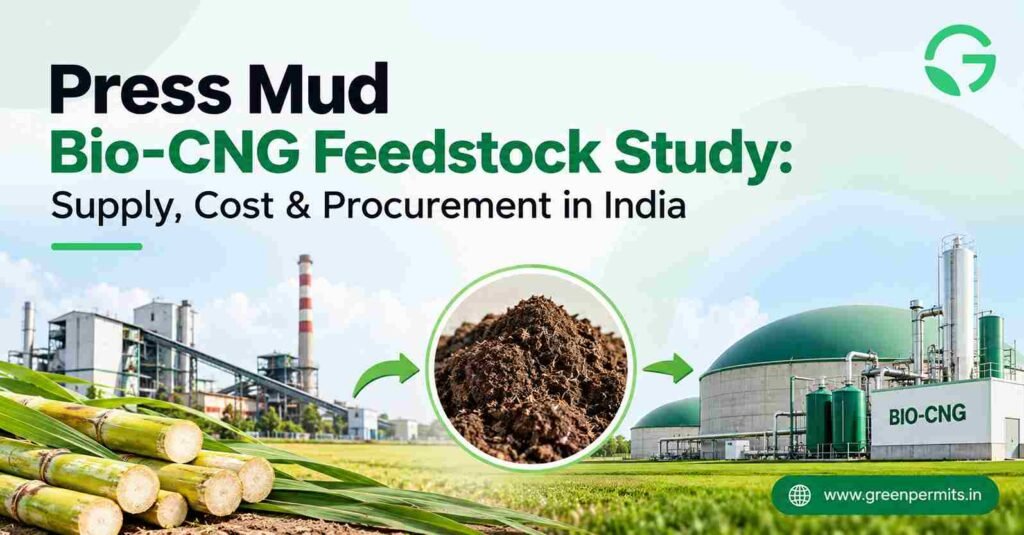
For a press mud based Bio-CNG plant, machinery is important, gas purification is important and CBG offtake is important. But the project starts with something much simpler: Can you secure enough feedstock, at the right quality and cost, for most of the operating year?
A proper Press Mud Bio-CNG Feedstock Study answers this before plant capacity, CAPEX and project returns are finalized.
Press mud is a semi-solid organic residue generated during sugar manufacturing. It is removed during clarification and filtration of sugarcane juice and contains organic matter that can be suitable for anaerobic digestion.
India has one of the world’s largest sugar industries. Sugarcane production during 2025-26 was around 500 million tonnes, which means the overall theoretical resource base for sugar industry residues is significant.
For Bio-CNG developers, press mud has several advantages. It is generated at identifiable industrial locations, usually in bulk quantities, and can be easier to aggregate than highly fragmented agricultural residues.
It is also biologically suitable for anaerobic digestion when the feedstock characteristics and plant process are properly matched.
However, availability at national level does not mean availability for an individual project. A Bio-CNG plant cannot run on national statistics. It runs on actual tonnes delivered to the plant gate every day.
That difference is exactly why a feedstock study is necessary.
One of the most common mistakes in project development is deciding the CBG capacity first and trying to arrange feedstock later.
A promoter may decide:
“We want to install a 5 TPD Bio-CNG plant.”
But a more reliable approach is:
Available feedstock -> Feedstock quality -> Gas potential -> Sustainable annual supply -> Plant capacity -> Technology -> DPR -> Financial model
This sequence reduces the risk of developing an oversized project.
For preliminary planning, some industry studies use approximately 25 tonnes of press mud to produce 1 tonne of CBG. This should be treated only as a screening benchmark because actual gas production changes with feedstock quality, moisture, volatile solids, methane potential, retention time and digestion technology.
Using that preliminary benchmark, a 5 TPD CBG plant operating for 330 days would require:
5 tonnes CBG per day x 25 tonnes press mud x 330 days = 41,250 tonnes of press mud per year
That means the project may need roughly 125 tonnes of press mud every operating day.
For a 10 TPD CBG project, the same screening assumption would indicate approximately 82,500 tonnes of press mud per year.
These numbers show why feedstock procurement cannot be treated as a secondary activity.
The first step is not to ask a sugar mill, “Do you have press mud?”
The real questions are:
For early-stage calculations, some sugar projects use press mud generation of around 3% to 4% of cane crushed. This percentage must not be treated as a guaranteed industry-wide value. Actual generation should always be verified from the sugar mill’s historical production records.
Consider a sugar mill crushing 10 lakh tonnes of cane in a season.
At an illustrative 4% press mud generation rate:
10,00,000 tonnes cane x 4% = 40,000 tonnes press mud
At first glance, this looks almost sufficient for a 5 TPD CBG project requiring about 41,250 tonnes annually under the earlier screening assumption.
But the project developer still cannot assume that all 40,000 tonnes are available.
Part of the quantity may already be sold. Some may be used for composting. Another Bio-CNG developer may be negotiating with the same mill. Actual cane crushing may also decline in a weak season.
This is why gross generation and commercially available quantity are two different numbers.
Press mud is linked to sugarcane crushing, while a Bio-CNG plant is usually expected to operate for most of the year.
A sugar mill may generate large volumes during its crushing season, but the Bio-CNG plant may plan to operate for around 300 to 330 days annually.
This creates a seasonal mismatch.
Suppose a plant needs 41,250 tonnes of press mud per year. If a large part of that material becomes available within only 4 or 5 months, the plant needs a strategy to carry enough feedstock into the non-crushing period.
A serious feedstock study should therefore prepare a monthly material balance.
For every month, the study should show:
This monthly calculation can completely change the project design.
A proposed 5 TPD CBG plant may look feasible based on annual press mud generation but may face a 3-month feedstock gap once seasonality is considered.
A sugar mill may quote press mud at ₹1,600 per tonne.
That does not mean the Bio-CNG plant’s feedstock cost is ₹1,600 per tonne.
The project should calculate the delivered plant-gate cost.
A proper cost structure may include:
Ex-mill press mud price + loading + transportation + unloading + storage + internal handling + preprocessing + losses
Industry-level financial studies have used approximately ₹1,500 to ₹2,000 per tonne as an indicative press mud price range for economic modelling.
Using a requirement of 41,250 tonnes per year:
At ₹1,500 per tonne:
41,250 x ₹1,500 = ₹6.19 crore per year
At ₹2,000 per tonne:
41,250 x ₹2,000 = ₹8.25 crore per year
That is a difference of more than ₹2 crore annually before considering transportation or storage.
Even a small change matters.
If feedstock cost increases by only ₹100 per tonne:
41,250 x ₹100 = ₹41.25 lakh additional annual cost
At ₹500 per tonne:
₹2.06 crore additional annual cost
At ₹1,000 per tonne:
₹4.13 crore additional annual cost
This is why feedstock price sensitivity should be included in the financial model before investors rely on projected EBITDA, DSCR or payback period.
Two sugar mills may offer press mud at the same ex-mill price, but the delivered economics can be completely different.
Assume one mill is 15 km from the proposed plant and another is 70 km away.
The second supplier may still be useful for contingency supply, but depending on vehicle capacity, loading conditions and freight rates, it may significantly increase the delivered feedstock cost.
Transport economics become more important because press mud is not a high-value material relative to its bulk.
The feedstock study should therefore map suppliers by distance bands, such as:
Instead of creating an arbitrary procurement radius, each supplier should be evaluated on delivered cost.
A plant located 10 km closer to two major sugar mills may sometimes have better long-term economics even if the land itself is slightly more expensive.
A discussion with the sugar mill owner is useful.
A long-term project, however, needs more than a verbal assurance.
Press mud is increasingly being treated as a commercially valuable material. Sugar mills can sell it through tenders, annual contracts or negotiated supply arrangements.
That means today’s available material may have another buyer next year.
A feedstock procurement strategy can generally use four models.
The Bio-CNG plant is developed by the sugar mill or within the same group.
This can reduce procurement and logistics risk, but cane crushing still needs to be evaluated carefully because captive ownership does not guarantee the same quantity every year.
A Bio-CNG developer signs a multi-year supply agreement with a sugar mill.
This can improve project visibility if quantity, pricing, quality and dispatch obligations are clearly defined.
The project sources from 2, 3 or more sugar mills.
This reduces dependence on one supplier but increases logistics coordination and transport costs.
Press mud is purchased through annual tenders or spot arrangements.
This gives flexibility, but it creates greater risk for a project carrying large debt because neither price nor quantity may be secured for the following season.
For an independent Bio-CNG project, depending completely on one mill under a one-season arrangement can create unnecessary risk.
A supply agreement should not simply say that the sugar mill will “provide press mud as available.”
The commercial clauses should be specific enough to support the project’s operating plan.
Important points include:
The financial model should also include a downside case if the contracted supplier provides less material than expected.
Press mud storage is not simply about keeping a pile of material inside the plant boundary.
Storage affects land requirement, working capital, drainage, internal movement, odour, leachate, material handling and feedstock quality.
The correct storage requirement should come from the monthly feedstock model.
For example, suppose the plant receives substantially more press mud than it consumes during December, January and February. The excess quantity has to be stored for use later.
The maximum inventory level may occur near the end of the crushing season.
If the monthly model shows peak inventory of 12,000 tonnes, the project should design storage around that requirement rather than using an arbitrary rule such as “three months of feedstock.”
Storage design should then consider actual bulk density, moisture, stack height, access roads, loader movement, drainage and environmental controls.
Two samples of press mud may not produce exactly the same amount of methane.
Feedstock characteristics can vary because of sugarcane quality, filtration process, moisture and handling.
Before finalizing the DPR, representative samples should be tested.
Typical feedstock evaluation may consider:
A Biochemical Methane Potential test can help the technology provider estimate realistic gas generation from the actual material.
This is much stronger than copying a gas-yield number from another project.
Consider an illustrative 5 TPD CBG project planned near a sugar-producing cluster.
The initial project concept assumes approximately 41,250 tonnes of press mud per year.
Three nearby sugar mills appear to generate a combined 75,000 tonnes annually.
On paper, feedstock coverage looks excellent.
After detailed verification, however, the picture changes.
Mill A generates 30,000 tonnes, but 12,000 tonnes are already committed to existing buyers.
Mill B generates 25,000 tonnes, but is willing to commit only 10,000 tonnes under a one-year agreement.
Mill C generates 20,000 tonnes, but is located 85 km from the proposed site, making delivered transport cost considerably higher.
The project’s realistically dependable supply may therefore be closer to:
18,000 tonnes from Mill A + 10,000 tonnes from Mill B = 28,000 tonnes
That creates a shortfall of:
41,250 – 28,000 = 13,250 tonnes per year
Now the promoter has several choices.
The plant can secure part of the requirement from Mill C, reduce the proposed CBG capacity, identify another sugar mill, introduce a compatible co-feedstock or redesign the procurement strategy.
The feedstock study has not delayed the project.
It has prevented the promoter from building capacity that may remain underutilized.
A good feedstock study should not produce only one “available tonnes” number.
It should test the project under different operating conditions.
For example:
Base Case
Normal sugarcane crushing, contracted quantities received and normal transport cost.
Downside Case 1
Press mud price increases by ₹500 per tonne.
Downside Case 2
Primary supplier delivers 20% less material.
Downside Case 3
Sugarcane crushing declines by 15%.
Downside Case 4
Average transport distance increases by 25 km.
Downside Case 5
The project must purchase an alternate feedstock for 60 operating days.
The financial model should show what happens to production cost, EBITDA, cash flow and debt-service capability under these conditions.
A Bio-CNG project that remains workable under reasonable downside assumptions is much stronger than one that only works under an ideal feedstock price.
Before the DPR is finalized, the study should answer six practical questions.
How much press mud can actually be secured annually?
During which months will it be available, and how much needs to be stored?
What is the realistic biomethane potential of the proposed feedstock?
What is the true delivered cost per tonne?
Are quantities supported by contracts, tenders or only verbal discussions?
What happens if one major supplier fails?
These six answers should then feed directly into the plant capacity, storage design, technology selection and financial model.
A Detailed Project Report becomes meaningful only when its key assumptions can be defended.
For a press mud Bio-CNG project, the most important assumptions include:
If feedstock cost is underestimated by ₹500 per tonne on a 41,250-tonne annual requirement, the financial model can be wrong by more than ₹2 crore every year.
That is not a minor adjustment.
It can change project viability.
Green Permits supports Bio-CNG developers from early project screening to DPR and implementation planning.
For a press mud based project, our work can include feedstock catchment mapping, sugar mill assessment, historical crushing analysis, procurement planning, delivered cost modelling, storage estimation, alternate feedstock assessment, capacity validation, DPR preparation and regulatory approval planning.
The objective is not to create an optimistic project report.
The objective is to determine what capacity the available feedstock can realistically support and build the project around verified assumptions.
For Bio-CNG projects, one principle should remain clear:
Secure the feedstock first. Size the plant second.
🌐 Website: https://www.greenpermits.in
📞 +91 78350 06182
📧 wecare@greenpermits.in
👉 Book a Consultation with Green Permits