
Imagine an entrepreneur who has decided to start a plastic recycling business in India. After weeks of research, he finds a suitable industrial plot, receives quotations from machinery suppliers and identifies companies willing to purchase recycled plastic granules.
Everything looks promising until he begins the approval process.
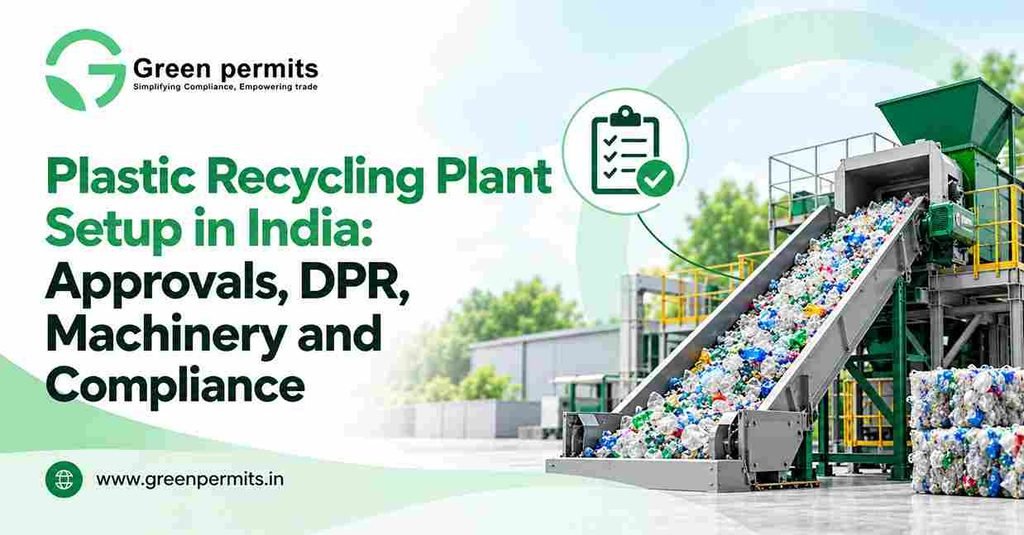
The machinery supplier has proposed a production capacity of 5 tonnes per day, but the factory layout does not include adequate space for raw material storage. The proposed washing system requires wastewater treatment, which was not included in the original investment estimate. The Detailed Project Report (DPR) also contains different production figures from those mentioned in the machinery quotation.
As a result, the entrepreneur must revise the project documents before moving forward.
This is a common type of challenge that businesses should prepare for when planning a recycling facility.
Plastic recycling plant setup in India involves much more than purchasing machinery and arranging a factory building. It requires proper technical planning, environmental approvals, a financially viable DPR, pollution-control systems and compliance with applicable plastic waste management regulations.
India’s plastic recycling sector offers opportunities for manufacturers, entrepreneurs and investors interested in converting discarded plastic into reusable industrial raw materials. However, the success of a recycling plant depends on choosing the right technology, maintaining a reliable supply of plastic waste and obtaining the necessary permissions before starting operations.
This guide explains the complete process of establishing a plastic recycling plant in India, including approvals, machinery, project costs, DPR preparation and ongoing compliance requirements.
A plastic recycling plant is an industrial facility that processes discarded plastic materials into products that can be used again in manufacturing.
Depending on the recycling technology, the final output may include recycled plastic flakes, granules or pellets. These materials can be supplied to manufacturers producing pipes, containers, packaging materials, furniture and other plastic products.
The recycling process usually begins with the collection and segregation of plastic waste. The material is then cleaned, shredded and processed according to its polymer type and intended application.
For example, a plant processing PET bottles may produce washed PET flakes, while an HDPE recycling facility may convert plastic waste into recycled granules through extrusion and pelletising.
The selection of machinery, plant capacity and environmental controls depends on the specific waste stream.
A recycling project should therefore begin with a feasibility assessment rather than a machinery purchase.
Plastic waste management has become an important part of India’s environmental and industrial development.
The Plastic Waste Management Rules, 2016, established a regulatory framework for managing plastic waste. Subsequent amendments strengthened responsibilities relating to collection, processing, recycling and Extended Producer Responsibility (EPR).
Under the EPR framework, covered producers, importers and brand owners must fulfil applicable plastic packaging waste-management obligations. Registered Plastic Waste Processors play an important role in the recycling and processing system.
This has increased the commercial importance of organised plastic waste management.
Recycled plastic also provides manufacturers with an alternative source of raw materials. Depending on quality requirements, recycled polymers can be used in various industrial applications.
However, not every recycling business will automatically become profitable.
Profitability depends on several practical factors:
A successful project needs a reliable business model alongside the required environmental permissions.
Before establishing a facility, entrepreneurs must decide which type of plastic they intend to recycle.
Different polymers require different processing technologies, equipment and quality-control systems.
PET recycling plants generally process discarded beverage bottles and suitable PET packaging waste.
The material is sorted, crushed, washed and dried to produce recycled PET flakes. Some facilities undertake additional processing to manufacture recycled pellets.
For higher-quality applications, more advanced sorting, washing and quality-control systems may be necessary.
High-Density Polyethylene (HDPE) and Polypropylene (PP) are widely used in industrial and consumer products.
Plastic crates, containers, automotive components and certain rigid packaging materials can provide feedstock for these facilities.
The recycling process may include sorting, shredding, washing, drying, extrusion and pelletising.
Low-Density Polyethylene (LDPE) is commonly found in films, certain packaging products and other flexible plastic materials.
Because flexible plastics can contain moisture, dirt and other contaminants, they may require specialised washing and drying arrangements.
Machinery selection should consider the low bulk density and handling characteristics of plastic films.
Mixed plastic recycling involves processing different plastic waste streams.
However, not all polymers can be recycled together using conventional mechanical processes.
Proper segregation and technical evaluation are necessary to determine which materials are suitable for recycling and how non-recyclable fractions should be handled.
Obtaining the correct permissions is one of the most important stages of establishing a plastic recycling facility.
The applicable approvals depend on the proposed location, machinery, manufacturing process, pollution potential and state-specific requirements.
Consent to Establish is an environmental permission issued by the concerned State Pollution Control Board (SPCB) or Pollution Control Committee (PCC).
It is generally required before establishing an industrial facility that falls within the applicable consent framework.
During the application process, the authority examines the proposed manufacturing activity, raw materials, pollution-control arrangements and environmental impacts.
The applicant may need to submit the project report, factory layout, machinery specifications, process flow diagram and details of wastewater and waste generation.
The information submitted must reflect the actual proposed facility.
Consent to Operate is required for applicable industrial units before commencing operations.
After installation, the pollution-control authority may examine whether the facility has been established according to the approved proposal.
The application generally includes details of installed machinery, pollution-control systems, production capacity and waste-management arrangements.
A business should not assume that obtaining CTE automatically permits commercial production.
CTE and CTO serve different purposes and must be obtained according to the applicable requirements.
Plastic recyclers covered under the EPR framework must obtain the applicable Plastic Waste Processor registration through the centralised plastic EPR portal.
The Central Pollution Control Board (CPCB) issued a Standard Operating Procedure for Plastic Waste Processor registration on 15 March 2022.
The procedure covers registration, submission of supporting documents and examination of processing facilities by the concerned authority.
PWP registration is especially relevant to recyclers planning to participate in the plastic waste EPR certificate system.
Some recycling operations may generate hazardous waste, such as certain used oils or contaminated residues.
If the waste and activities fall within the Hazardous and Other Wastes (Management and Transboundary Movement) Rules, 2016, the facility must comply with the applicable authorisation and waste-handling requirements.
Depending on the project and location, additional requirements may include a factory licence, fire-safety approval, building permissions and other local registrations.
The complete approval checklist should be prepared before finalising the land or starting construction.
A properly planned project follows a sequence in which technical decisions and regulatory approvals support one another.
Step 1: Conduct a feasibility study
Evaluate the proposed plastic waste stream, availability of suppliers, expected recovery, processing technology and demand for recycled output.
Step 2: Select suitable industrial land
Check land-use permissions, road connectivity, water availability, electrical infrastructure and requirements for storing incoming waste.
Step 3: Finalise plant capacity and machinery
Determine the proposed input capacity and select equipment capable of processing the chosen material.
Step 4: Prepare the DPR
Develop the technical, financial and environmental details of the project.
Step 5: Apply for Consent to Establish
Submit the proposed plant information and supporting documents to the concerned pollution-control authority.
Step 6: Install machinery and pollution-control systems
After obtaining the applicable establishment permissions, proceed with construction, machinery installation and required safety arrangements.
Step 7: Obtain Consent to Operate
Apply for operating consent once the facility is ready for the relevant assessment.
Step 8: Complete PWP registration
Submit the required documents through the prescribed EPR registration system and obtain approval as applicable.
Once all necessary permissions are in place, the facility can begin operations while maintaining the required compliance records.
A Detailed Project Report is one of the most important planning documents for a recycling project.
It explains how the proposed plant will operate, how much investment it requires and whether the business is technically and financially feasible.
A properly prepared plastic recycling plant DPR also helps align machinery, infrastructure and environmental approval applications.
The technical section describes the proposed recycling process, input material, installed capacity, machinery specifications and utility requirements.
It should include the process flow diagram and expected material recovery.
For example, a facility designed to process 5 tonnes of plastic waste per day must have machinery, storage and utilities suitable for that capacity.
The financial section estimates the initial investment, operating expenses, working capital and potential revenue.
It should consider machinery utilisation, material losses and fluctuations in raw material prices.
A project that appears profitable at full capacity may produce weaker returns if the plant operates below its planned utilisation.
The DPR should explain the expected wastewater, air emissions, solid waste and processing rejects.
Where required, it should also describe the proposed Effluent Treatment Plant (ETP), pollution-control equipment and waste disposal arrangements.
A comprehensive DPR makes it easier to evaluate the project before committing substantial capital.
Machinery selection depends on the polymer type, incoming material quality and desired output.
A typical mechanical plastic recycling facility may require the following equipment:
| Machinery | Main function |
|---|---|
| Sorting conveyor | Separates different plastics and contaminants |
| Shredder or crusher | Reduces the size of plastic waste |
| Washing equipment | Removes dirt and surface contaminants |
| Float-sink tank | Helps separate suitable materials |
| Friction washer | Improves cleaning efficiency |
| Dryer | Removes moisture from processed material |
| Extruder | Processes plastic into a molten material stream |
| Pelletiser | Converts processed plastic into granules |
| Testing equipment | Checks relevant material quality parameters |
Not every project requires all these machines.
A plant selling washed plastic flakes may not need extrusion and pelletising equipment. Similarly, dry industrial scrap may require less washing than heavily contaminated post-consumer material.
Before placing machinery orders, entrepreneurs should verify rated capacity, electricity consumption, water requirements, warranty conditions and after-sales support.
The land requirement for a plastic recycling plant cannot be determined using a single standard figure.
A compact shredding unit may require significantly less space than a washing and pelletising facility with large raw material storage areas.
The plant layout should provide space for incoming waste, sorting, processing, finished products, rejected materials and vehicle movement.
Electricity is another major consideration. Shredders, extruders, dryers and auxiliary systems contribute to the overall connected load.
Water requirements depend on the selected process.
A dry recycling facility may consume relatively little process water, while a washing-based facility may require substantial water treatment and recirculation arrangements.
The DPR should calculate these requirements using actual machinery data and expected operating hours.
The cost of setting up a plastic recycling plant depends on the proposed capacity, technology, automation, location and infrastructure.
A basic shredding or grinding facility will have a different investment profile from a complete washing and pelletising plant.
The total project cost should include:
An important consideration is that machinery cost alone does not represent the complete investment.
For example, if an investor receives a machinery quotation of ₹50 lakh, the project budget must still account for site development, installation, utilities, pollution-control equipment and operational cash requirements.
The ₹50 lakh figure is an illustration, not a standard market quotation.
A reliable investment estimate should be based on supplier offers and project-specific engineering calculations.
Consider a hypothetical entrepreneur planning an HDPE and PP recycling facility in India.
The proposed plant has a plastic waste input capacity of 5 metric tonnes per day and is expected to operate for 26 days per month.
At full planned utilisation, monthly plastic waste input would be:
5 tonnes × 26 days = 130 tonnes per month
Now assume the process produces saleable recycled material equal to 80% of the incoming plastic waste.
The expected output would be:
130 tonnes × 80% = 104 tonnes of recycled material per month
The remaining 26 tonnes would include processing rejects, contaminants and other material or moisture losses, depending on the process.
These are illustrative assumptions, not guaranteed industry recovery rates.
The financial impact of small changes can be significant.
If the net selling price of recycled material decreases by ₹5 per kilogram, the monthly revenue impact at the assumed output volume would be:
104,000 kg × ₹5 = ₹5.20 lakh per month
Similarly, a reduction of just 1 percentage point in saleable recovery would reduce monthly output by 1,300 kilograms at the assumed 130-tonne input level.
This example demonstrates why plant profitability depends on feedstock quality, recovery efficiency and product pricing, not simply the installed machinery capacity.
A DPR should examine these factors before the investment decision.
Extended Producer Responsibility is an important part of India’s plastic waste management framework.
Under the applicable EPR provisions, covered producers, importers and brand owners are responsible for meeting specified plastic packaging waste-management obligations.
Registered Plastic Waste Processors can participate in the system through eligible processing activities.
Depending on regulatory requirements, verified processing data and the approved activity, a processor may become eligible to generate relevant EPR certificates.
However, PWP registration does not automatically guarantee EPR certificate generation or income.
The recycler must maintain accurate information regarding waste received, processed material, recovered products and waste disposal.
Businesses should also distinguish between plastic waste purchased, plastic waste processed and material eligible for certificate generation.
The Plastic Waste Management framework has continued to evolve since 2016.
For example, the Plastic Waste Management (Amendment) Rules, 2025, notified on 23 January 2025, introduced additional plastic packaging information requirements for covered producers, importers and brand owners, effective from 1 July 2025.
These packaging-related provisions should not be confused with the separate registration and operational requirements applicable to recyclers.
Plant operators should review current CPCB portal instructions and applicable amendments before submitting returns or regulatory information.
A plastic recycler should prepare its documentation before starting the registration process.
According to the CPCB’s PWP registration framework, applicants may need to provide business identification, pollution consent, process details and facility-related information.
Important documents include PAN, GST details, applicable incorporation records, process flow diagrams, relevant consents and geo-tagged photographs of plant machinery and operating areas.
Electricity bills, waste-characterisation information, authorised-person details and occupational safety documents may also form part of the application.
Hazardous waste authorisation must be provided where applicable.
The exact document requirements should be checked against the latest registration procedure.
Importantly, the production capacity, machinery information and site details should remain consistent across the DPR, pollution consents and PWP application.
Many recycling projects face difficulties because regulatory compliance is considered only after machinery procurement.
An entrepreneur may purchase equipment based on a supplier’s advertised capacity without considering the practical space, electricity demand or environmental arrangements necessary to operate it.
Other common issues include incorrect process descriptions, inadequate wastewater planning and differences between the proposed and installed machinery.
Projects can also face financial challenges if the expected quantity or quality of plastic waste is unavailable.
A recycling facility should therefore finalise its technical assumptions and compliance requirements before making major investment commitments.
Establishing a recycling facility requires coordination between machinery suppliers, technical professionals, financial advisers and regulatory authorities.
A plastic recycling plant consultant can help review the proposed technology, identify applicable approvals and prepare consistent technical documentation.
Green Permits provides consulting support for recycling plant establishment, including feasibility assessment, DPR preparation, environmental approvals and regulatory compliance planning.
The objective is to help businesses understand project requirements early and reduce avoidable documentation problems during establishment and registration.
Setting up a plastic recycling plant in India can be a valuable business opportunity, but it requires careful planning from the beginning.
A technically sound plant needs more than machinery. It requires suitable land, a reliable waste supply, an accurate DPR, pollution-control arrangements and the necessary regulatory approvals.
Entrepreneurs who evaluate these requirements before investing are better positioned to avoid expensive modifications and operational delays.
Whether the proposed facility will process PET, HDPE, PP or other suitable plastics, the first step should be to establish a realistic project plan supported by technical and financial information.
With appropriate planning and compliance support, businesses can develop recycling facilities that contribute to resource recovery and India’s circular economy.
Green Permits helps entrepreneurs, manufacturers and investors with plastic recycling plant feasibility studies, DPR preparation, CTE and CTO documentation, Plastic Waste Processor registration and environmental compliance consulting.
Get expert guidance on planning your recycling project and preparing the necessary approvals.
🌐 Website: https://www.greenpermits.in
📞 Phone: +91 78350 06182
📧 Email: wecare@greenpermits.in
Book a Consultation with Green Permits Today.
Begin by selecting the plastic waste category and conducting a feasibility study. Choose suitable industrial land, prepare a DPR, finalise machinery and obtain the required environmental approvals. Complete applicable PWP registration before undertaking activities that require it.
Plastic recyclers covered by the applicable PWP framework must obtain registration through the prescribed centralised portal. The concerned SPCB or PCC handles registration under the relevant procedure.
Investment depends on capacity, machinery, infrastructure, technology and working capital. A project-specific DPR and machinery quotations are necessary for a reliable estimate.
CTE concerns permission to establish an applicable industrial facility, while CTO concerns permission to operate it. Both are issued by the concerned pollution-control authority under the applicable legal framework.
A DPR is important for project planning, financing and technical evaluation. Whether a particular authority requires a DPR or specified project-report information depends on the applicable approval process.