
Imagine investing ₹5 crore in a vehicle scrapping plant, installing modern machinery, hiring skilled workers and completing the required approvals. Everything looks ready for operations. But after a few months, the plant is processing only 8 vehicles per day instead of the planned 20.
The machinery is available, employees are on the payroll and electricity bills continue to arrive. The problem is not the technology. It is the shortage of vehicles available for scrapping at commercially viable prices.
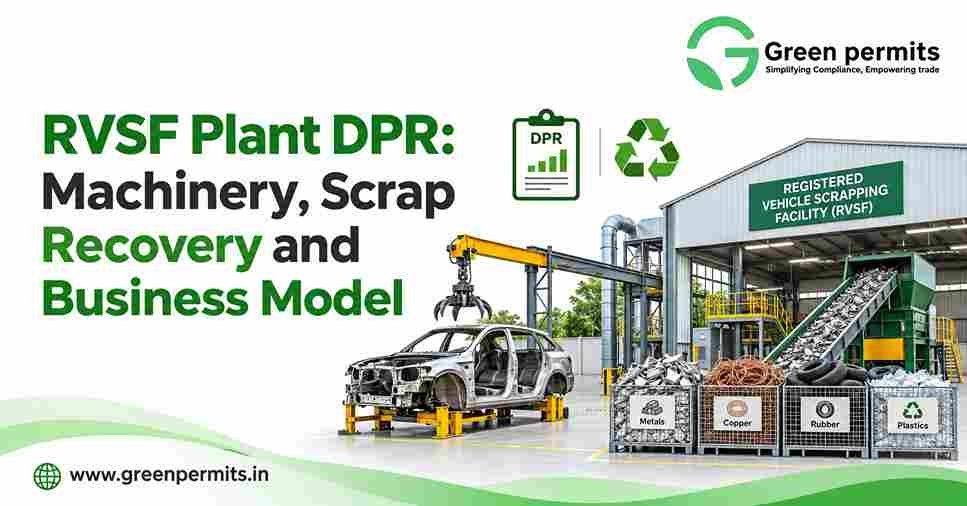
This is one of the biggest risks entrepreneurs need to understand before investing in a Registered Vehicle Scrapping Facility (RVSF).
India’s vehicle recycling industry is creating opportunities for businesses interested in recovering steel, aluminium, copper and other valuable materials from End-of-Life Vehicles (ELVs). The Extended Producer Responsibility (EPR) framework has introduced another potential revenue stream through eligible steel recovery certificates.
However, a profitable vehicle scrapping business requires much more than machinery and government approvals.
A professionally prepared RVSF Plant Detailed Project Report (DPR) helps investors understand the complete business model, including machinery requirements, vehicle procurement, scrap recovery, investment, operating expenses, financial projections and regulatory compliance.
Before investing crores of rupees, the most important question is not how many vehicles a plant can process. It is how many vehicles the business can consistently procure, process and recycle profitably.
An RVSF Plant DPR is a detailed technical and financial report prepared to evaluate the feasibility of establishing a Registered Vehicle Scrapping Facility in India.
It explains how the plant will operate, what machinery is required, how much investment is needed and how revenue will be generated through recovered materials and other eligible activities.
Unlike a basic business plan, a DPR combines engineering, environmental compliance, market research and financial modelling.
For example, if an entrepreneur wants to establish a facility with a capacity of 15 vehicles per day, the DPR must determine whether sufficient vehicles are available within the proposed collection area.
It should also evaluate the machinery needed to process those vehicles, the quantity of recoverable materials, the operating cost per vehicle and the expected revenue.
A comprehensive RVSF project report generally covers plant capacity, market demand, machinery specifications, material recovery, land requirements, utilities, environmental approvals, manpower, investment, working capital and projected profitability.
For entrepreneurs seeking bank financing, a detailed DPR also provides financial projections such as cash flow, break-even analysis, Internal Rate of Return (IRR), Debt Service Coverage Ratio (DSCR) and investment payback.
India has introduced a regulatory framework to encourage environmentally sound handling and scrapping of End-of-Life Vehicles.
The Motor Vehicles (Registration and Functions of Vehicle Scrapping Facility) Rules, 2021 established a framework for registered vehicle scrapping facilities.
The Environment Protection (End-of-Life Vehicles) Rules, 2025 were subsequently notified on 6 January 2025 and came into effect on 1 April 2025.
These rules introduced an Extended Producer Responsibility framework for eligible vehicles.
Under this system, registered vehicle scrapping facilities can generate EPR certificates based on eligible steel recovered from End-of-Life Vehicles, subject to regulatory requirements and verification.
Vehicle producers can purchase these certificates to fulfil applicable EPR obligations.
This development creates an additional commercial opportunity alongside traditional scrap recovery.
A vehicle contains several materials with potential economic value. Steel from the body and chassis can enter metal recycling channels, while aluminium, copper and selected components may generate additional income.
Nevertheless, government regulations alone cannot ensure profitability. A facility must establish reliable vehicle procurement, efficient operations and dependable buyers for recovered materials.
That is where a detailed feasibility study becomes important.
Machinery selection directly affects plant investment, processing capacity and operating efficiency.
An RVSF designed for dismantling passenger cars will require a different machinery configuration from a facility processing heavy commercial vehicles.
Similarly, a plant focused on manual and semi-automatic dismantling may require less investment than an integrated facility equipped with industrial shredding and advanced separation systems.
The major equipment commonly considered during RVSF plant planning includes:
| Machinery | Main Function |
|---|---|
| Weighbridge | Measures incoming vehicles and outgoing scrap |
| Vehicle lifting system | Supports safe dismantling |
| Depollution equipment | Removes fuel, oil, coolant and other fluids |
| Refrigerant recovery system | Recovers air-conditioning refrigerants |
| Hydraulic dismantling tools | Removes vehicle components |
| Hydraulic cutting machine | Cuts metal structures |
| Hydraulic baling press | Compresses recovered metal scrap |
| Industrial shredder | Processes dismantled vehicle shells |
| Magnetic separator | Separates ferrous metals |
| Eddy-current separator | Recovers selected non-ferrous metals |
| Forklift and material handler | Moves vehicles and scrap |
| Pollution-control equipment | Supports environmentally safe operations |
Consider a plant designed to process 15 vehicles per day over an 8-hour shift.
The available operating time is approximately 480 minutes.
If the facility relies on only one dismantling station, its processing capability may be insufficient to complete all activities at the planned throughput.
A better configuration might use multiple workstations, allowing depollution, dismantling and material segregation to operate simultaneously.
The DPR should calculate the processing time required at each stage and identify potential bottlenecks.
Machinery should not be selected only because a supplier recommends a particular model. The final equipment configuration should match the intended capacity, vehicle mix, safety requirements and projected material throughput.
A large shredder can improve processing efficiency in high-capacity operations, but it also increases machinery investment, electricity consumption, maintenance expenses and infrastructure requirements.
Some RVSF business models may focus on depollution, dismantling, segregation and baling, followed by sending prepared material to suitable downstream processors.
Whether on-site shredding is required depends on the approved processing model, technical requirements and applicable regulations.
An entrepreneur should therefore compare the economics of installing a shredder against using suitable downstream processing arrangements.
The primary business activity of an RVSF is converting old vehicles into recoverable materials.
A vehicle reaching the end of its useful life is not entirely waste. Different components and materials can be separated for recycling or other permitted uses.
The process normally begins with receiving and verifying the vehicle, followed by weighing, depollution, dismantling and segregation.
During depollution, hazardous fluids and materials are removed to reduce environmental and safety risks.
The vehicle is then dismantled to recover metals, components, plastics, glass and other materials.
Steel and aluminium are separated, copper wiring is removed and suitable materials are prepared for dispatch to downstream buyers or authorised recycling facilities.
Steel and ferrous metals: Vehicle bodies, chassis and structural components contain significant quantities of ferrous material. Steel recovery often forms a major part of the scrap revenue model.
Aluminium: Engine components, wheels and certain structural parts may contain recoverable aluminium.
Copper: Wiring harnesses, electrical motors and other electrical components contain copper that can be recovered through appropriate dismantling and separation.
Reusable components: Selected mechanical components may retain value, depending on their condition and applicable restrictions.
Plastics, tyres and glass: These materials require segregation and suitable recycling or disposal arrangements.
Batteries and hazardous materials: Waste batteries, used oil, refrigerants and other regulated materials must be handled and channelised according to the applicable waste-management rules.
The actual material composition varies according to vehicle type, model, age and condition.
For this reason, a DPR should include a material balance prepared using project-specific vehicle data rather than assuming every vehicle produces identical quantities of scrap.
Before estimating revenue, investors must understand the relationship between installed capacity and actual processing volume.
Consider an illustrative facility designed to process 15 passenger vehicles per day.
| Parameter | Illustrative Value |
|---|---|
| Daily capacity | 15 vehicles |
| Annual working days | 300 |
| Installed annual capacity | 4,500 vehicles |
| Assumed utilisation | 60% |
| Vehicles processed annually | 2,700 |
| Average incoming vehicle weight | 1,200 kg |
| Annual vehicle input | 3,240 MT |
At 60% utilisation, the plant processes approximately 2,700 vehicles annually rather than its maximum capacity of 4,500.
This difference significantly affects revenue.
For example, if the average operating contribution is ₹5,000 per vehicle, processing 2,700 vehicles generates ₹1.35 crore of annual contribution before deducting fixed operating expenses.
At 4,500 vehicles, the same contribution per vehicle generates ₹2.25 crore.
The difference is ₹90 lakh annually.
These are illustrative financial assumptions, not guaranteed operating margins. They demonstrate why capacity utilisation must be evaluated before purchasing machinery.
An RVSF generally operates through a combination of material recovery, component sales and eligible EPR certificate transactions.
The business model should identify each source of revenue separately.
Steel is one of the primary recovered materials from vehicle dismantling.
Recovered steel can be sold to appropriate metal recyclers, processors and industrial buyers.
Revenue depends on the quantity recovered, material grade, contamination level and prevailing market prices.
Non-ferrous metals may generate attractive revenue per kilogram compared with ordinary ferrous scrap.
However, recovery quantities depend heavily on the type and design of vehicles being dismantled.
A DPR should estimate aluminium and copper recovery separately rather than applying one combined metal value.
Certain dismantled components may have secondary-market value where reuse and sale are legally permitted.
Their commercial value depends on condition, compatibility, demand and inspection requirements.
For conservative financial planning, reusable-component revenue should not be overstated.
Under the ELV EPR framework, eligible RVSFs can generate certificates linked to steel recovered from applicable End-of-Life Vehicles.
These certificates may be transacted with producers fulfilling their EPR obligations.
However, the DPR should not assume a fixed EPR certificate price or guaranteed annual revenue.
Certificate generation, eligibility, verification and transactions depend on the applicable regulatory and portal requirements.
A financially responsible project report should calculate profitability both with and without potential EPR certificate income.
Consider an illustrative business case involving an entrepreneur planning to establish a vehicle scrapping facility in an industrial area.
The proposed facility is designed to process 15 passenger vehicles daily over 300 operating days.
The entrepreneur initially estimates profitability based on the maximum annual capacity of 4,500 vehicles.
However, the DPR examines the local availability of ELVs and develops a more conservative operating model.
For the first operating stage, it assumes 60% capacity utilisation, equivalent to 2,700 vehicles annually.
The DPR then prepares an illustrative contribution model for each vehicle.
| Financial Parameter | Amount per Vehicle |
|---|---|
| Steel scrap sales | ₹16,800 |
| Aluminium recovery | ₹8,400 |
| Copper recovery | ₹4,500 |
| Other eligible material/component sales | ₹5,000 |
| Total illustrative revenue | ₹34,700 |
| Vehicle procurement | ₹22,000 |
| Processing expenses | ₹6,500 |
| Collection and logistics | ₹1,200 |
| Contribution before fixed expenses | ₹5,000 |
The scrap revenue calculations use hypothetical recovered quantities and selling prices for demonstration. They are not current verified scrap-market quotations or guaranteed vehicle recovery values.
At 2,700 vehicles annually, the business generates an illustrative contribution of ₹1.35 crore before fixed expenses, depreciation, financing costs and taxes.
Now consider what happens when vehicle procurement costs increase by ₹5,000 per vehicle.
The additional annual procurement cost becomes:
2,700 vehicles × ₹5,000 = ₹1.35 crore
Under the otherwise unchanged assumptions, the entire original contribution would be eliminated.
This case study highlights an important lesson: vehicle acquisition cost and sourcing efficiency can have a greater impact on profitability than small savings in machinery operating costs.
A proper DPR should test these variables before concluding that a project is financially viable.
The cost of establishing an RVSF depends on plant capacity, location, infrastructure and machinery configuration.
A project involving industrial land purchase and integrated shredding equipment may require substantially higher investment than a smaller dismantling and baling facility operating on leased land.
Instead of relying on one generic investment figure, the DPR should divide costs into two categories.
CAPEX includes land development, industrial sheds, machinery, electrical infrastructure, pollution-control systems, material-handling equipment and installation.
The report should also account for engineering, commissioning, contingency and pre-operative expenditure.
OPEX includes vehicle procurement, salaries, electricity, collection and transportation, maintenance, consumables, insurance, administration and waste-management expenses.
Working capital deserves particular attention.
For example, if a facility purchases 15 vehicles daily at an average price of ₹22,000, daily procurement spending alone reaches ₹3.30 lakh.
For 20 operating days, vehicle purchases would total ₹66 lakh, assuming all vehicles are purchased at that price.
Actual working capital depends on payment terms, processing time, inventory turnover and scrap-sale collections. The DPR must model these cash movements carefully.
Vehicle scrapping facilities must operate within India’s applicable automotive and environmental regulatory frameworks.
The Motor Vehicles (Registration and Functions of Vehicle Scrapping Facility) Rules, 2021 govern RVSF registration and related operational requirements.
The Environment Protection (End-of-Life Vehicles) Rules, 2025 introduced the ELV EPR framework.
Depending on the project configuration and location, the promoter may also need to address Consent to Establish, Consent to Operate, hazardous-waste authorisation, fire safety, factory-related permissions and other applicable approvals.
CPCB’s January 2026 RVSF EPR portal SOP requires information relating to facility capacity, installed equipment, pollution-control devices and different categories of waste handled.
It also provides an RVSF EPR portal registration fee structure based on installed annual scrapping capacity.
| Installed Annual Scrapping Capacity | Portal Registration Fee |
|---|---|
| Up to 6,000 ELVs | ₹25,000 |
| Above 6,000 to 15,000 ELVs | ₹50,000 |
| Above 15,000 to 30,000 ELVs | ₹75,000 |
| Above 30,000 ELVs | ₹1,00,000 |
The January 2026 SOP also specifies an annual processing fee equivalent to 50% of the registration application fee at the time of filing returns.
These fees relate to the EPR portal and are separate from plant development costs, professional charges and other statutory approvals.
An entrepreneur may estimate profitability by multiplying expected profit per vehicle by annual capacity.
However, this approach ignores several important business variables.
A bankable RVSF DPR should evaluate revenue under different levels of vehicle availability and changes in scrap selling prices.
It should also account for depreciation, interest expenses, loan repayment schedules and working capital requirements.
Financial projections should include EBITDA, cash flow, break-even capacity, DSCR, IRR and payback period.
For example, if machinery and infrastructure investments remain unchanged while annual throughput falls by 40%, the fixed costs must be absorbed by fewer vehicles.
This increases the cost per vehicle and can weaken operating margins.
The DPR should therefore answer a practical question: Can the plant remain financially sustainable even if vehicle supply develops more slowly than expected?
One common mistake is selecting machinery before assessing the availability of End-of-Life Vehicles.
Another is assuming that the plant will immediately operate at maximum capacity.
Entrepreneurs may also underestimate collection costs, working capital, maintenance requirements and the expense of handling hazardous waste.
Overestimating material recovery can create unrealistic revenue projections, while treating EPR certificate income as guaranteed can make the financial model excessively optimistic.
A reliable DPR should use documented assumptions, realistic utilisation levels, properly estimated machinery costs and sensitivity analysis.
The financial projections should also match the proposed plant layout, equipment capacity and vehicle mix.
Establishing a vehicle scrapping facility requires coordination between technical planning, environmental compliance, financial feasibility and business development.
Green Permits supports entrepreneurs and investors with RVSF feasibility studies, Detailed Project Report preparation, machinery planning, project cost estimation and regulatory compliance guidance.
Our consulting approach helps businesses evaluate vehicle sourcing, processing capacity, material recovery, infrastructure requirements and financial viability before committing investment.
Whether the proposed project involves a small dismantling facility or a larger integrated vehicle recycling operation, a project-specific DPR provides a foundation for informed planning.
An RVSF Plant DPR evaluates the technical, commercial, environmental and financial feasibility of establishing a Registered Vehicle Scrapping Facility.
Investment varies according to capacity, land, machinery, automation and infrastructure. A project-specific cost estimate is necessary to determine the required investment.
Typical equipment includes vehicle lifts, depollution systems, dismantling tools, hydraulic cutters, baling presses and material-handling equipment. Shredding and advanced separation machinery depend on the proposed processing model.
Revenue may come from recovered steel, aluminium, copper, eligible reusable components, other materials and EPR certificates generated under applicable requirements.
Potentially, yes. Eligible EPR certificates can create additional revenue, but certificate prices, demand and transactions are not guaranteed.
India’s vehicle scrapping industry offers business opportunities in material recovery, automotive recycling and environmentally responsible waste management.
However, building a profitable RVSF requires careful planning.
Machinery selection, vehicle sourcing, scrap recovery, working capital and regulatory compliance must be evaluated together rather than as separate activities.
A properly prepared RVSF Plant DPR helps investors estimate project costs, understand revenue opportunities, assess financial risks and make informed investment decisions.
The success of a vehicle scrapping facility ultimately depends not only on how many vehicles its machinery can process, but on how efficiently the business can source vehicles, recover materials and sell its output.
For entrepreneurs planning to enter the vehicle recycling sector, investing in a detailed feasibility study before establishing the facility can help prevent costly planning mistakes.
Explore our detailed guide on Vehicle Scrapping Plant Setup in India: RVSF License, Cost and Approvals to understand the broader plant establishment and registration requirements.
Planning to establish a Registered Vehicle Scrapping Facility in India?
Green Permits provides support for RVSF project feasibility, DPR preparation, machinery planning, financial modelling and environmental approvals.
Website: https://www.greenpermits.in/
📞 +91 78350 06182
📧 wecare@greenpermits.in