
A businessman planning to enter India’s vehicle recycling industry identifies a two-acre industrial property, contacts machinery suppliers and starts calculating the potential revenue from recovered steel, aluminium and copper. His initial plan is to establish a facility capable of scrapping 15 vehicles every day.
The business looks promising. Used vehicles are available, scrap metals have established markets and India’s vehicle scrappage policy is encouraging organised recycling. However, when he begins discussing the project with regulatory consultants, he discovers that purchasing machinery and obtaining one registration will not be enough.
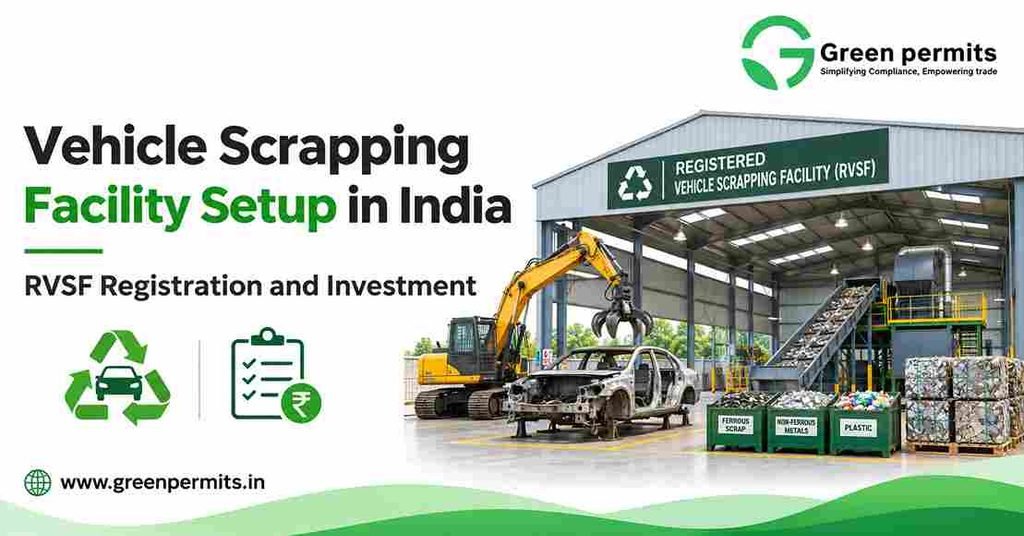
He needs a Registered Vehicle Scrapping Facility (RVSF) registration, environmental approvals, proper depollution infrastructure, hazardous waste management arrangements and registration under the End-of-Life Vehicle (ELV) EPR framework.
More importantly, he needs to establish whether enough vehicles will actually reach his facility to justify the investment.
This is where many vehicle scrapping projects face their first major challenge.
Vehicle scrapping facility setup in India is not simply about dismantling old cars. It involves building a legally compliant recycling operation with a reliable vehicle supply chain, suitable infrastructure and a financially sustainable business model.
For investors, recyclers and entrepreneurs, understanding RVSF registration, machinery requirements, project investment and revenue opportunities is essential before committing capital.
A Registered Vehicle Scrapping Facility is an authorised establishment responsible for dismantling and scrapping end-of-life vehicles in an environmentally sound manner.
Unlike conventional scrap yards, an RVSF follows a structured process to recover useful materials while safely managing hazardous components.
A typical vehicle contains steel, aluminium, copper, plastics, rubber, glass, batteries, engine oil, fuel and electronic components. These materials cannot all be processed or disposed of in the same way.
For example, a passenger car may contain approximately 60% to 70% ferrous materials by weight, although the actual composition depends on its model, age and construction.
The facility must first remove hazardous liquids and components before dismantling and separating materials for recycling or authorised downstream processing.
India’s RVSF framework is governed primarily by the Motor Vehicles (Registration and Functions of Vehicle Scrapping Facility) Rules, 2021, as amended.
Additionally, the Environment Protection (End-of-Life Vehicles) Rules, 2025 introduced an Extended Producer Responsibility framework that became effective on 1 April 2025.
This has created additional compliance and business considerations for registered vehicle scrapping facilities.
India has a large automotive market, with millions of passenger vehicles, commercial vehicles and two-wheelers operating across the country.
As vehicles age, their maintenance costs generally increase. Some become economically unviable, fail fitness requirements or are voluntarily surrendered by their owners.
The government’s vehicle scrappage framework aims to encourage environmentally sound disposal and material recovery through authorised facilities.
The opportunity extends beyond the removal of old vehicles from roads.
Scrapping allows valuable materials to re-enter manufacturing supply chains. Recovered steel can be supplied to metal processors, while aluminium, copper and other recyclable materials can generate additional revenue.
However, the difference between market opportunity and actual project profitability is substantial.
A vehicle scrapping facility needs consistent incoming vehicles, competitive procurement prices, reliable scrap buyers and controlled operating expenses.
For example, a plant designed to process 5,000 vehicles annually but receiving only 1,500 vehicles will operate at 30% utilisation.
Even if its machinery is technically efficient, low throughput may make it difficult to recover fixed costs.
That is why feedstock availability and project feasibility should be studied before establishing an RVSF.
One of the most common misunderstandings among new investors is that RVSF registration and CPCB ELV registration are the same.
They serve different purposes.
A vehicle scrapping facility must obtain registration under the Motor Vehicles (Registration and Functions of Vehicle Scrapping Facility) Rules, 2021, including applicable amendments.
The registration process is linked to the State or Union Territory where the proposed facility will operate and is facilitated through the National Single Window System.
The regulatory framework covers eligibility, required documentation, operational conditions and facility requirements.
The 2024 amendments also strengthened the integration of pollution-control approvals into the RVSF framework.
The Environment Protection (End-of-Life Vehicles) Rules, 2025 introduced a separate environmental compliance system.
Under this framework, Registered Vehicle Scrapping Facilities are required to register on the centralised ELV EPR portal.
The portal facilitates registration, reporting and the generation and transaction of EPR certificates.
RVSFs can generate EPR certificates based on eligible recovered steel quantities, subject to applicable rules and material accounting requirements.
The distinction is important: an RVSF registration does not automatically replace the separate environmental and ELV EPR obligations.
Setting up an RVSF requires coordinated planning across several stages.
The approval sequence should be established before construction or machinery procurement begins.
The first step is to estimate the number of end-of-life vehicles available within the proposed collection area.
A feasibility study should examine vehicle registrations, ageing fleets, potential institutional suppliers, existing RVSFs and transportation costs.
For instance, a facility planning to scrap 15 vehicles daily would require approximately 4,500 vehicles annually if it operates 300 days a year at full capacity.
Whether this target is achievable depends on vehicle procurement agreements, local competition and access to scrappage channels.
The project should therefore evaluate realistic utilisation rather than assuming that every installed machine will operate at maximum capacity.
The proposed land must accommodate vehicle movement, storage, depollution, dismantling and segregated material handling.
Industrial land is generally preferable, subject to the applicable State rules and land-use permissions.
Land requirement depends on the type of vehicles, processing capacity and technology.
A facility handling passenger cars and two-wheelers may have different space requirements from a facility processing buses and heavy commercial vehicles.
A project may consider approximately 1 to 2 acres as an initial planning assumption for certain smaller or medium configurations, but this is not a universal statutory minimum. The actual requirement must be verified against State-specific conditions, capacity and the proposed plant layout.
A Detailed Project Report (DPR) establishes the technical and financial basis of the RVSF.
It should explain how vehicles will be procured, processed and converted into marketable recovered materials.
A professional DPR normally covers vehicle capacity, machinery selection, utilities, manpower, environmental management, material recovery, investment, operating costs and profitability.
Financial projections should account for changing scrap prices and vehicle procurement costs.
The proposed facility must address applicable approvals from the State Pollution Control Board or Pollution Control Committee.
Consent to Establish (CTE) should be obtained in accordance with the RVSF regulatory framework before establishing the facility.
Consent to Operate (CTO), hazardous waste authorisation and other operational permissions must also be addressed as applicable.
The RVSF framework includes a requirement to obtain CTO or apply for it at least 60 days before the commencement of operations. This does not remove the need to comply with the consent conditions applicable before operations begin.
The promoter must submit the required application through the designated registration system.
The authority examines the application, supporting documents and compliance with the applicable RVSF requirements.
The applicant should maintain consistency between the proposed capacity, site information, machinery details and environmental approvals.
Once the relevant establishment approvals and project conditions permit, civil works and machinery installation can proceed.
The facility should include dedicated depollution, dismantling, material segregation and waste-storage areas.
Before beginning commercial operations, the promoter must satisfy the applicable operational requirements.
The RVSF must also complete registration under the CPCB ELV EPR framework and establish the required reporting and record-management systems.
The machinery requirement depends on the chosen technology and whether the project will operate primarily as a dismantling facility or an integrated recycling operation.
A basic vehicle scrapping facility requires equipment for depollution, dismantling, vehicle lifting, material handling and safe storage.
An integrated facility may additionally install shredders, shears, balers and automated metal separation equipment.
| Machinery or equipment | Primary purpose |
|---|---|
| Vehicle lift | Safe access for dismantling |
| Depollution equipment | Removal of oil, fuel and operating fluids |
| Refrigerant recovery unit | Controlled recovery of AC refrigerants |
| Airbag deactivation equipment | Safe handling of safety systems |
| Hydraulic cutting tools | Dismantling and component removal |
| Material handling equipment | Movement of vehicles and recovered materials |
| Baler or shear | Compaction or cutting of metal scrap |
| Industrial shredder | Size reduction of materials, if integrated processing is planned |
| Magnetic separator | Separation of ferrous metals |
| Weighbridge | Vehicle and material weight recording |
Not every RVSF needs an in-house industrial shredder.
A dismantling-based facility can channel suitable recovered materials to registered or authorised downstream recyclers and processors.
This can reduce initial capital expenditure, although it may also affect the value retained from recovered materials.
The machinery selection should therefore be based on throughput, recovery requirements and financial feasibility rather than simply choosing the largest available equipment.
The most important question for many entrepreneurs is: How much investment is required to start a vehicle scrapping facility in India?
There is no single fixed project cost.
Investment depends on location, land cost, capacity, automation, machinery configuration and working capital.
For perspective, a 2026 NITI Aayog analysis used an investment benchmark of approximately ₹14 crore for a model RVSF processing around 20,000 vehicles annually, including land and scrapping machinery.
This is a model benchmark, not a government-prescribed minimum investment or a quotation for every proposed facility.
A smaller dismantling-oriented operation may require a different capital structure from a large integrated facility.
The project budget generally includes land acquisition or lease, site development, industrial shed construction, depollution machinery, dismantling equipment, storage systems and environmental infrastructure.
Additional expenditure includes electrical connections, safety systems, weighing equipment, installation, professional services and pre-operative expenses.
Working capital is particularly important.
Even after the facility becomes operational, the operator may need substantial funds to purchase incoming vehicles before recovering money from the sale of scrap materials.
For this reason, machinery cost alone should never be presented as the total investment required for RVSF setup.
Government registration fees should be budgeted separately from project investment.
For RVSF registration under the Motor Vehicles framework, the National Single Window System specifies a ₹1,00,000 processing fee and a ₹10,00,000 security deposit or bank guarantee.
The security arrangement should be distinguished from a non-refundable fee and treated according to its actual financial terms.
A separate fee structure applies to registration on CPCB’s ELV EPR portal.
The January 2026 CPCB SOP specifies:
| Annual scrapping capacity | CPCB ELV registration fee |
|---|---|
| Up to 6,000 vehicles | ₹25,000 |
| Above 6,000 to 15,000 vehicles | ₹50,000 |
| Above 15,000 to 30,000 vehicles | ₹75,000 |
| Above 30,000 vehicles | ₹1,00,000 |
The SOP also specifies an annual processing fee equivalent to 50% of the application fee at the time of filing returns.
These are two different registration systems and the fees should not be combined into one unexplained amount.
Other expenses such as pollution-control consents, professional fees and local approvals depend on the proposed project and jurisdiction.
Consider an illustrative investment case involving an entrepreneur planning a vehicle scrapping facility with a design capacity of 15 passenger cars per day.
The promoter expects to operate 300 days annually.
At full utilisation, the facility would be capable of processing:
15 vehicles × 300 days = 4,500 vehicles per year
However, a project rarely begins at full capacity.
The investor therefore prepares a financial model using different operating conditions.
| Utilisation | Vehicles processed annually |
|---|---|
| 25% | 1,125 |
| 50% | 2,250 |
| 75% | 3,375 |
| 100% | 4,500 |
For illustration, assume that each processed vehicle generates a contribution of ₹10,000 after vehicle acquisition, directly attributable processing and other variable costs, but before fixed overheads, financing, depreciation and tax.
At 50% utilisation, the estimated annual contribution would be:
2,250 vehicles × ₹10,000 = ₹2.25 crore
At 75% utilisation, the estimated annual contribution increases to ₹3.375 crore.
These are illustrative assumptions, not verified market margins or net-profit forecasts.
The investor must still deduct fixed manpower costs, administration, maintenance, insurance, financing expenses and depreciation. Tax and the actual timing of cash flows must also be considered.
More importantly, the ₹10,000 per-vehicle contribution is not guaranteed. It depends on procurement pricing, vehicle weight, material recovery, scrap selling prices and processing efficiency.
This case study demonstrates why utilisation and per-vehicle economics are central to RVSF investment planning.
A project with lower installed capacity but stronger sourcing arrangements may be financially preferable to a larger facility operating below its potential.
A vehicle scrapping facility can earn revenue by selling recovered materials and, subject to the applicable framework, generating ELV EPR certificates.
Steel is an important recovery product because vehicles contain substantial ferrous material.
Aluminium and copper may generate additional value, depending on recovery quantities and purity.
Reusable components may also have commercial value, provided their handling and resale comply with the applicable requirements.
Other recovered fractions such as plastics, tyres, batteries and electronic parts must be managed through the appropriate authorised recycling channels.
Under the ELV EPR framework, an RVSF can generate certificates linked to the weight of eligible recovered steel.
For example, if a facility processes vehicles and records 1,000 tonnes of qualifying steel scrap, this represents a potential certificate quantity based on the prescribed mechanism, subject to verified accounting, material recovery and compliance conditions.
However, 1,000 tonnes of recovered steel should not automatically be treated as a guaranteed EPR certificate sale or a fixed revenue amount.
Certificate revenue depends on eligibility, portal verification, transaction conditions and demand from obligated Producers.
A financially responsible DPR should therefore show material-sale income and potential EPR certificate revenue separately.
Documentation requirements vary between the RVSF registration process and the CPCB ELV portal.
For the CPCB ELV registration process, the January 2026 SOP seeks business details, facility information, RVSF registration details, environmental approvals, process information, capacity and machinery records.
Typical documents and records include:
New facilities should verify which historical records are applicable to their situation rather than assuming that all documents required from an existing operator must already exist before first commissioning.
Consistency among the application, consent documents and actual installed equipment is especially important.
Regulatory processing and complete project execution are different timelines.
CPCB’s January 2026 ELV portal SOP provides a 15-working-day processing period for RVSF portal applications by the concerned SPCB/PCC.
Incomplete applications may require further information or resubmission.
This timeline does not mean that a complete RVSF project, including site approvals, construction, machinery installation and all registrations, can necessarily be completed within 15 working days.
After commissioning, the facility must maintain records of incoming end-of-life vehicles, recovered materials and quantities dispatched to authorised downstream entities.
Under the 2025 ELV Rules, RVSFs are required to file quarterly returns covering the vehicles received and the materials processed, recycled, refurbished or sent for downstream treatment.
The returns are due by the 30th day of the month following the relevant quarter.
Proper weighment, material accounting and record management should therefore be incorporated into routine plant operations.
One of the most expensive mistakes is selecting a site without verifying its regulatory suitability.
A property may appear commercially attractive because of low land cost, but inadequate access, drainage, zoning or surrounding land-use conditions can complicate approvals.
Another mistake is ordering machinery before finalising the process flow and capacity.
If the installed equipment does not match the proposed throughput or pollution-control design, modifications may be required.
Vehicle procurement is another frequently underestimated area.
An RVSF cannot operate profitably merely because old vehicles exist in the wider market. The business must be able to purchase or receive eligible vehicles at commercially workable prices and transport them efficiently.
Finally, investors sometimes calculate returns using only steel-sale revenue or, at the opposite extreme, assume that EPR certificate revenue will be assured.
Both approaches can lead to inaccurate financial projections.
The better approach is to prepare a detailed material balance and test the project under different vehicle-sourcing, scrap-price and utilisation conditions.
A vehicle scrapping project involves several connected decisions. The project may be technically feasible but financially weak, or commercially attractive but difficult to execute because of site and approval constraints.
Green Permits supports entrepreneurs and businesses planning registered vehicle scrapping facilities through feasibility assessments, Detailed Project Reports, approval planning and environmental compliance advisory.
The consulting process can cover proposed capacity, land suitability, machinery requirements, process layout, pollution-control systems, applicable RVSF registration procedures and CPCB ELV EPR compliance.
For investors approaching banks or financial institutions, a DPR can provide a structured evaluation of project investment, operating expenditure, material recovery, potential revenues and financial risks.
The objective is to identify major technical, commercial and regulatory issues before substantial investment is committed.
RVSF investment depends on capacity, land, machinery and technology. A NITI Aayog model estimated approximately ₹14 crore for a 20,000-vehicle-per-year facility, including land and scrapping machinery. Smaller or differently configured projects require independent feasibility and cost estimation.
Yes, a facility operating as a registered vehicle scrapping facility must meet the applicable Motor Vehicles RVSF registration requirements. Separate environmental and ELV EPR obligations must also be addressed.
Land requirements depend on State-specific rules, proposed throughput, vehicle categories, storage requirements and machinery layout. There is no single nationwide acreage that should be assumed for every project.
Under the January 2026 CPCB ELV portal SOP, the registration fee ranges from ₹25,000 to ₹1,00,000 depending on annual scrapping capacity.
Yes. Eligible recovered steel can support ELV EPR certificate generation through the CPCB portal, subject to the prescribed material accounting and compliance requirements.
India’s vehicle scrapping industry presents opportunities for organised recycling, recovered-material supply and environmentally sound management of end-of-life vehicles.
However, a successful vehicle scrapping facility setup in India requires more than identifying a location and purchasing dismantling equipment.
Investors must evaluate vehicle availability, land suitability, RVSF registration, CPCB ELV compliance, machinery capacity, environmental approvals and the financial impact of operating at different utilisation levels.
The most reliable approach is to complete project feasibility and prepare a detailed investment roadmap before making major capital commitments.
With proper planning, an RVSF can become part of India’s growing circular economy while operating within the applicable regulatory framework.
Planning to establish a vehicle scrapping facility? Green Permits can help you evaluate project feasibility, prepare a Detailed Project Report and plan the necessary regulatory approvals.
Website: https://www.greenpermits.in/
📞 +91 78350 06182