
When EcoVolt Recyclers, a growing lithium battery recycling company from Pune, processed its first 40 tonnes of Li-ion scrap, the team celebrated a major operational milestone. The plant output was clean, the machinery performed flawlessly, and their clients were happy.
Two weeks later, their founder Raghav opened his inbox and froze.
“Your recycler registration may be suspended due to missing EPR certificate uploads.”
Inside the factory, they were doing everything right.
But they missed one simple thing — following the correct EPR certificate workflow on the CPCB portal.
If you’ve ever felt unsure about compliance, certificates, or CPCB rules, this guide is written for you.
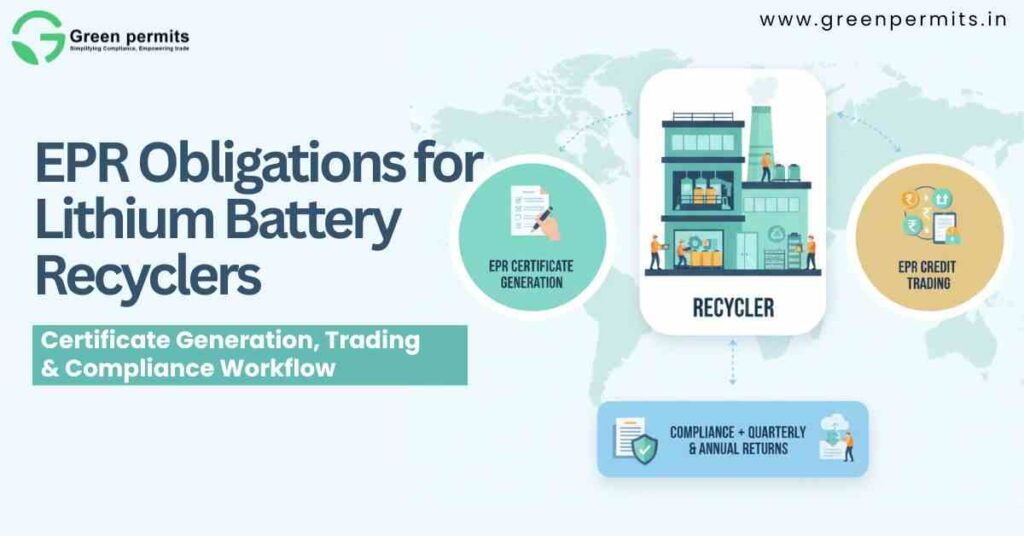
Lithium battery recycling is no longer just a processing exercise. It is a regulated ecosystem where every batch, every kilogram of metal recovered, and every sale invoice plays a part in generating EPR certificates.
Producers depend on recyclers to meet their annual EPR targets.
If the recycler misses a step, both parties face consequences.
This article breaks the process down in a clean, uncomplicated way.
Before earning or selling any certificates, a recycler must:
Why this matters:
You cannot legally operate or sell certificates without this registration.
Many new recyclers lose months waiting because they begin operations without completing the portal process.
After registration:
This data forms the foundation for certificate approval.
Tip:
Maintain a simple digital logbook to avoid mismatches during audits.
Recyclers do not generate certificates for black mass or intermediate material.
Certificates are created only for the actual metals recovered and sold:
Metals in Li-ion Batteries
Metal in Lead-Acid Batteries
Why this matters:
Recovering metals is not enough — selling them with a valid invoice is what triggers certificate generation.
The formula is extremely simple:
EPR Certificate (kg) = Actual Quantity of Metal Recovered and Sold (kg)
Examples:
No claims, no estimates. Only verified metal weight and sale invoices count.
Quarterly returns include:
Quarterly returns must be filed in sequence.
If Q2 is missing, Q3 cannot be submitted.
Once quarterly returns are approved, the system credits the recycler’s wallet with certificates.
Example wallet:
| Metal | Recovered (kg) |
|---|---|
| Lithium | 50 |
| Nickel | 100 |
| Cobalt | 200 |
| Manganese | 100 |
| Aluminium | 100 |
| Iron | 150 |
This wallet is what you use to sell certificates to producers.
Producers buy certificates based on their annual targets.
Trading happens only inside the CPCB portal.
Market insight:
| Metal | Avg Recovery % | Demand | Revenue Potential |
|---|---|---|---|
| Cobalt | 8–12% | Very High | High |
| Nickel | 12–16% | High | High |
| Lithium | 1–2% | Very High | Medium–High |
| Copper | 10–15% | High | Medium–High |
| Aluminium | 20–25% | Medium | Medium |
| Iron | 5–10% | Low | Low |
Interpretation: cobalt, nickel, and lithium drive the highest certificate value.
| Requirement | Mandatory | Notes |
|---|---|---|
| CPCB Registration | Yes | Must be active and valid |
| CTO & HW Authorization | Yes | Should match declared capacity |
| Process Flow Diagram | Yes | Valid for audit checks |
| Metal Sale Invoices | Yes | Required for certificate generation |
| Quarterly Returns | Yes | Must be filed sequentially |
| Annual Returns | Yes | Needed for renewal |
| Geo-tagged Photos | Yes | Must match facility location |
Without invoices, no certificates can be generated.
This results in immediate rejection or inspection.
Even one missed quarter blocks renewal.
This leads to incorrect metal estimates and certificate issues.
Purity matters for certificate quantity and acceptance.
EPR compliance is not complicated once the workflow is clear.
For recyclers, EPR certificates are not just a legal requirement—they are an important revenue source and a competitive advantage.
By maintaining clean records, filing returns on time, and documenting every sale, recyclers can:
If compliance feels overwhelming, expert guidance can save both time and money.
📞 +91 78350 06182
📧 wecare@greenpermits.in
Book a Consultation with Green Permits