
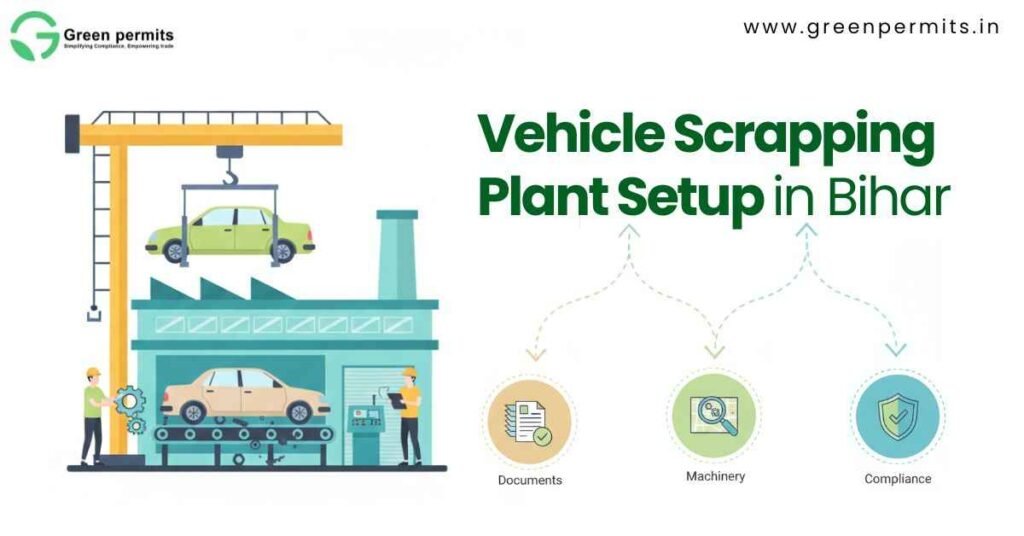
Setting up a Registered Vehicle Scrapping Facility (RVSF) in Bihar has become a strong business opportunity driven by rising vehicle numbers, government incentives, and the push for environmentally responsible disposal of End-of-Life Vehicles (ELVs). This guide provides a clear view of the market landscape, approval workflow, investment needs, and compliance expectations for entrepreneurs exploring this sector.
Bihar is experiencing a steady increase in old vehicles reaching end-of-life due to expanding urban centres, higher vehicle ownership, and aging government fleets. This creates predictable ELV availability for scrapping operators.
A new RVSF can secure consistent supply contracts with government bodies, private logistics companies, schools, hospitals, and insurance firms. Since the number of operational facilities in Bihar is still limited, early entrants enjoy higher market share and visibility.
This region benefits from well-developed road connectivity, active industrial pockets, and proximity to vehicle dealerships and large commercial fleets. The steady inflow of urban vehicles makes this one of the strongest choices for RVSFs aiming for 40–60 vehicles/day capacity.
A major trade hub with heavy movement of buses, tourist vehicles, and light commercial vehicles. Land pricing is comparatively moderate, helping investors reduce upfront CAPEX. Its location supports operations targeting northern Bihar districts.
Gaya is strategically positioned on national highways and has consistent commercial traffic. The region suits small to medium RVSFs catering to both urban users and surrounding rural markets.
A site located close to major transport corridors reduces procurement travel cost, speeds up dismantling turnaround, and improves logistics flow. Proper zoning also speeds up pollution control approvals.
A sustainable scrapping business depends on reliable ELV inflow. Bihar provides multiple high-volume sources.
| ELV Source Category | Estimated Share (%) | Why It Matters |
|---|---|---|
| Government & PSU Fleets | 25–30% | Often auctioned in bulk, predictable inflow |
| Private Fleets & Logistics | 30–35% | High turnover of diesel and LCV vehicles |
| Individual Vehicle Owners | 20–25% | Supported by incentive schemes |
| Insurance & Accidental Vehicles | 10–15% | Higher scrap value and reusable components |
Business insight
Securing MoUs with fleet operators and participating in government scrap auctions can significantly stabilize monthly ELV volumes.
Setting up a compliant scrapping facility requires approvals from both state and central authorities. Each approval ensures that the facility meets safety, environmental, and operational standards.
1. RVSF License (Vehicle Scrappage Facility License)
Issued by Bihar Transport Department as per MoRTH Scrappage Rules. It validates the infrastructure, machinery, safety systems, and digital processes of the scrapping facility.
2. CTE (Consent to Establish) from Bihar State Pollution Control Board
Mandatory before construction and installation of machinery. It confirms that the project layout and pollution mitigation systems follow environmental norms.
3. CTO (Consent to Operate)
Issued after installation, it allows the facility to start operations legally.
4. Authorization for Hazardous Waste Handling
Required due to handling of oils, coolants, batteries, airbags, e-waste components, and other regulated materials.
5. Factory Registration & Local NOCs
Depending on land location, power requirement, and workforce size, local approvals may also be needed.
A non-compliant facility risks suspension, penalties, and cancellation of RVSF license. Proper documentation ensures smooth inspections and lowers long-term regulatory risk.
Investment depends on plant size, machinery configuration, and land price. Below are realistic estimates used in most modern scrapping facilities.
| Plant Type | Vehicles/Day | Approx. CAPEX (₹) | Monthly OPEX (₹) |
|---|---|---|---|
| Small RVSF | 20–30 | 1.2–1.8 crore | 10–14 lakh |
| Medium RVSF | 40–60 | 2.2–3.5 crore | 16–22 lakh |
Medium-sized facilities achieve better economies of scale, improving per-vehicle profit margins and reducing operational downtime.
While Bihar has not launched a scrappage-specific incentive, existing industrial policies provide meaningful financial advantages.
These incentives can collectively reduce effective project cost and support early-stage profitability.
Scrapped material feeds directly into large and growing downstream industries.
Diversifying buyers strengthens cash flow and protects against price fluctuations in scrap markets. Establishing long-term agreements with mills significantly boosts revenue predictability.
A properly functioning RVSF must maintain high compliance standards throughout the lifecycle of each vehicle.
Any mismatch in documentation or improper fluid disposal can trigger inspections, suspension, or monetary penalties. Maintaining a detailed digital record is essential.
This is the recommended implementation plan for launching a vehicle scrapping plant in Bihar.
1. Select Suitable Land
Ensure industrial zoning, road connectivity, and adequate space for machinery and storage.
2. Apply for CTE (Pollution Control Board)
Submit plant design, machinery list, pollution mitigation systems, and environmental safeguards.
3. Apply for RVSF License
Provide land documents, digital infrastructure details, staff training plan, and machinery proof.
4. Install Machinery
Set up depollution, dismantling, sorting, and baling lines.
5. Recruit and Train Workforce
Ensure safety training and technical skill development.
6. Integrate with Vahan Scrapping Portal
Mandatory for generating certificates and reporting vehicle data.
7. Apply for CTO and Begin Operations
Conduct trial runs, safety checks, and regular compliance assessments.
Most facilities become operational within 4–6 months when documentation and planning are handled correctly.
Bihar presents a strong and underserved market for vehicle scrapping facilities. With rising ELV volume, expanding transport networks, and supportive industrial policies, investors can build a profitable and compliant RVSF with the right planning. Clear approvals, strong sourcing networks, and efficient operations form the foundation of long-term success.
Call: +91 78350 06182
Email: wecare@greenpermits.in
→ Book a Consultation with Green Permits and start your scrappage plant journey today!