
Importing Electronics into India 2026: BIS, CRS & EPR Compliance Checklist for First-Time Importers

  • Home
  • EPR
  • Importing Electronics into India 2026: BIS, CRS & EPR Compliance Checklist for First-Time Importers

A Delhi-based electronics importer brought in his first shipment of 8,000 lithium power banks. Payment cleared. IEC active. Distributor orders confirmed.

Then customs flagged the consignment. The BIS registration was filed — but not approved. The CPCB EPR registration was “under process.”

The container sat at port for 27 days. Demurrage crossed ₹3.8 lakh. Two distributors withdrew. Working capital froze.

This is the reality of importing electronics into India 2026 — compliance delays now cost more than customs duty.
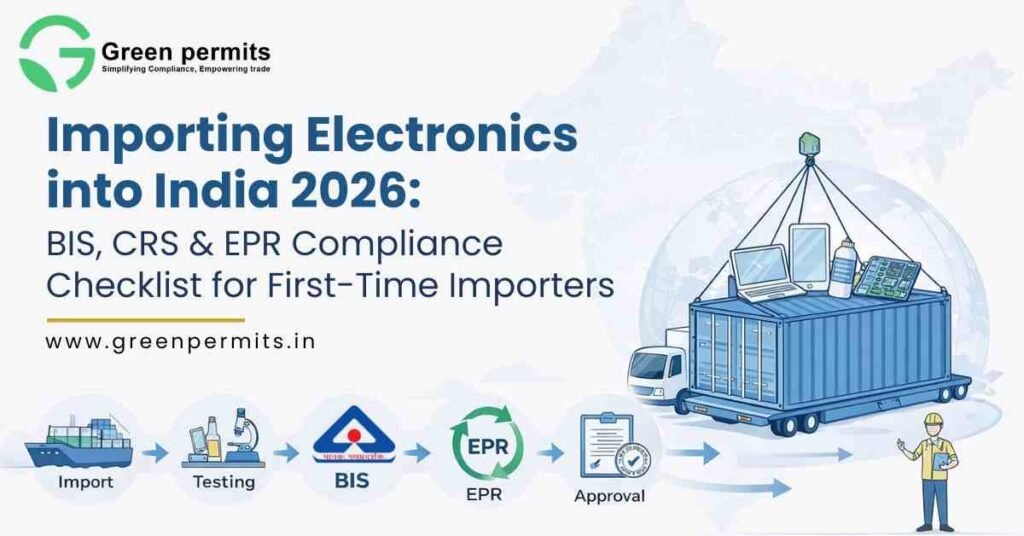
BIS CRS Registration – The First Regulatory Barrier Before Import

For most electronics, BIS registration is not optional. It is a pre-import legal requirement under the Bureau of Indian Standards Act, 2016.

More than 76 electronic product categories fall under the Compulsory Registration Scheme (CRS). Each model and brand variant must be registered separately. Even a minor PCB variation requires fresh approval.

Key regulatory realities importers often underestimate:

  • Registration validity: 2 years
  • Testing must be conducted in BIS-recognized labs in India
  • Average testing timeline: 15–25 days
  • BIS processing timeline: 30–45 working days
  • Total realistic compliance window: 45–60 days before shipment
  • Foreign manufacturer must appoint Authorized Indian Representative (AIR)
  • Test reports valid only for 90 days from date of issue

Customs clearance requires:

  • Valid BIS registration number
  • Product marking compliance
  • Correct model alignment with invoice

If BIS is pending at time of arrival:

  • Customs may detain shipment
  • Re-export direction may be issued
  • Warehouse charges accumulate daily
  • Financial loss can range from ₹2–10 lakh per container depending on port

The most common mistake is assuming BIS can be obtained “while shipment is in transit.” In 2026, that assumption is commercially risky.

E-Waste EPR Registration – Mandatory Before Market Placement

Under Rule 4(1) of E-Waste (Management) Rules, 2022, every Producer — including Importer — must obtain CPCB registration before placing electronic equipment in the market.

Importer is legally classified as “Producer” if introducing electronics in India under own brand or imported brand.

What this means in operational terms:

  • EPR registration validity: 5 years
  • Application scrutiny: 15–30 working days
  • Query response window: 7 working days
  • Obligation declaration deadline: 30 April (same financial year)
  • Annual return filing deadline: 30 June (following financial year)
  • Quarterly return filing mandatory

Obligation calculation is based on:

  • Total quantity placed in market (in Metric Tons)
  • Applicable recycling percentage for that financial year

For example:

If an importer places 120 MT of electronics in FY 2026–27 and recycling target is 60%, then 72 MT equivalent recycling certificates must be procured.

Failure scenarios seen in 2025:

  • Non-declaration before 30 April triggered portal alerts
  • Environmental compensation notices ranging from ₹5–₹25 lakh
  • Temporary restriction on certificate generation

The financial risk is not theoretical — it is already being enforced.

Plastic Waste Amendment 2025 – The Packaging Compliance Layer

Electronics importers often focus on the device and ignore the packaging. That is now a mistake.

Under Plastic Waste Management (Amendment) Rules, 2025, effective from 1 July 2025:

Producers and Importers must:

  • Print barcode or QR code on plastic packaging
  • Declare packaging details on CPCB portal
  • Fulfill plastic EPR obligations annually

This applies to:

  • Product cartons
  • Thermocol inserts
  • Bubble wrap
  • Polybags
  • Plastic blister packs

Regulatory structure includes:

  • Registration validity: 5 years
  • Annual reporting deadline: 30 June
  • Quarterly compliance monitoring
  • Liability under Section 15 of Environment (Protection) Act, 1986

Many importers underestimate packaging weight.

Example:

If annual imports involve 500,000 mobile units and average plastic packaging weight is 80 grams per unit, total packaging plastic introduced equals 40 MT per year. That volume carries EPR recovery obligations.

Non-compliance risks include:

  • Environmental compensation
  • Show cause notices
  • State PCB intervention

Battery Waste Management Rules – Lithium Devices Require Separate Compliance

If your product contains a battery, it falls under a separate compliance framework.

Covered items include:

  • Power banks
  • Smartphones
  • Rechargeable speakers
  • Tablets
  • Lithium-ion devices
  • EV battery packs

Battery Waste Management Rules require:

  • Producer registration on CPCB battery portal
  • Declaration of battery chemistry and weight
  • Obligation declaration by 30 April
  • Annual return filing by 30 June
  • Purchase of EPR certificates from registered recyclers

Numerical example:

If an importer introduces 25 MT of lithium-ion batteries annually and recycling obligation is 70%, then 17.5 MT equivalent recycling certificates must be purchased.

Failure consequences observed in 2025:

  • Portal suspension
  • Certificate shortfall notice
  • Environmental compensation demands

Battery compliance is independently monitored from e-waste obligations.

Regulatory Overview Matrix – Importing Electronics into India 2026

Regulation Key Requirement Deadline Validity Risk if Ignored
BIS CRS Model-specific registration Before import 2 years Customs detention
E-Waste Rules CPCB EPR registration Before sale 5 years Environmental compensation
Plastic Waste Amendment Barcode & packaging declaration 1 July 2025 onward 5 years Section 15 penalty
Battery Waste Rules Battery EPR registration Before sale 5 years Portal suspension
Annual Filing Return submission 30 June Annual Registration suspension

Interpretation:

Compliance is no longer sequential — it is parallel.
Missing one registration affects entire import operation.

Real Cost of Non-Compliance in 2025–2026

Financial exposure includes:

  • Demurrage: ₹15,000–₹40,000 per day per container
  • Warehouse rent: ₹20–₹35 per sq ft per day
  • Environmental compensation: ₹5–₹50 lakh
  • Distributor cancellation penalties
  • Marketplace suspension

Legal exposure under Section 15 of Environment (Protection) Act, 1986 includes:

  • Imprisonment up to 5 years
  • Fine up to ₹1 lakh per day for continuing violation

Operational exposure:

  • Working capital freeze
  • Import license scrutiny
  • Brand damage

Compliance is now a risk management function, not paperwork.

Structured Compliance Timeline for First-Time Importers

60 Days Before Shipment:

  • Identify BIS standard
  • Conduct lab testing
  • Appoint Authorized Indian Representative
  • Apply for BIS CRS

45 Days Before Shipment:

  • Apply for E-Waste EPR
  • Apply for Battery EPR (if applicable)
  • Apply for Plastic Waste EPR

30 Days Before Shipment:

  • Receive BIS certificate
  • Obtain EPR registration number
  • Calculate annual obligation (in MT)

During Financial Year:

  • Declare obligation by 30 April
  • Maintain recycler agreements
  • Procure certificates periodically

After Financial Year:

  • File annual return by 30 June

Missing April declaration often creates cascading compliance risk.

Why Early Registration Reduces Compliance Cost

Importers who complete registration 60 days before shipment typically:

  • Avoid 100% demurrage exposure
  • Reduce compliance query cycles from 30 days to 7–10 days
  • Secure lower EPR certificate pricing
  • Improve distributor trust
  • Avoid financial year-end portal congestion

The cost of early compliance is significantly lower than cost of regulatory delay.

Conclusion – Compliance Is Now a Core Business Strategy

Importing electronics into India 2026 is governed by:

  • BIS CRS under BIS Act, 2016
  • E-Waste (Management) Rules, 2022
  • Plastic Waste (Amendment) Rules, 2025
  • Battery Waste (Amendment) Rules, 2025
  • Section 15 of Environment (Protection) Act, 1986

Regulatory enforcement has shifted from advisory to data-driven monitoring.

Importers who:

  • Register before shipment
  • Declare obligations before 30 April
  • File returns before 30 June
  • Maintain accurate MT-based reporting

Operate with lower disruption and predictable compliance cost.

Importers who delay compliance treat regulation as a cost.
Those who plan compliance treat it as protection.

📞 +91 78350 06182
📧 wecare@greenpermits.in

Book a Consultation with Green Permits


Book a Technical Call with Expert

📞 +91 78350 06182